Why You Need This "Raw" Style
In an era where AI art increasingly chases perfect lighting and explosive details, a style that goes against the grain is quietly gaining popularity.
"Minimalist Raw Expressionism" is not just a visual style; it's a narrative attitude. It strips away all unnecessary decoration, using trembling lines, imperfect smudges, and massive amounts of negative space to force the viewer to focus on the emotional core of the story.
This style is particularly suitable for:
- Zines (Independent Publications): Achieve high artistic quality even with low-cost printing.
- Philosophical/Emotional Content: Express heavy themes (like loneliness, existentialism) with minimal ink.
- High-End Social Media: In an information-overloaded feed, a "calming" black-and-white drawing often achieves higher read-through rates.
This tutorial will guide you through 10 specific cases, teaching you how to use Nano Banana to recreate this visual language with an Indie Graphic Novel vibe.
01. Core Logic: The Meta Prompt
To generate this style, we need to build a stable "style container." The core lies in locking down imperfect lines, irregular borders, and the materiality of paper.
Universal Style Formula:
Create a raw, minimalist comic manuscript page.
Style: Rough expressionist sketch, native and sparse.
Line Quality: Loose, open, non-closed lines, rough edges, high contrast ink strokes.
Composition: Multi-panel layout with hand-drawn, irregular, rounded-corner borders.
Palette: Monochromatic; Charcoal grey/Black ink on Off-white/Cream paper texture.
Visual Logic: 2D flat perspective, heavy use of Negative Space, no gradients, no shading.
- Key Points:
Hand-drawn irregular borders: Breaks the mechanical feel of AI, injecting human warmth.Off-white paper: Provides the realism of a physical medium, avoiding digital stark white.Loose, open lines: The soul of expressionism, emphasizing "intent over precision."
02. In-Depth Practice: 10 Philosophical Micro-Stories
We apply this style to 10 classic philosophical themes to see how minimalist lines can carry grand narratives.
1. The Absurdity of Effort (Sisyphus)

Using heavy negative space to depict "futility," while the shaky lines perfectly fit Sisyphus's struggle.
Prompt:
Create a raw minimalist comic manuscript page, theme: [Sisyphus].
Layout: Three vertically arranged irregular panels.
Panel 1: A sketchy stick-figure-like man pushing a giant, rough round stone at the foot of a hill. Extremely sparse lines.
Panel 2: The figure halfway up, body leaning forward, twisted lines showing the pain of exertion.
Panel 3: The summit is empty, the stone rolling back down to the bottom.
Text: Handwritten caption in the bottom negative space: "One must imagine Sisyphus happy."
Style: Expressionist sketch, off-white paper background, high contrast black ink.
2. The Shadow vs. Reality (Plato's Cave)
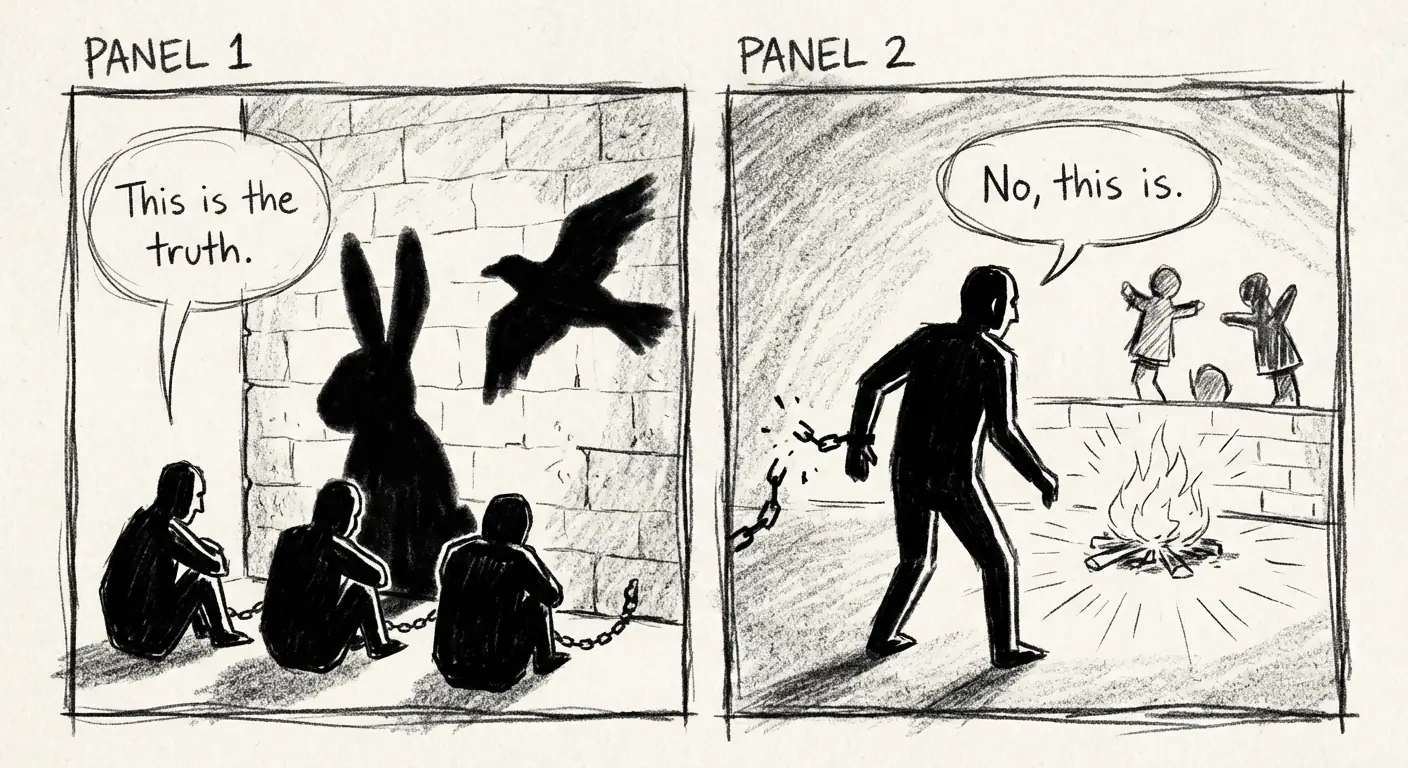
A philosophical classic. Visualizing the limitations of perception through the contrast between "silhouette" and "line."
Prompt:
Create a rough style comic page, theme: [Plato's Cave].
Layout: Split left and right panels.
Panel 1 (Left): People chained facing a wall, strange black silhouettes (rabbit, bird) projected on the wall.
Panel 2 (Right): One person breaks chains, turns around to see the fire and puppets casting shadows behind them.
Visual Logic: Totally flat, using silhouettes and negative space to distinguish "Shadow" vs "Entity".
Text: Panel 1 bubble: "This is the truth." Panel 2 bubble: "No, this is."
Style: Native sketch, non-closed lines, charcoal grey texture.
3. Freedom is Scary (The Paradox of the Cage)
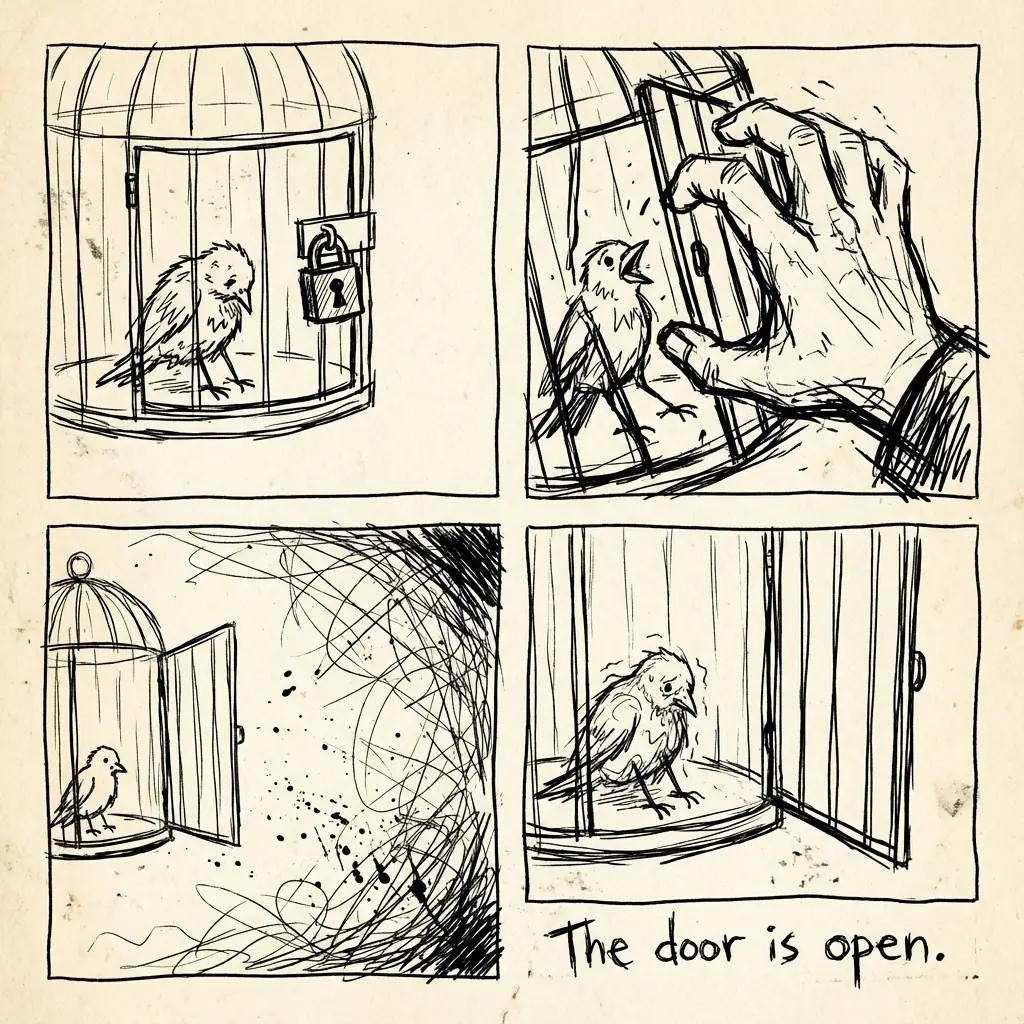
Uses the "vast white space" in Panel 3 to metaphorically represent the fear of the unknown outside world, while minimalist lines outline the bird's shrinking away.
Prompt:
Create an expressionist comic page, theme: [Fear of Freedom].
Layout: 2x2 grid of square panels.
Panel 1: A bird inside a cage, door locked.
Panel 2: A giant hand enters frame, opening the cage door. Rough strokes.
Panel 3: Door wide open, outside world is vast negative space.
Panel 4: The bird remains huddled in the corner of the cage, not flying away.
Text: Handwritten below the last panel: "The door is open."
Style: Sparse lines, cream paper, irregular borders.
4. The Illusion of Choice (Two Identical Roads)
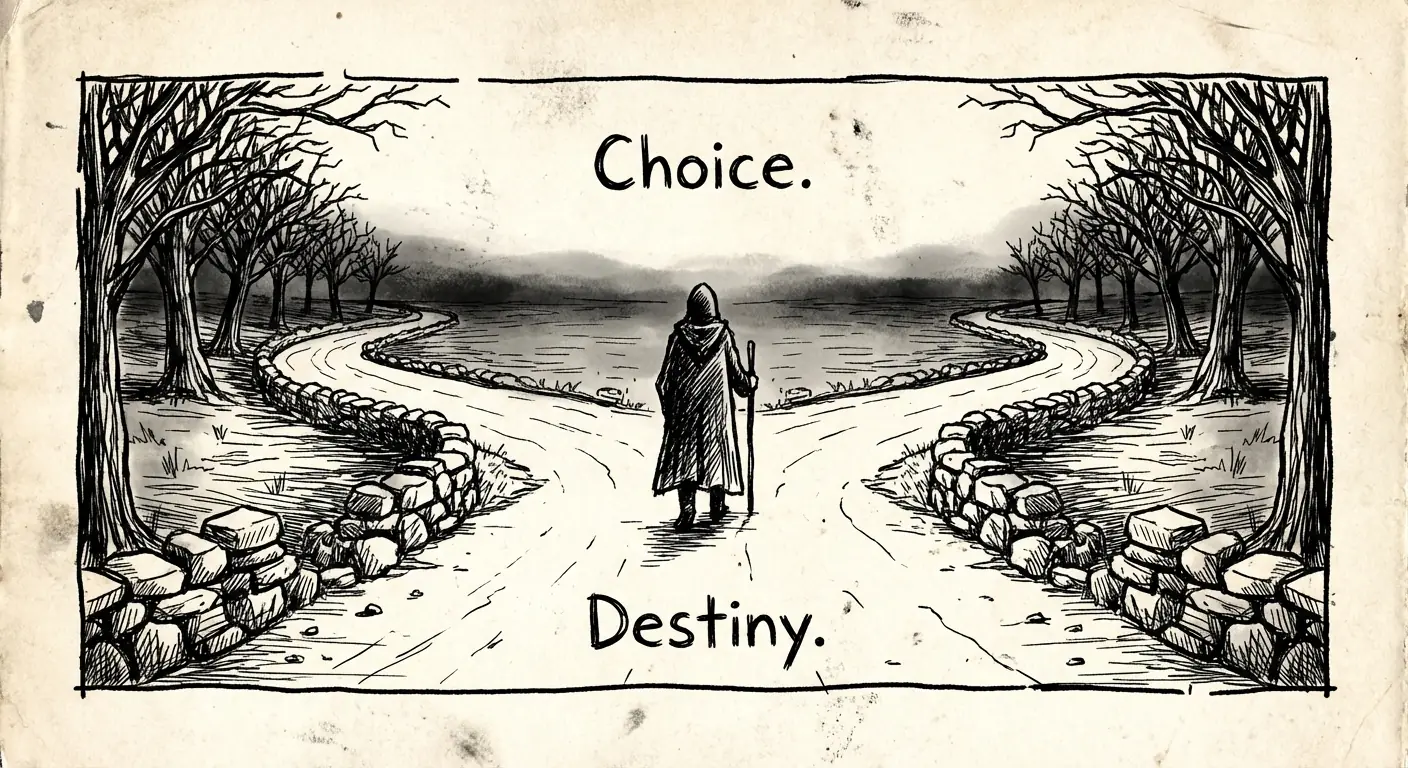
Symmetrical composition combined with rough lines satirizes the nihilistic nature of so-called "choice."
Prompt:
Create a minimalist comic manuscript, theme: [Dilemma of Choice].
Composition: Single large panel with hand-drawn border.
Content: A lonely traveler standing at a fork in the road. The left path and right path look exactly the same, extending into nothingness.
Details: Trees and stones on the roadside are symmetrical, emphasizing absurd identity.
Text: Handwritten text floating above: "Choice." Text floating below: "Destiny."
Style: High contrast B&W, broken lines, clumsy feel.
5. Self-Estrangement (Stranger in the Mirror)
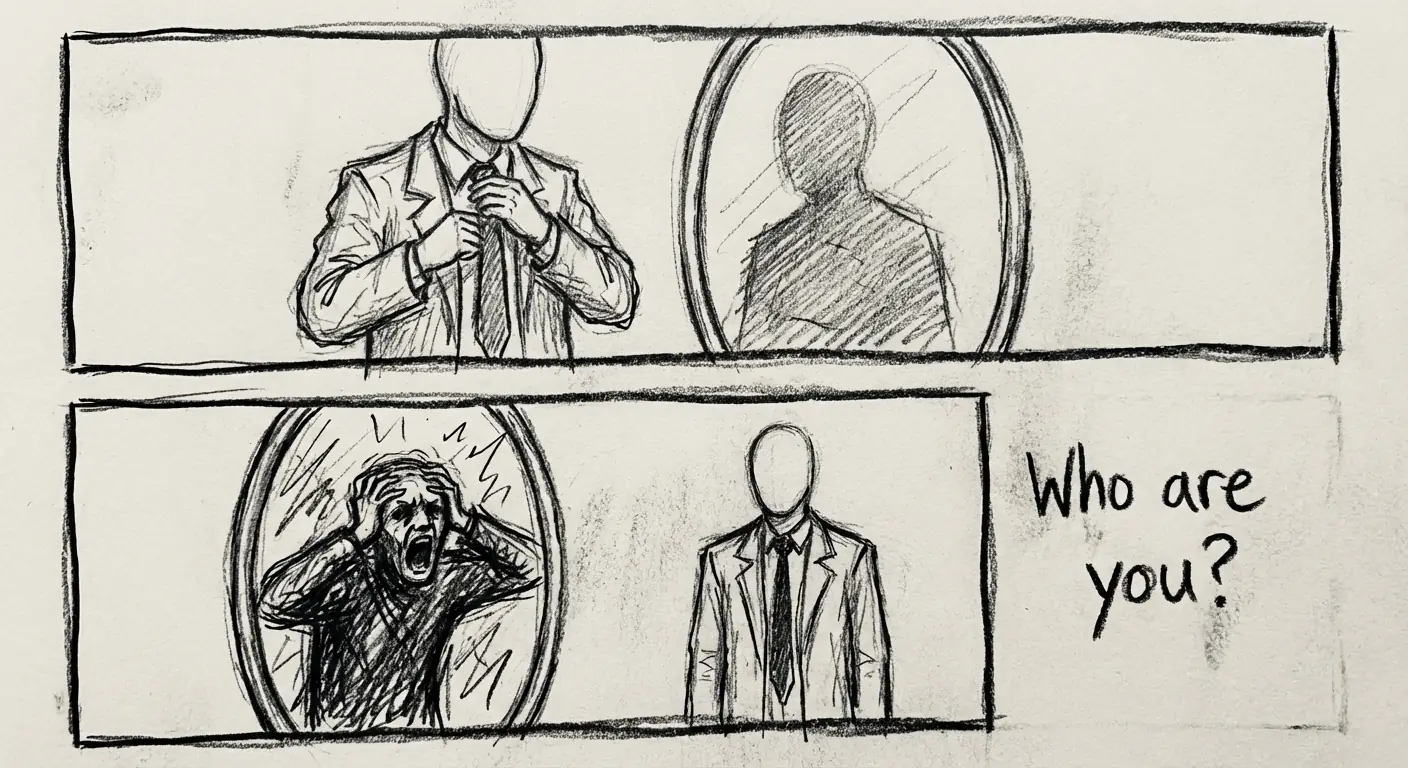
Classic psychological horror elements. The "faceless" design enhances the sense of immersion and alienation.
Prompt:
Create a rough style comic page, theme: [Self-Estrangement].
Layout: Top and bottom panels.
Panel 1 (Top): A person standing before a mirror adjusting a tie. Simple lines, faceless.
Panel 2 (Bottom): The reflection in the mirror is doing a completely different action (e.g., screaming holding head), while the person outside stands straight.
Text: Written next to Panel 2: "Who are you?"
Style: Expressionist sketch, charcoal texture, grey-black lines, no mid-tones.
6. Faith & Persistence (Watering the Dead Tree)
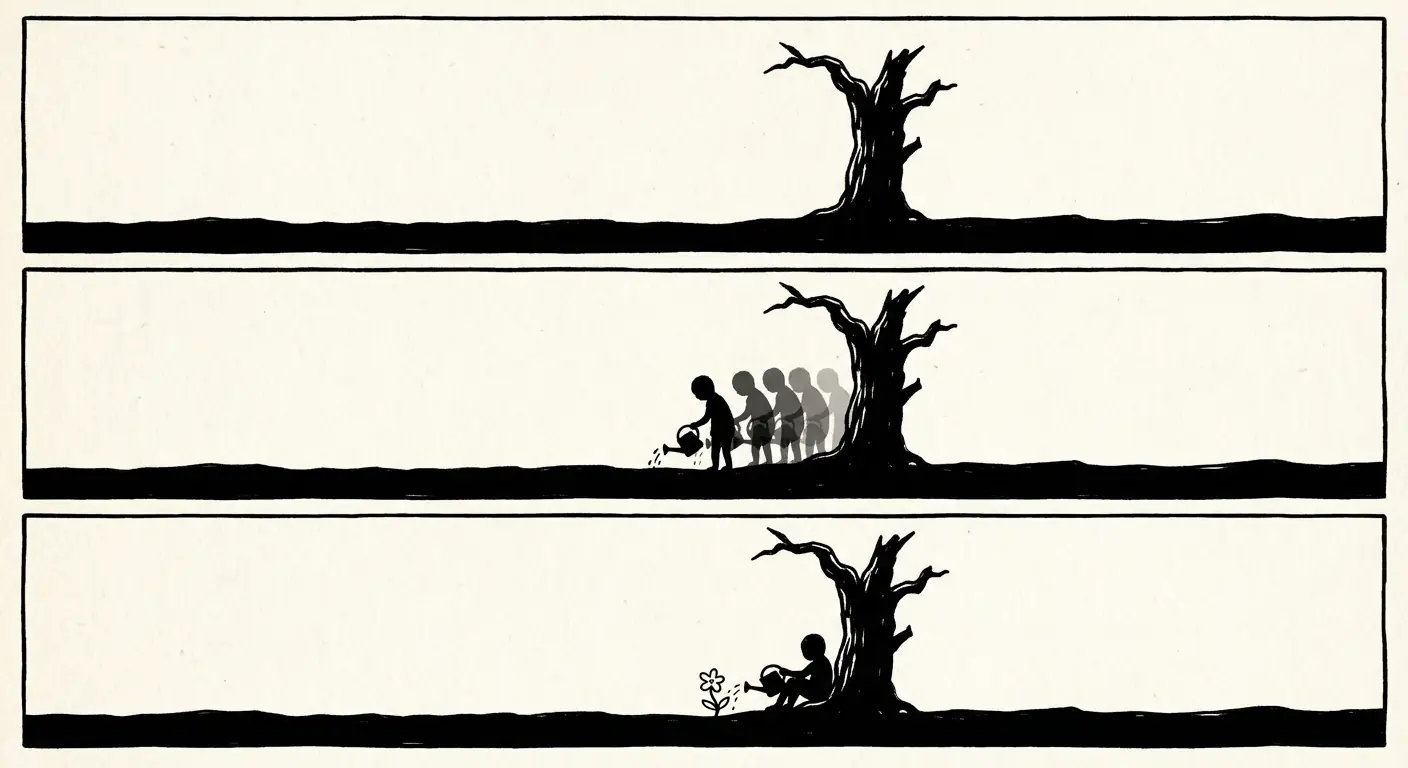
A story about "unintentional results" or "process as meaning." Minimalism maximizes the visual impact of the tiny flower at the end.
Prompt:
Create a minimalist comic page, theme: [Faith].
Layout: Three horizontal strip panels.
Panel 1: Barren black ground, a thoroughly dead black tree trunk.
Panel 2: A tiny figure with a watering can, watering the dead tree. Multiple silhouettes of the figure repeating to imply passing of time.
Panel 3: The tree is still dead, but a tiny flower (outlined only) has bloomed at the figure's feet.
Text: No text. Visual storytelling only.
Style: Native rough, heavy negative space, off-white background.
7. The Masks We Wear (Social Disguise)
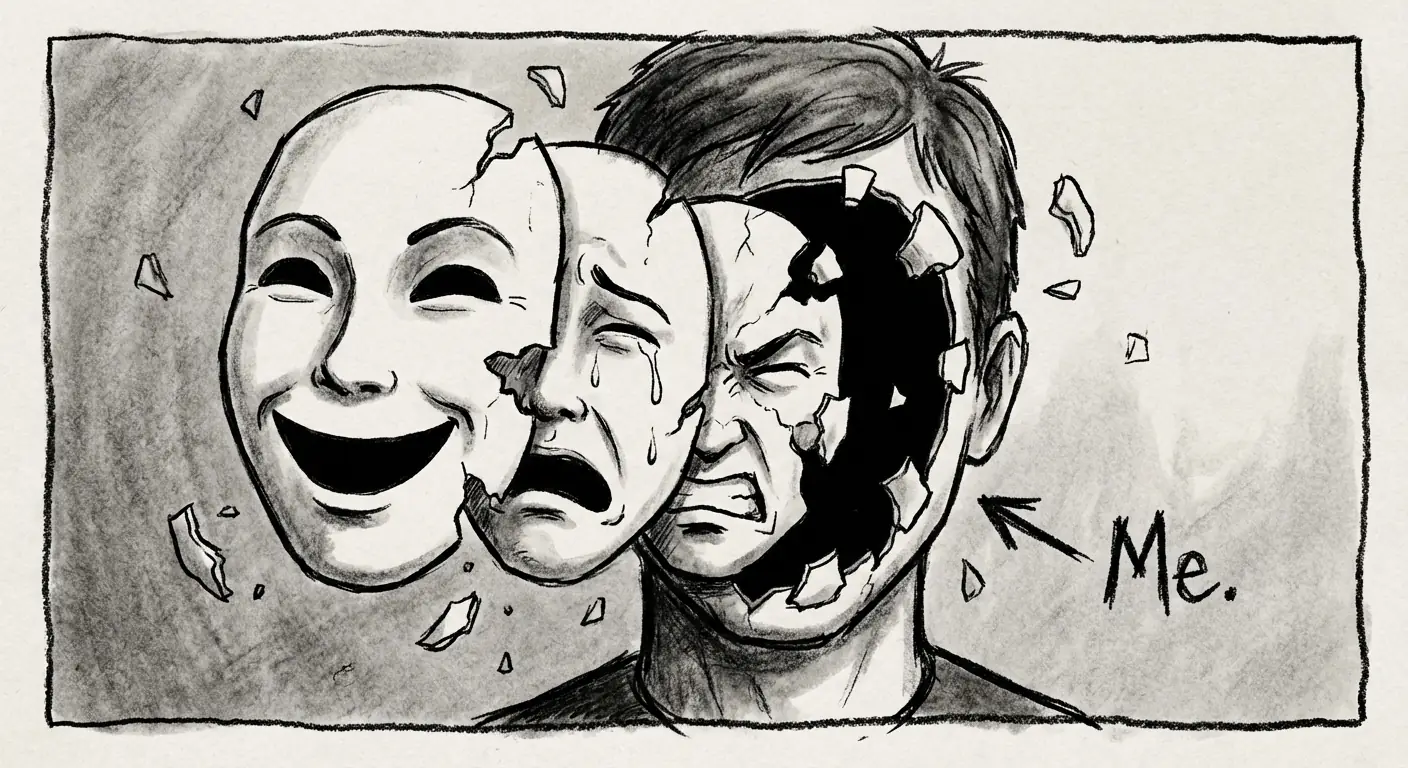
Reveals the complexity of human nature and the emptiness of the core through the action of "peeling," perfectly suited for expressionist style.
Prompt:
Create an expressionist comic page, theme: [Disguise].
Layout: Large close-up single panel.
Content: A person's face peeling away like an onion. Outer layer is smiling, second is crying, third is angry, innermost is a black void (solid black fill).
Visual Technique: Rough broken lines, strong hand-drawn feel, peeling mask fragments scattered around.
Text: Arrow pointing to the central black void, labeled: "Me."
Style: Grey-black charcoal, paper texture, irregular border.
8. Loneliness in Crowds (Modern Isolation)
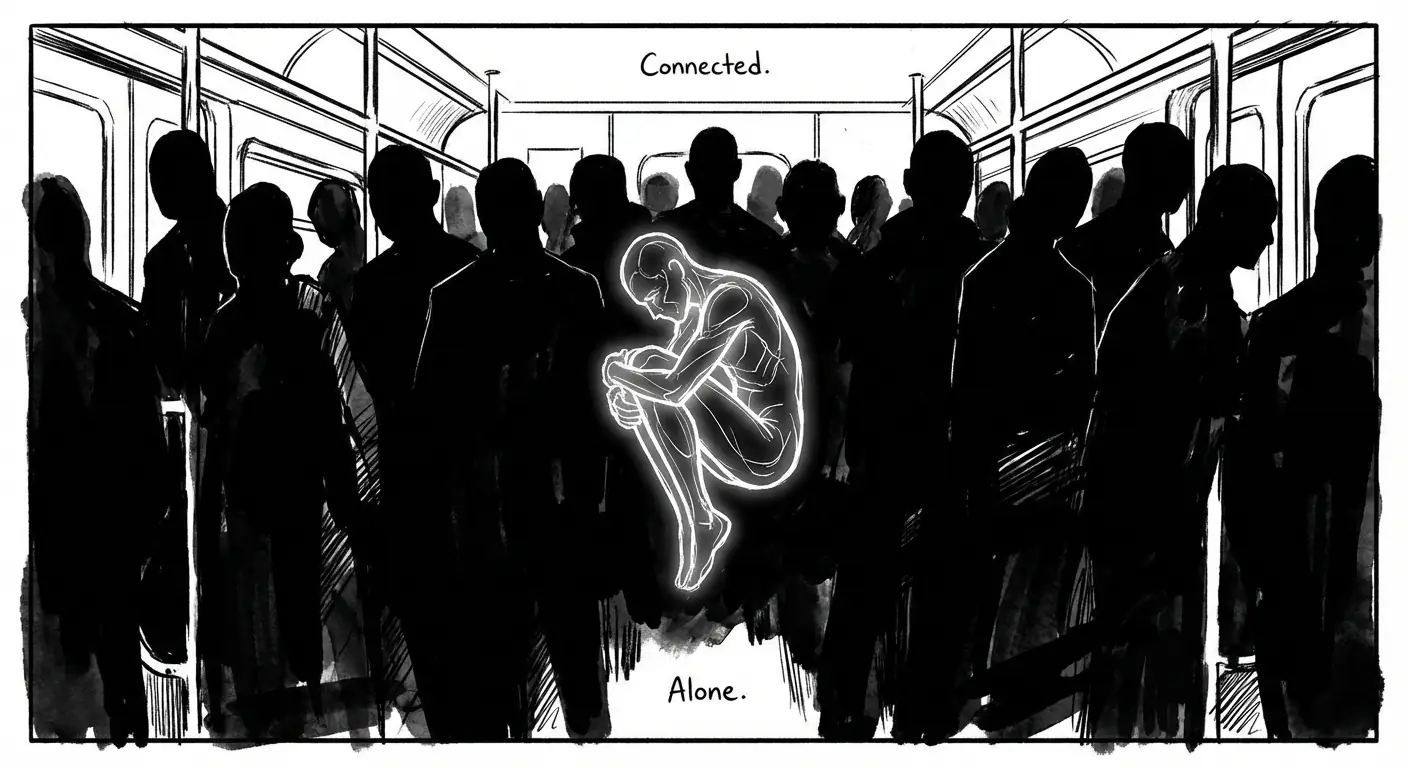
Uses the extreme contrast between "sparse and dense," "black and white" to express the isolation of modern individuals within a group.
Prompt:
Create a rough style comic page, theme: [Modern Loneliness].
Layout: Full page splash.
Content: The frame is packed with dense black human silhouettes, like a morning subway rush.
Focus: In the sea of black silhouettes, there is one transparent figure outlined in white lines, curled up, existing in a different dimension.
Text: Small handwritten text at top: "Connected." Small text at bottom: "Alone."
Style: Minimalist, high contrast, negative space composition.
9. Entropy (The Hourglass of Time)
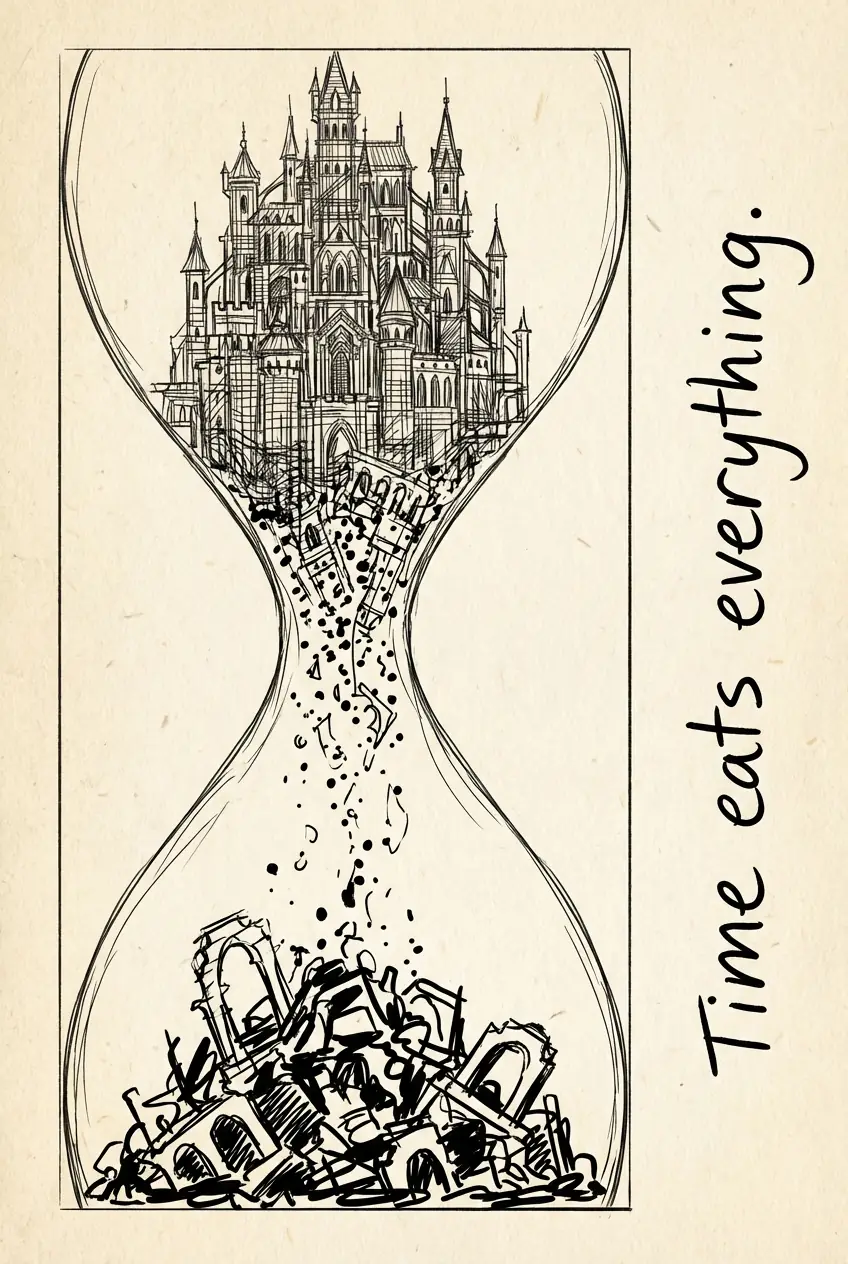
Visualizes the Second Law of Thermodynamics through the process of "Structure" to "Deconstruction." Minimalist lines are perfect for depicting "disintegration."
Prompt:
Create a minimalist comic manuscript, theme: [Entropy].
Layout: Vertical strip composition, mimicking an hourglass shape.
Top part: An intricate, complexly lined castle.
Middle part: The castle is disintegrating, turning into black dots and lines falling down.
Bottom part: Piling up into a chaotic mound of black ruins.
Text: Handwritten text vertically on the side: "Time eats everything."
Style: Native sketch, non-closed lines, cream paper.
10. The Wait (Chair by the Cliff)
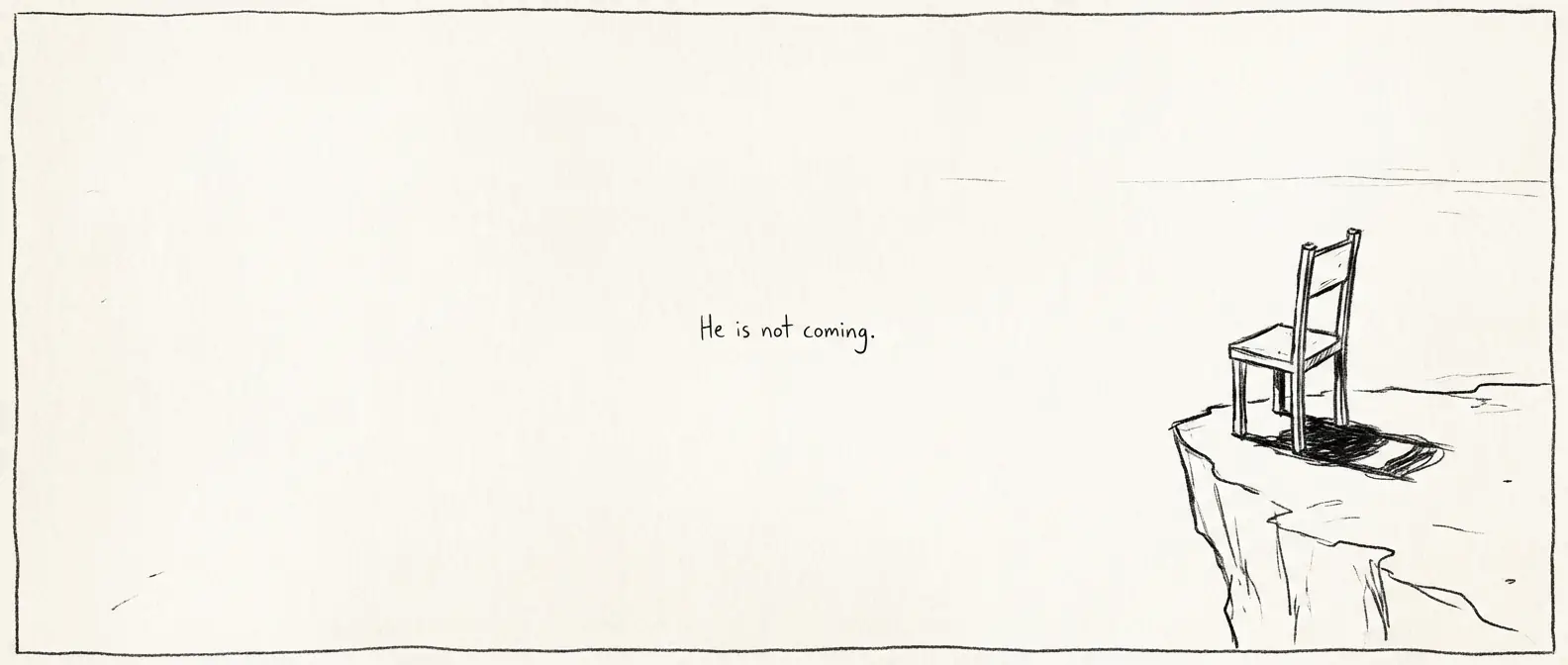
Extreme subtraction. An empty chair and a single sentence leave infinite room for the reader's imagination.
Prompt:
Create an expressionist comic page, theme: ["Waiting for Godot" style absurdity].
Composition: Extremely empty panoramic panel, massive negative space.
Content: On the far right edge of a cliff, sits an empty chair. Facing the void.
Details: A bit of shadow under the chair, the rest is blank.
Text: Tiny handwritten text in the exact center: "He is not coming."
Style: Sparse lines, rough edges, off-white background, indie graphic novel vibe.
03. Pitfall Guide: Keeping it "Clumsy"
When creating with Nano Banana, you might encounter the problem of the model "drawing too well." Here are three correction tips:
Beware of "Auto Grayscale":
- Models love to automatically add subtle shading. You must emphasize
No shading,No gradients,Pure ink strokes. If the image looks too grey, try adding weight(High contrast:1.5).
- Models love to automatically add subtle shading. You must emphasize
Break the "Perfect Line":
- AI's default lines are often too smooth. Try adding
Trembling lines,Scratches,Naive art, or evenChildlike sketchto break this digital perfection and restore the clumsy beauty of hand-drawing.
- AI's default lines are often too smooth. Try adding
The Vitality of Borders:
- Never forget
Hand-drawn borders. Perfectly straight rectangular borders will instantly turn the image into a generic comic strip, losing its indie niche vibe.
- Never forget
Conclusion
Minimalism isn't just about "drawing less"; it's about precise control. It requires the creator to have a deep understanding of the story's core, daring to discard details that seem flashy but are actually useless.
Now, take this "style container" and tell those unspoken micro-stories in your heart. If you make a Zine or print them out, welcome to share them with us on social media using the #NanoBanana tag.