AI photo booth strip prompts: 10 portrait examples
AI photo booth strip prompts turn one fictional person or pair into a narrow printed strip with three or four photos stacked in order. Specify the number of equal frames, white gutters, a fixed camera, and visible details that stay the same in each portrait. Then name one expression or small pose change per frame. The ten examples below are original still images generated from text.
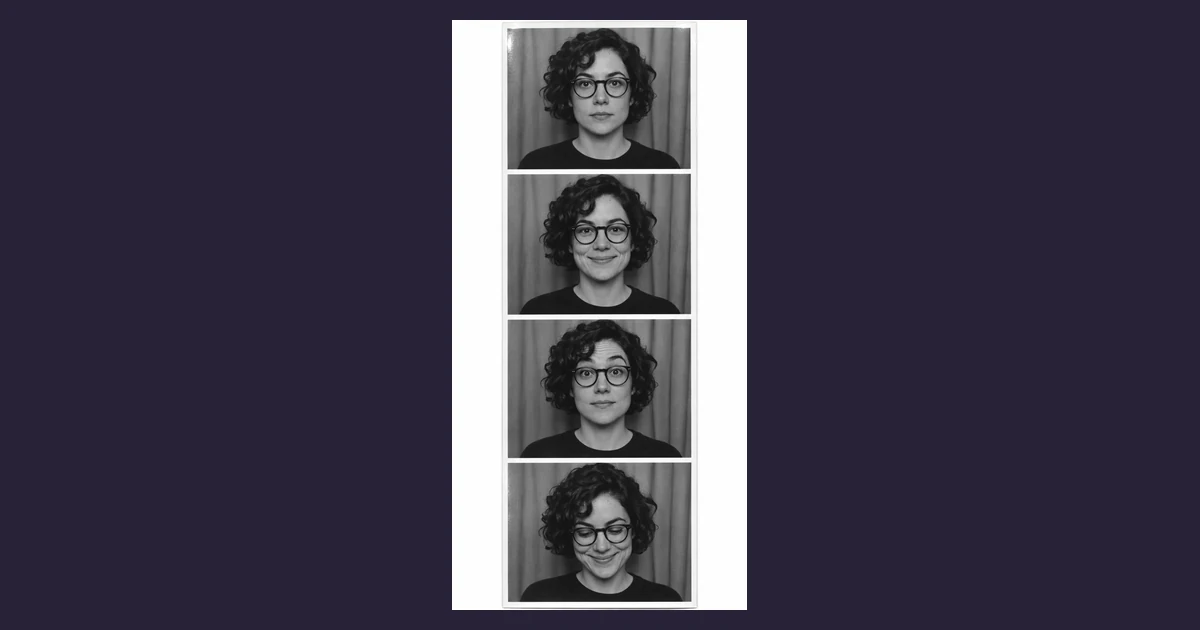
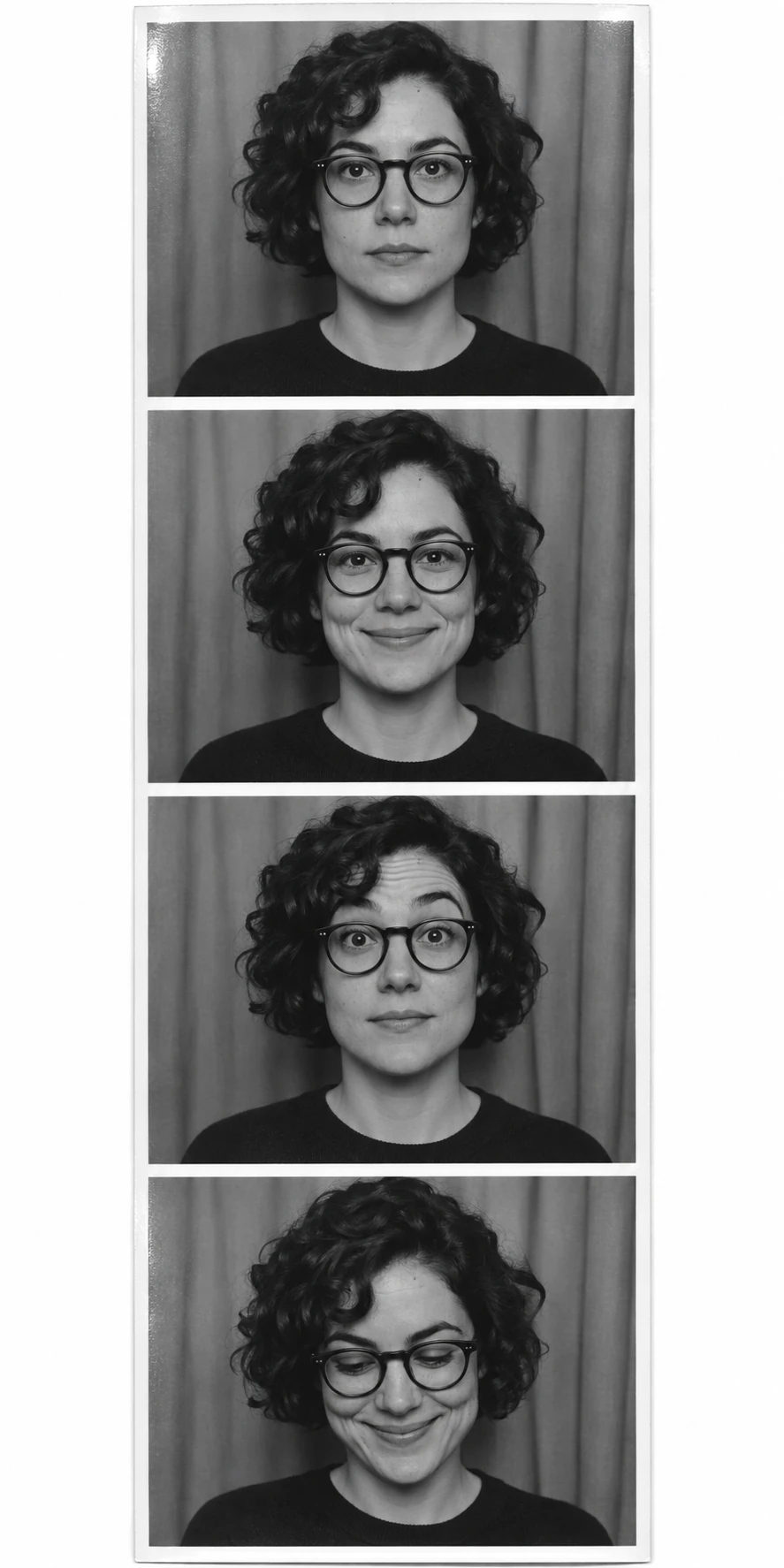
Four monochrome frames retain the same round glasses, short curls and black crewneck. Even white gutters divide the expressions.
Complete prompt
Task: Design one finished vertical photo booth strip as a single still image.
Subject: One fictional adult woman with short dark curls, round dark glasses and a plain black crewneck.
Context: A small analog booth with a simple mid-gray curtain.
Style: Glossy monochrome silver gelatin photo print on white stock.
Composition: Place exactly 4 equal horizontal photo rectangles in one vertical column on one flat printed strip. Repeat a head-and-shoulders crop of the subject at the same camera height and scale. In order from top to bottom show: Neutral, closed-mouth smile, eyebrows raised, then looking down and smiling.
Lighting: Fixed soft flash next to the lens.
Constraints: Preserve these visible anchors in every frame: Glasses shape, hair outline, sweater neckline. Use clear white horizontal gutters between all adjacent photos, equal left and right paper margins and a slim plain white outside edge. The strip fills the portrait canvas, photographed straight on. No second strip, split column, extra panel, decorative marks, letters or watermark.
Output: One portrait-oriented high-resolution image showing the complete strip with no cut-off edges.
What to inspect
Check glasses shape, hair outline, sweater neckline across the strip. Count the separate photos and check the spacing.
Adjustable parameters
Change one expression, paper width or curtain tone. Keep the camera distance and repeated visual details fixed.
Failure correction
If frames merge, request a straight white band across the full width between every pair of photos.
Two friends under a teal curtain
4 stacked photos with original example imagery.
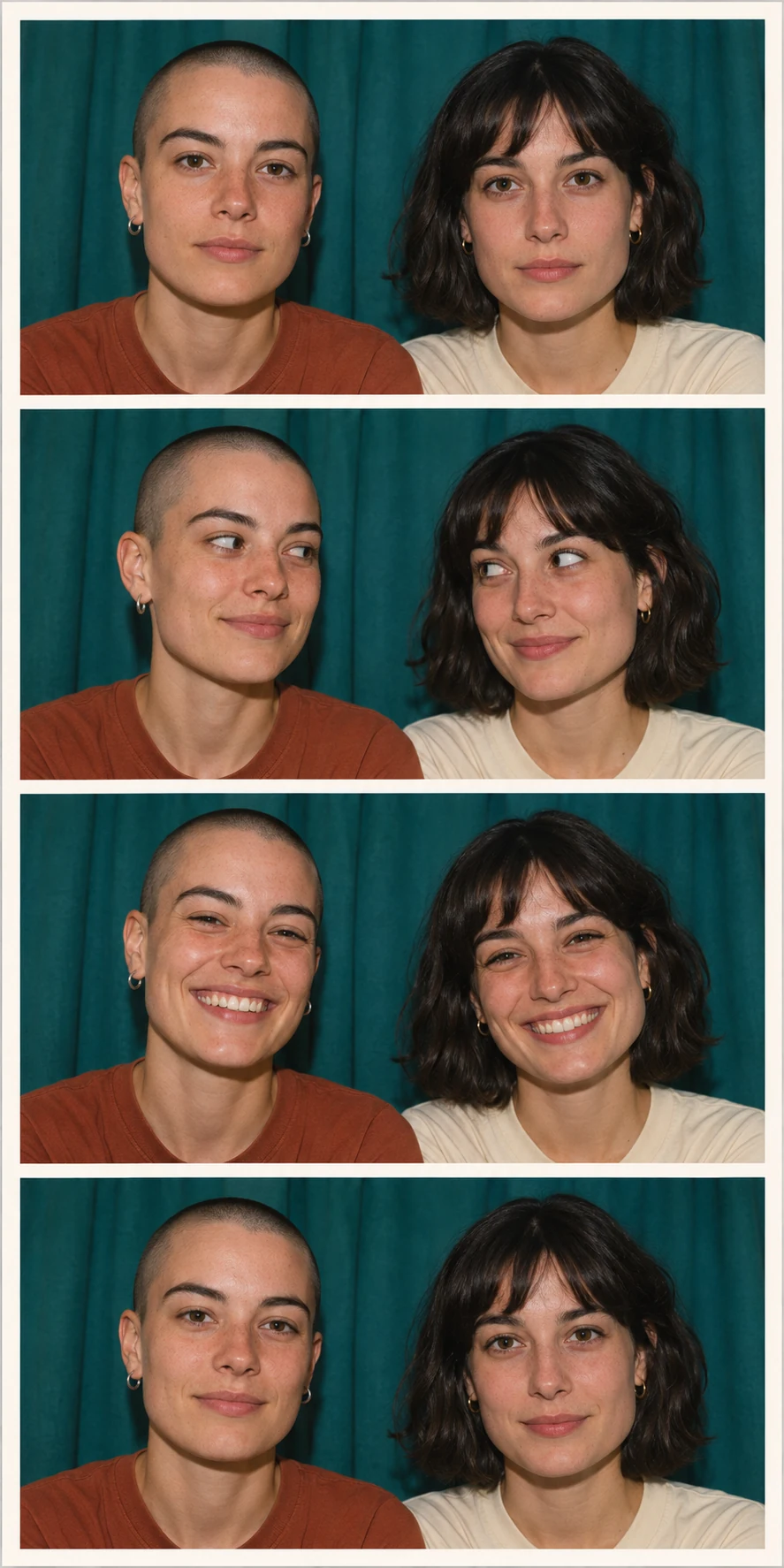
Four teal frames keep the cropped-haired adult on the left and the bob-haired adult on the right as their eyes and smiles shift.
Complete prompt
Task: Design one finished vertical photo booth strip as a single still image.
Subject: Two fictional adult friends, one with a shaved head and rust shirt on the left, the other with a dark bob and ivory shirt on the right.
Context: A small festival photo booth with a plain teal curtain.
Style: Clean direct-flash color photographs printed on matte ivory paper.
Composition: Place exactly 4 equal horizontal photo rectangles in one vertical column on one flat printed strip. Repeat a close head-and-shoulders crop of the two subjects at the same camera height and scale. In order from top to bottom show: Both face forward, both turn eyes toward each other, both smile, both look back at the camera.
Lighting: One soft direct flash with calm warm skin tones.
Constraints: Preserve these visible anchors in every frame: Seating order, shirts, visible shoulders, two people in each frame. Use clear white horizontal gutters between all adjacent photos, equal left and right paper margins and a slim plain white outside edge. The strip fills the portrait canvas, photographed straight on. No second strip, split column, extra panel, decorative marks, letters or watermark.
Output: One portrait-oriented high-resolution image showing the complete strip with no cut-off edges.
What to inspect
Check seating order, shirts, visible shoulders, two people in each frame across the strip. Count the separate photos and check the spacing.
Adjustable parameters
Change one expression, paper width or curtain tone. Keep the camera distance and repeated visual details fixed.
Failure correction
If their seats change, repeat the shirt colors and left-right order next to each expression.
Quiet ivory studio strip
4 stacked photos with original example imagery.
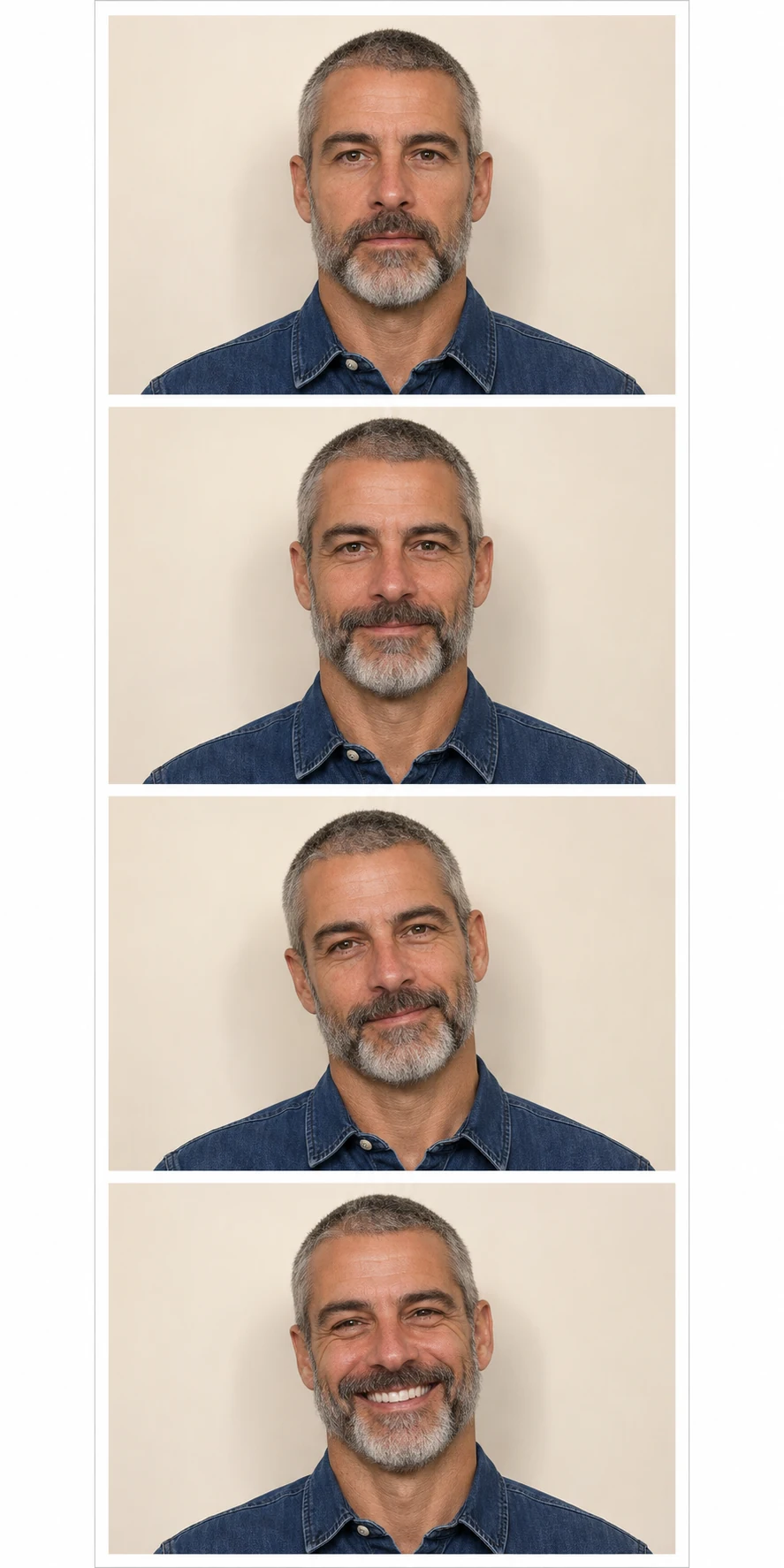
Four softly lit ivory frames keep the same beard and denim shirt. The sequence moves from neutral to a slight smile, a tilt and a broad smile.
Complete prompt
Task: Design one finished vertical photo booth strip as a single still image.
Subject: One fictional adult man with a salt-and-pepper beard, a short gray buzz cut and a plain deep blue denim shirt.
Context: A minimal studio booth with a warm ivory wall.
Style: Clean natural-color portrait photography on cream stock.
Composition: Place exactly 4 equal horizontal photo rectangles in one vertical column on one flat printed strip. Repeat a head-and-shoulders crop of the subject at the same camera height and scale. In order from top to bottom show: Neutral, half-smile, a small head tilt, then a full smile.
Lighting: Even softbox lighting with a faint shadow behind the head.
Constraints: Preserve these visible anchors in every frame: Beard shape, collar and hairline. Use clear white horizontal gutters between all adjacent photos, equal left and right paper margins and a slim plain white outside edge. The strip fills the portrait canvas, photographed straight on. No second strip, split column, extra panel, decorative marks, letters or watermark.
Output: One portrait-oriented high-resolution image showing the complete strip with no cut-off edges.
What to inspect
Check beard shape, collar and hairline across the strip. Count the separate photos and check the spacing.
Adjustable parameters
Change one expression, paper width or curtain tone. Keep the camera distance and repeated visual details fixed.
Failure correction
If the crop jumps, anchor eyebrow height and the space above the head to the first frame.
Sepia paper proof
4 stacked photos with original example imagery.
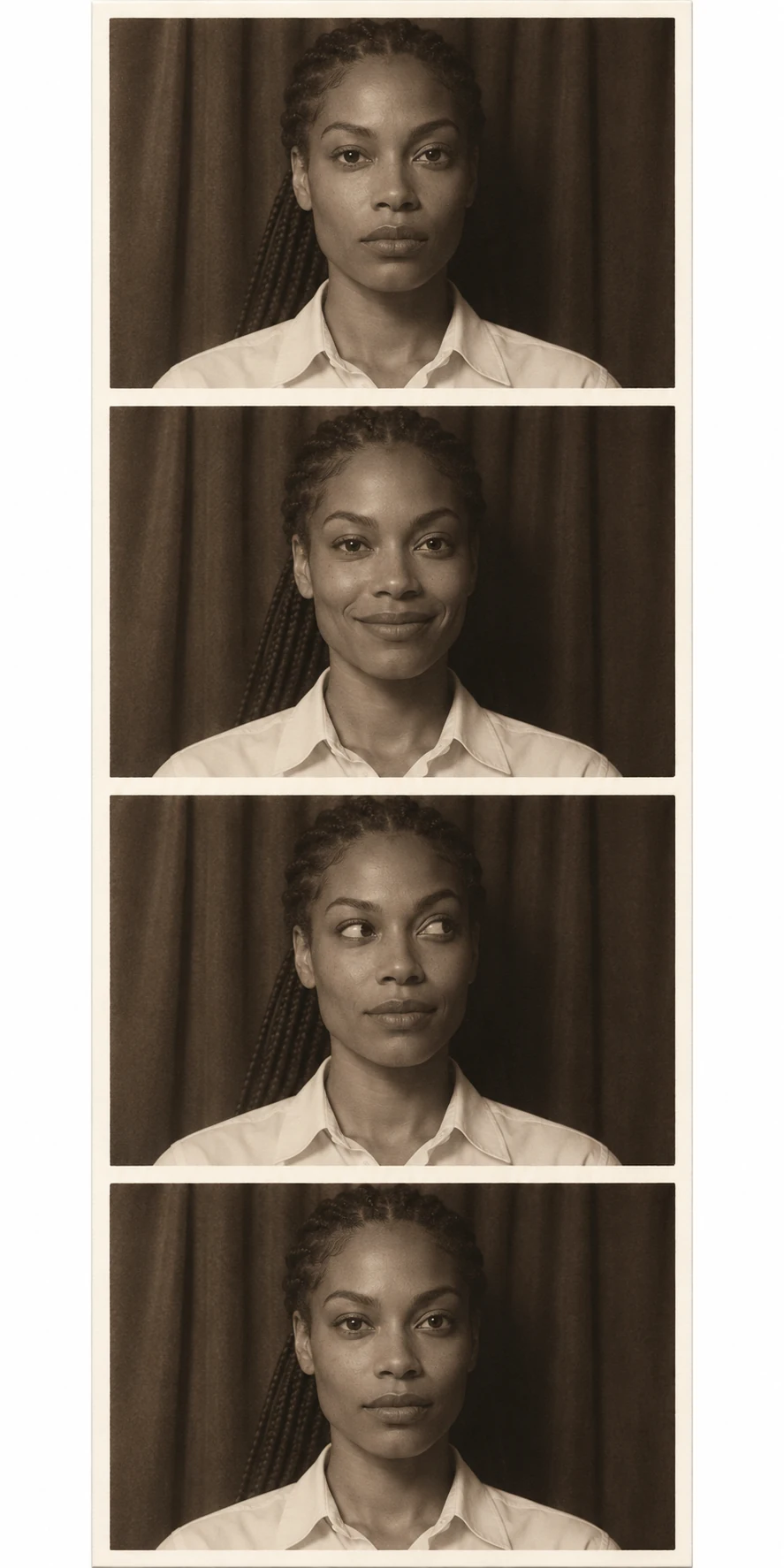
Four sepia frames retain braids and a white collar. The third frame looks toward the right edge and the last returns forward.
Complete prompt
Task: Design one finished vertical photo booth strip as a single still image.
Subject: One fictional adult woman with long dark braids pulled back, high cheekbones and a plain white collared shirt.
Context: A small archival-style booth with a dark canvas curtain.
Style: Quiet sepia monochrome and subtle photographic grain on cream paper.
Composition: Place exactly 4 equal horizontal photo rectangles in one vertical column on one flat printed strip. Repeat a head-and-shoulders crop of the subject at the same camera height and scale. In order from top to bottom show: Solemn, a small smile, eyes glancing right, then eyes looking straight back at the lens.
Lighting: One fixed warm soft light from camera left.
Constraints: Preserve these visible anchors in every frame: Braids, shirt collar and position. Use clear white horizontal gutters between all adjacent photos, equal left and right paper margins and a slim plain white outside edge. The strip fills the portrait canvas, photographed straight on. No second strip, split column, extra panel, decorative marks, letters or watermark.
Output: One portrait-oriented high-resolution image showing the complete strip with no cut-off edges.
What to inspect
Check braids, shirt collar and position across the strip. Count the separate photos and check the spacing.
Adjustable parameters
Change one expression, paper width or curtain tone. Keep the camera distance and repeated visual details fixed.
Failure correction
If sepia washes out the eyes, keep the overall tint and raise the local contrast on both eyes.
Red curtain after dark
4 stacked photos with original example imagery.
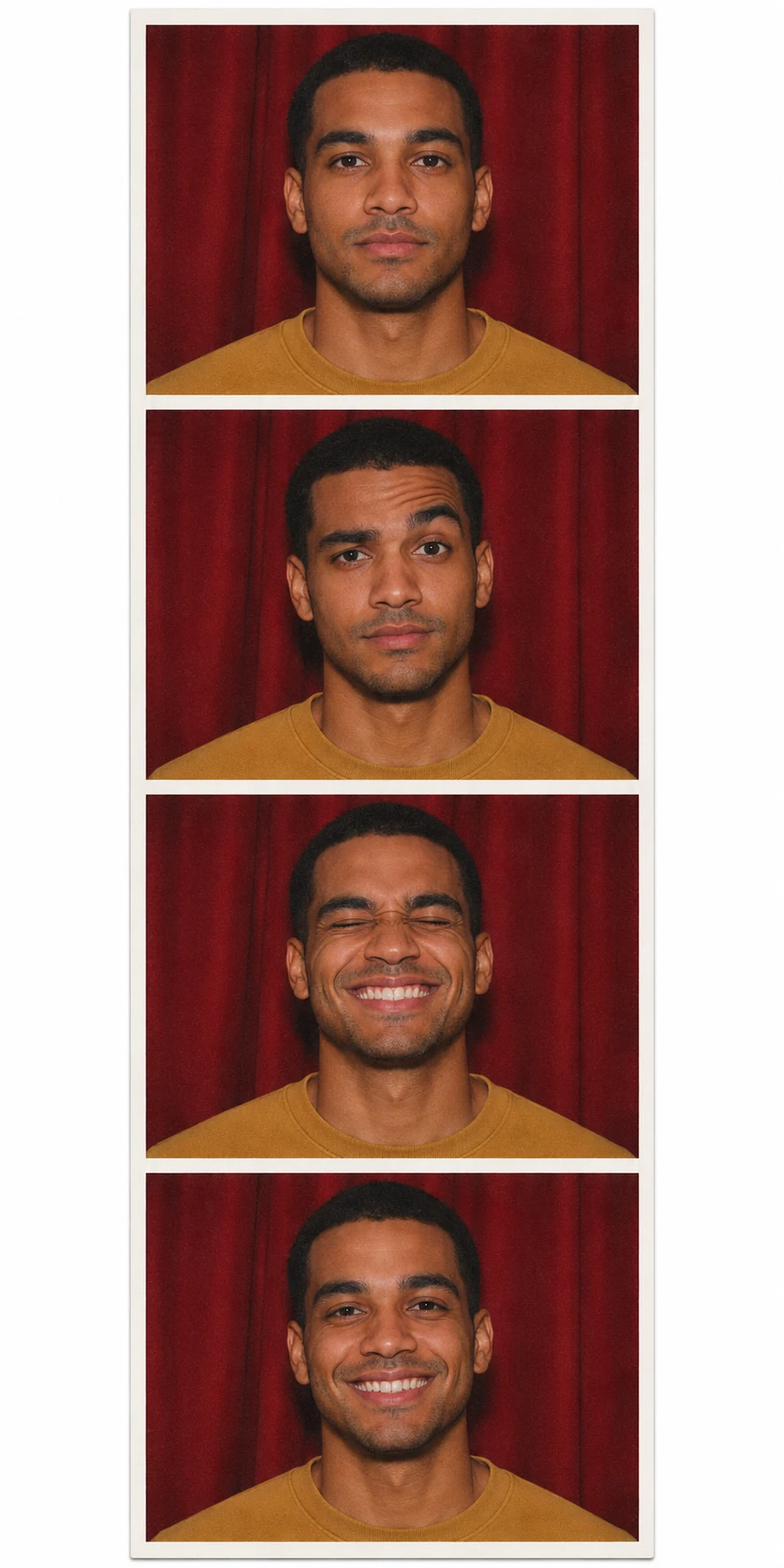
Four crimson and mustard frames keep the same subject. The third has an eyes-closed grin and the fourth an open-eyed smile.
Complete prompt
Task: Design one finished vertical photo booth strip as a single still image.
Subject: One fictional adult man with medium-brown skin, cropped dark hair and a muted mustard crewneck.
Context: An evening arcade booth behind a plain crimson curtain.
Style: Slightly grainy warm color film print on white paper.
Composition: Place exactly 4 equal horizontal photo rectangles in one vertical column on one flat printed strip. Repeat a head-and-shoulders crop of the subject at the same camera height and scale. In order from top to bottom show: Still expression, one eyebrow raised, closed-eye grin, then a relaxed open smile.
Lighting: Direct flash on the face with muted dark red in the background.
Constraints: Preserve these visible anchors in every frame: Mustard neckline, hairline and curtain color. Use clear white horizontal gutters between all adjacent photos, equal left and right paper margins and a slim plain white outside edge. The strip fills the portrait canvas, photographed straight on. No second strip, split column, extra panel, decorative marks, letters or watermark.
Output: One portrait-oriented high-resolution image showing the complete strip with no cut-off edges.
What to inspect
Check mustard neckline, hairline and curtain color across the strip. Count the separate photos and check the spacing.
Adjustable parameters
Change one expression, paper width or curtain tone. Keep the camera distance and repeated visual details fixed.
Failure correction
If the colored cloth tints the skin, request neutral frontal light and leave red in the background.
Broad paper edge
4 stacked photos with original example imagery.
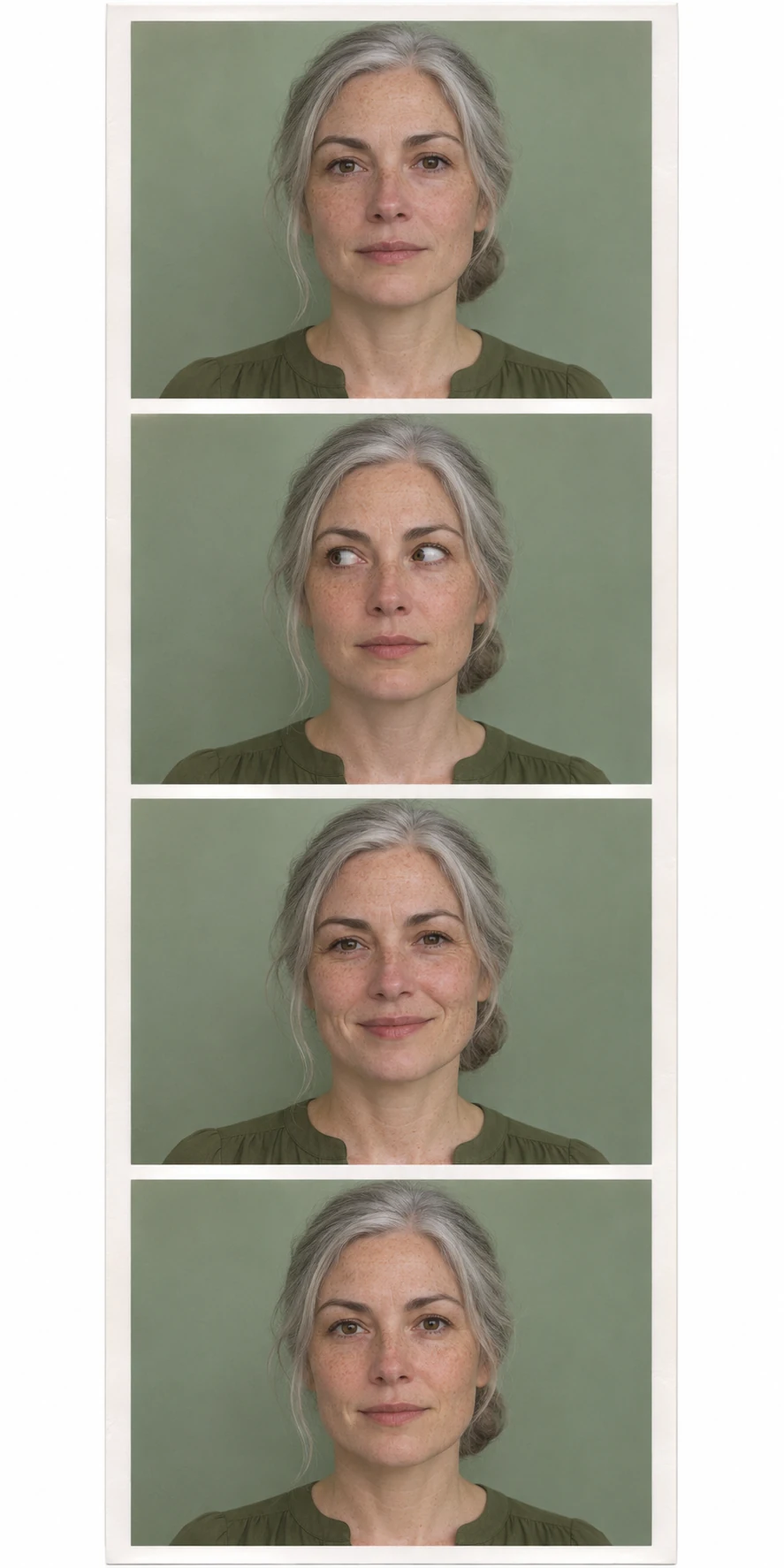
Four sage frames retain the silver bun and olive top. The pale outer margins are wider than the bands separating the portraits.
Complete prompt
Task: Design one finished vertical photo booth strip as a single still image.
Subject: One fictional adult woman with silver hair in a low bun, freckled skin and a plain olive green blouse.
Context: An unbranded museum event booth with a muted sage backdrop.
Style: Natural color instant photography with a clean pale paper edge.
Composition: Place exactly 4 equal horizontal photo rectangles in one vertical column on one flat printed strip. Repeat a head-and-shoulders crop of the subject at the same camera height and scale. In order from top to bottom show: Calm expression, glance left with eyes only, subtle smile, then looking forward.
Lighting: Broad low-contrast light from the same camera-side direction.
Constraints: Preserve these visible anchors in every frame: Hair bun, freckles, olive neckline and a broad blank paper band at both sides. Use clear white horizontal gutters between all adjacent photos, equal left and right paper margins and a slim plain white outside edge. The strip fills the portrait canvas, photographed straight on. No second strip, split column, extra panel, decorative marks, letters or watermark.
Output: One portrait-oriented high-resolution image showing the complete strip with no cut-off edges.
What to inspect
Check hair bun, freckles, olive neckline and a broad blank paper band at both sides across the strip. Count the separate photos and check the spacing.
Adjustable parameters
Change one expression, paper width or curtain tone. Keep the camera distance and repeated visual details fixed.
Failure correction
If a paper edge is clipped, ask for the complete perimeter and a little room outside the paper.
Three frame rehearsal
3 stacked photos with original example imagery.
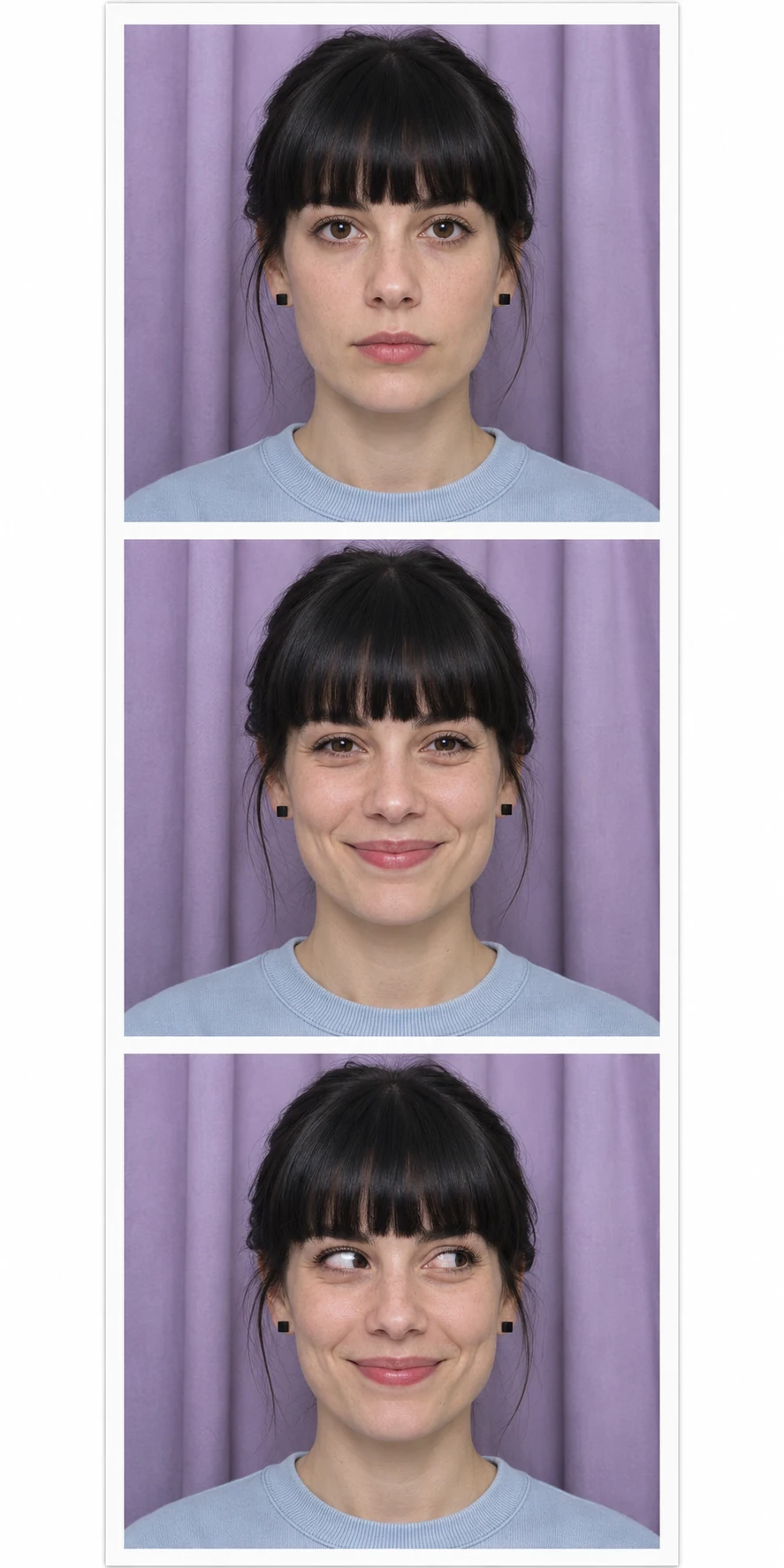
Three lavender frames retain bangs, square studs and a blue sweater, shifting from neutral to smile to side glance.
Complete prompt
Task: Design one finished vertical photo booth strip as a single still image.
Subject: One fictional adult woman with a blunt black fringe, pale blue crewneck and square black stud earrings.
Context: A compact booth with a lavender curtain.
Style: Fine-grained contemporary color print on white stock.
Composition: Place exactly 3 equal horizontal photo rectangles in one vertical column on one flat printed strip. Repeat a head-and-shoulders crop of the subject at the same camera height and scale. In order from top to bottom show: Eyes straight ahead with a neutral face, gentle grin, then an amused sideways glance.
Lighting: Soft fixed frontal light with no colored casts on skin.
Constraints: Preserve these visible anchors in every frame: Same fringe, earrings and neckline; exactly three visible frames. Use clear white horizontal gutters between all adjacent photos, equal left and right paper margins and a slim plain white outside edge. The strip fills the portrait canvas, photographed straight on. No second strip, split column, extra panel, decorative marks, letters or watermark.
Output: One portrait-oriented high-resolution image showing the complete strip with no cut-off edges.
What to inspect
Check same fringe, earrings and neckline; exactly three visible frames across the strip. Count the separate photos and check the spacing.
Adjustable parameters
Change one expression, paper width or curtain tone. Keep the camera distance and repeated visual details fixed.
Failure correction
If you get a fourth portrait, specify exactly three rectangles and label the expressions first, second and third.
Warm daylight booth
4 stacked photos with original example imagery.
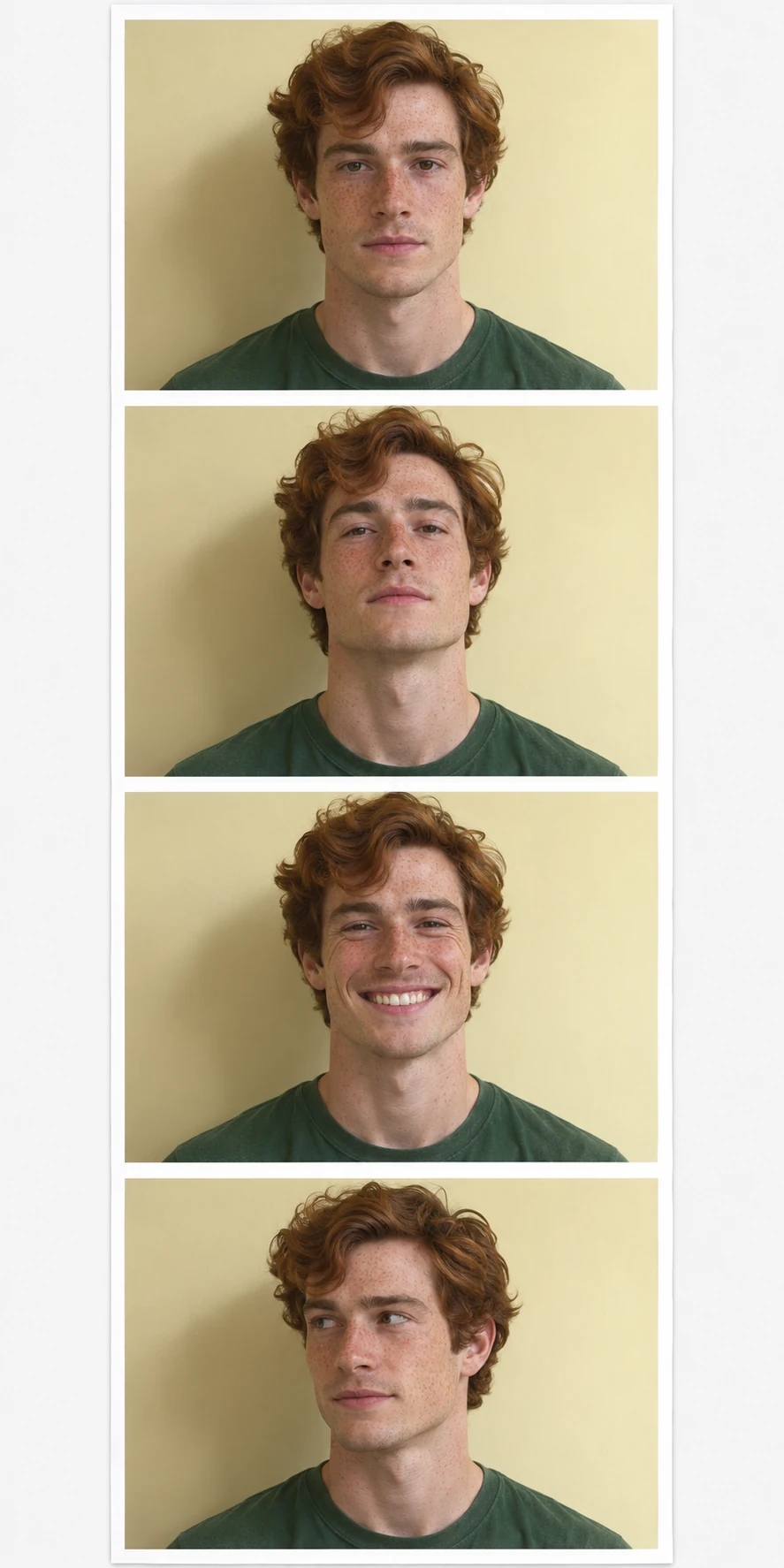
Four frames keep auburn waves, freckles and a mustard backdrop. A small tilt and changes in gaze read as separate poses under steady light.
Complete prompt
Task: Design one finished vertical photo booth strip as a single still image.
Subject: One fictional adult man with auburn wavy hair, light freckles and a plain pine-green shirt.
Context: A window-lit booth with a clean pale yellow wall.
Style: Soft daylight portrait series printed on natural white paper.
Composition: Place exactly 4 equal horizontal photo rectangles in one vertical column on one flat printed strip. Repeat a head-and-shoulders crop of the subject at the same camera height and scale. In order from top to bottom show: Neutral, chin raised slightly, broad smile, then gaze to viewer left.
Lighting: Fixed diffuse side light from a high window on camera right.
Constraints: Preserve these visible anchors in every frame: Hairline, freckles, green shirt and unchanged shadow direction. Use clear white horizontal gutters between all adjacent photos, equal left and right paper margins and a slim plain white outside edge. The strip fills the portrait canvas, photographed straight on. No second strip, split column, extra panel, decorative marks, letters or watermark.
Output: One portrait-oriented high-resolution image showing the complete strip with no cut-off edges.
What to inspect
Check hairline, freckles, green shirt and unchanged shadow direction across the strip. Count the separate photos and check the spacing.
Adjustable parameters
Change one expression, paper width or curtain tone. Keep the camera distance and repeated visual details fixed.
Failure correction
If the shadow direction flips, say the only window is fixed at camera right for all four shots.
Close crop in blue and white
4 stacked photos with original example imagery.
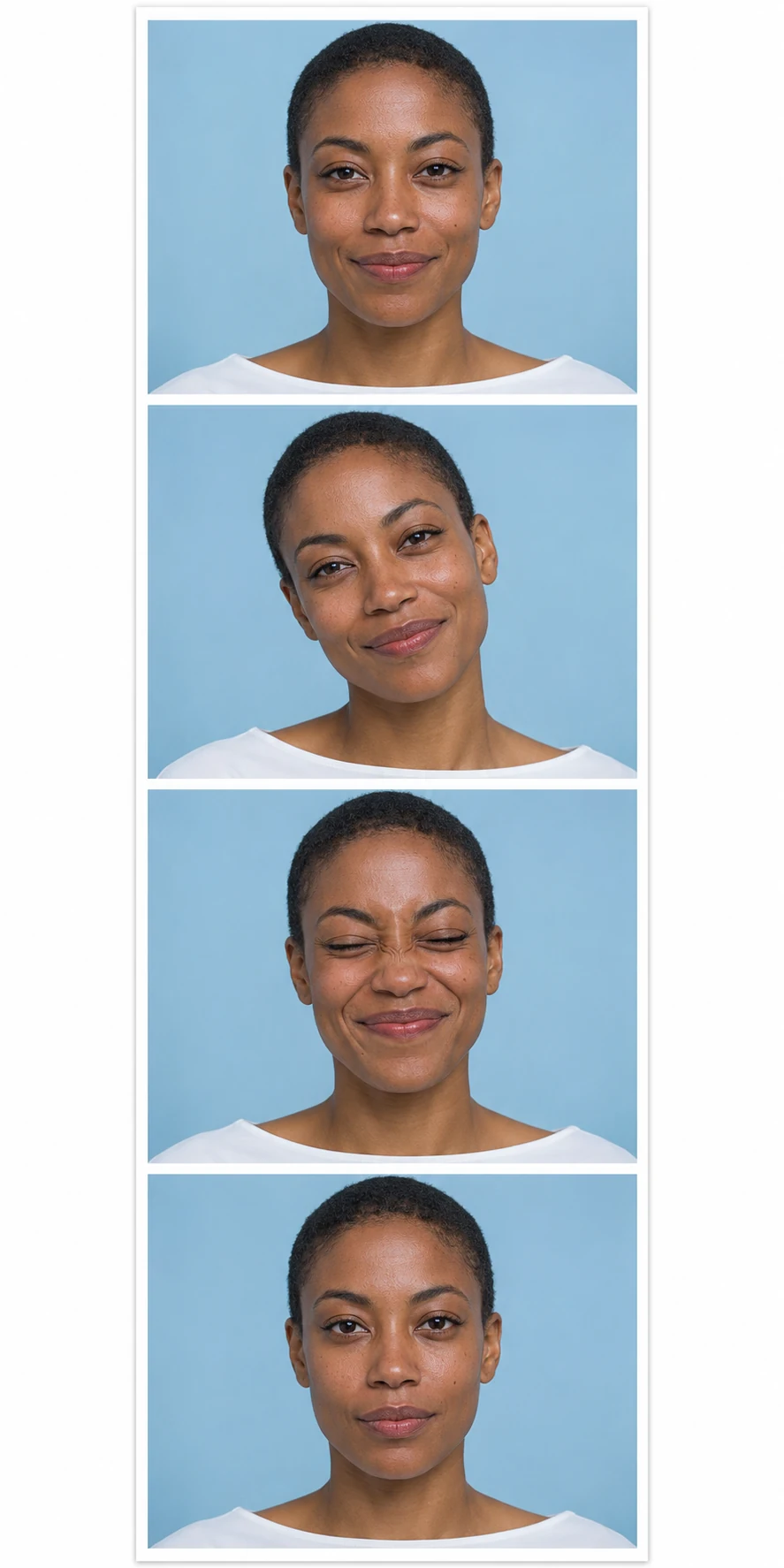
Four pale blue frames hold the same close crop and white neckline. The eyes close in the third frame before the final forward gaze.
Complete prompt
Task: Design one finished vertical photo booth strip as a single still image.
Subject: One fictional adult woman with brown skin, a close-cropped haircut and a white shirt with a simple boat neckline.
Context: A modern booth with a flat pale blue backdrop.
Style: Crisp cool color editorial portrait print on clean white paper.
Composition: Place exactly 4 equal horizontal photo rectangles in one vertical column on one flat printed strip. Repeat a head-and-shoulders crop of the subject at the same camera height and scale. In order from top to bottom show: Faint smile, face tilted a little, closed-mouth laugh, then calm steady gaze.
Lighting: A fixed broad front fill that preserves natural skin texture.
Constraints: Preserve these visible anchors in every frame: Ear outline, white neckline and the same close crop. Use clear white horizontal gutters between all adjacent photos, equal left and right paper margins and a slim plain white outside edge. The strip fills the portrait canvas, photographed straight on. No second strip, split column, extra panel, decorative marks, letters or watermark.
Output: One portrait-oriented high-resolution image showing the complete strip with no cut-off edges.
What to inspect
Check ear outline, white neckline and the same close crop across the strip. Count the separate photos and check the spacing.
Adjustable parameters
Change one expression, paper width or curtain tone. Keep the camera distance and repeated visual details fixed.
Failure correction
If the camera cuts off the ears in just one shot, fix the side margins and eye height in every frame.
Two person monochrome rehearsal
4 stacked photos with original example imagery.
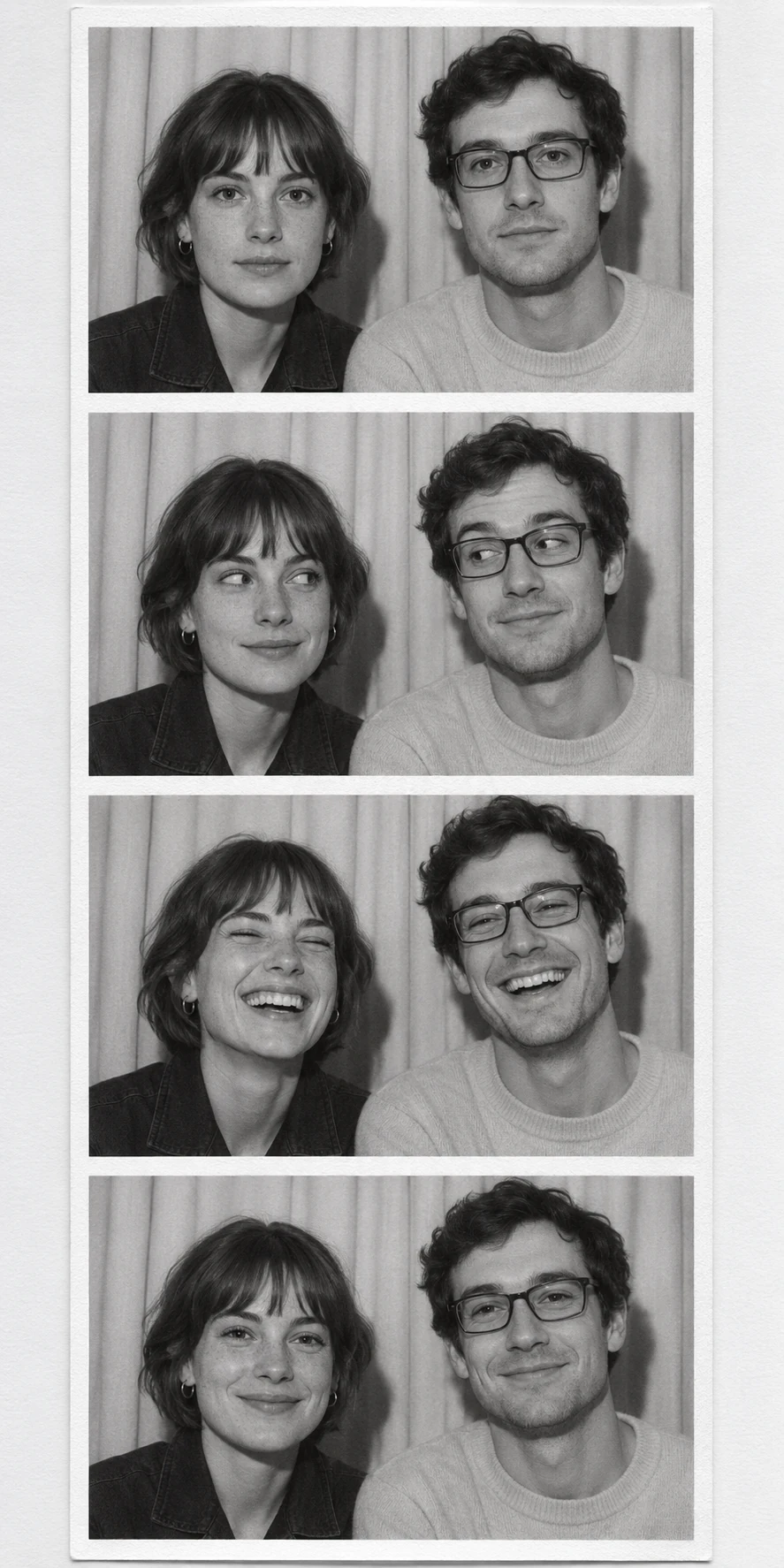
Four monochrome frames keep the adult with bangs and a dark jacket on the left and the adult with glasses and a light sweater on the right.
Complete prompt
Task: Design one finished vertical photo booth strip as a single still image.
Subject: Two fictional adults: a woman with short brown bangs and dark jacket seated left, a man with rectangular glasses and plain pale sweater seated right.
Context: An enclosed booth with a simple lightly pleated cream curtain.
Style: Neutral monochrome direct-flash print on lightly textured white stock.
Composition: Place exactly 4 equal horizontal photo rectangles in one vertical column on one flat printed strip. Repeat a close head-and-shoulders crop of the two subjects at the same camera height and scale. In order from top to bottom show: Both face the lens, both glance sideways, both laugh, then both settle into a soft smile.
Lighting: Same frontal bounce and modest shadow behind both heads.
Constraints: Preserve these visible anchors in every frame: Two adults in every frame, fixed left-right order, glasses shape and garment contrast. Use clear white horizontal gutters between all adjacent photos, equal left and right paper margins and a slim plain white outside edge. The strip fills the portrait canvas, photographed straight on. No second strip, split column, extra panel, decorative marks, letters or watermark.
Output: One portrait-oriented high-resolution image showing the complete strip with no cut-off edges.
What to inspect
Check two adults in every frame, fixed left-right order, glasses shape and garment contrast across the strip. Count the separate photos and check the spacing.
Adjustable parameters
Change one expression, paper width or curtain tone. Keep the camera distance and repeated visual details fixed.
Failure correction
If one portrait shows only one person, name both seated subjects again in the instruction for that frame.
Build one strip with a sequence of expressions
Decide the frame count before describing the people. A four-frame photo booth strip gives a portrait time to move from a neutral expression to something less posed. A three-frame strip leaves more space for each face. Write each expression in order from top to bottom. Use three or four numbered clauses if the generator tends to skip the middle of a list. If the output looks like a square contact sheet, ask for a single vertical column with no second column.
Use an imaginary adult for the first test. Write down three things you can see at a glance, such as a round frame on the glasses, a straight fringe and a dark crewneck. Reuse those exact details in the instruction. Then choose one camera position and one backdrop. The purpose of a fixed setup is to make the changing expressions visible, so save changes in lighting, outfit or body position for another run.
Keep pairs simple. Put one person on the left and one on the right, and give them different necklines or top colors. Name both people in each pose. Ask them to turn their eyes toward each other before asking them to turn their bodies. This gives you a small understandable change without letting their shoulders trade places or pushing the faces to the edge.
Control the border, gutters and crop
Describe the paper around the strip separately from the space between the photos. The outer border is the paper visible along the edges. A gutter is the white band between two images. Ask for equal frame heights and a gutter that spans the full width between photographs. At thumbnail size, you should be able to count the rectangles without zooming. If a pale shirt joins the next frame, request a straight photograph edge and a continuous gutter.
Use the portrait canvas that leaves room for the whole strip. Keeping the top and bottom visible matters more than matching an exact ratio. A centered strip can be sized later for a post. Avoid cropping to the first and last faces before saving the original. If the image generator pads the canvas, check that all four paper corners are present before trimming the extra background in a layout editor.
The choice of color changes what you can check. Black and white emphasizes the shape and size of highlights. Sepia unifies the color but can hide a wardrobe change. A muted curtain and a colored shirt make continuity easier to check. If the dark edge of a curtain blends with dark hair, add a little more light to the background or choose a lighter curtain.
Troubleshoot uneven frames and changed faces
Look at the whole strip first. Count the frames, check left and right margins, and see whether the strip has been copied as a second object. When the layout is wrong, fix the count and column before reworking a face. Try a plain instruction like exactly four photo rectangles in a single column. Put the order of the portraits immediately after that instruction.
Once the layout is stable, zoom in on the most different-looking frame. If glasses or an earring disappear, specify their shape and where they appear again in every image. If the head size jumps, ask for the same distance from the camera and matching space over the hair. If expressions look too similar, change the last one first. A quiet smile and a laugh give you a clearer comparison than asking for four degrees of happiness.
Examine light direction in every photo. Shadows under the nose and jaw should move only as the subject moves, and the backdrop should keep its basic tone. If one panel looks like it was taken outdoors, restore the fixed flash and curtain in the instruction. When two people trade places, use separate descriptions anchored to the same sides and reduce pose changes to eye movement for the next attempt.
Use the strip in a layout or print proof
Use the file at its actual pixel size when planning a handout or keepsake. A generated image that looks sharp on a phone can still look soft when printed large. Decide the finished width, set your print layout to that size and check a small proof. If you need measured borders or spacing, place the frames in an editor with guides so exact trim and gutter positions are under your control.
Add date stamps, names or captions separately so you can spell-check them before exporting. Reinspect the paper edges after adding any decorations. The examples on this page use synthetic people and do not measure how well an image tool preserves the face from a photograph. If you adapt the workflow to real photos, use material you have permission to upload, compare every frame with the input, and share edited portraits only with the appropriate permission.
A photo strip is useful as a still reference for event design, a mockup or a fictional portrait study. Keep the framing, lighting and background simple until the sequence works. A second pass can test one more distinct color or expression, with the first version available beside it for comparison.
Frequently asked questions
What is an AI photo booth strip prompt?
It is a set of instructions for making one still image that looks like a photo booth print. It describes the number of frames and their order, the printable border, and which features stay fixed as a person changes expression.
Is a three-frame or four-frame strip easier to make?
Three frames give each portrait more room, while four provide one more beat in the sequence. Use one column with a fixed count and give each frame a short description. Check the actual result for extra or missing frames.
How do I make the same person appear in every panel?
Repeat visible features such as the hair outline, glasses and neckline, then keep the camera and background fixed. Inspect each panel for small changes. This article uses fictional adults and does not test identity preservation from real photos.
Can I make a strip with two people?
Yes. Assign left and right seats, describe different outfits and keep both people in the same crop. A side glance is easier to inspect than a large turn because both faces stay visible.
What if the output looks like a grid or collage?
Ask for a single printed strip with one narrow vertical column and visually separate rectangular photos. Remove words such as collage and grid while you correct the layout.
Can I print the result at photo booth size?
Use a layout editor to set the finished dimensions and evaluate a proof. Check output resolution, trim, margins and gutters at that actual size. The prompts themselves do not set a guaranteed print resolution.
Are these prompts free, and how were the examples made?
The ten prompts are free to copy. The displayed still images were generated individually from text with ChatGPT’s built-in image tool. The tool did not provide a specific model version. Usage limits depend on the tool you use.