AI book cover art prompts help you turn a story premise into flat front-cover artwork. Name the genre, choose one image that carries the story, and specify where the title and author name will sit. Generate the illustration without type, then test real lettering over it at the size readers see in a bookstore thumbnail. The ten fictional covers below show how to plan that space across genres. They are visual concepts for the front panel.
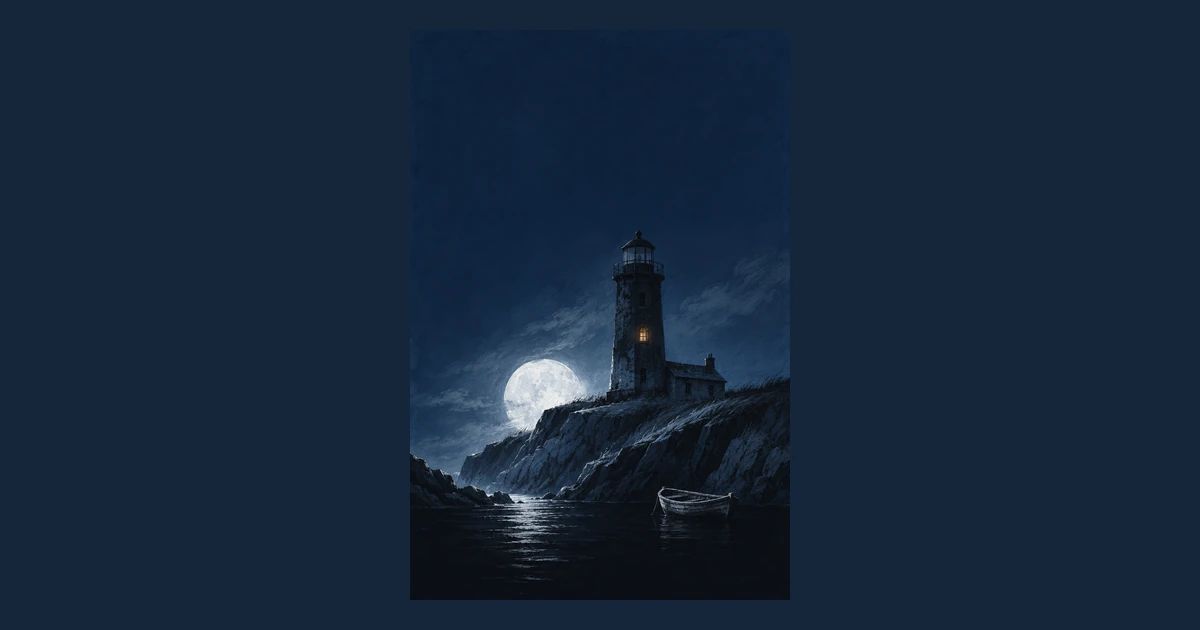
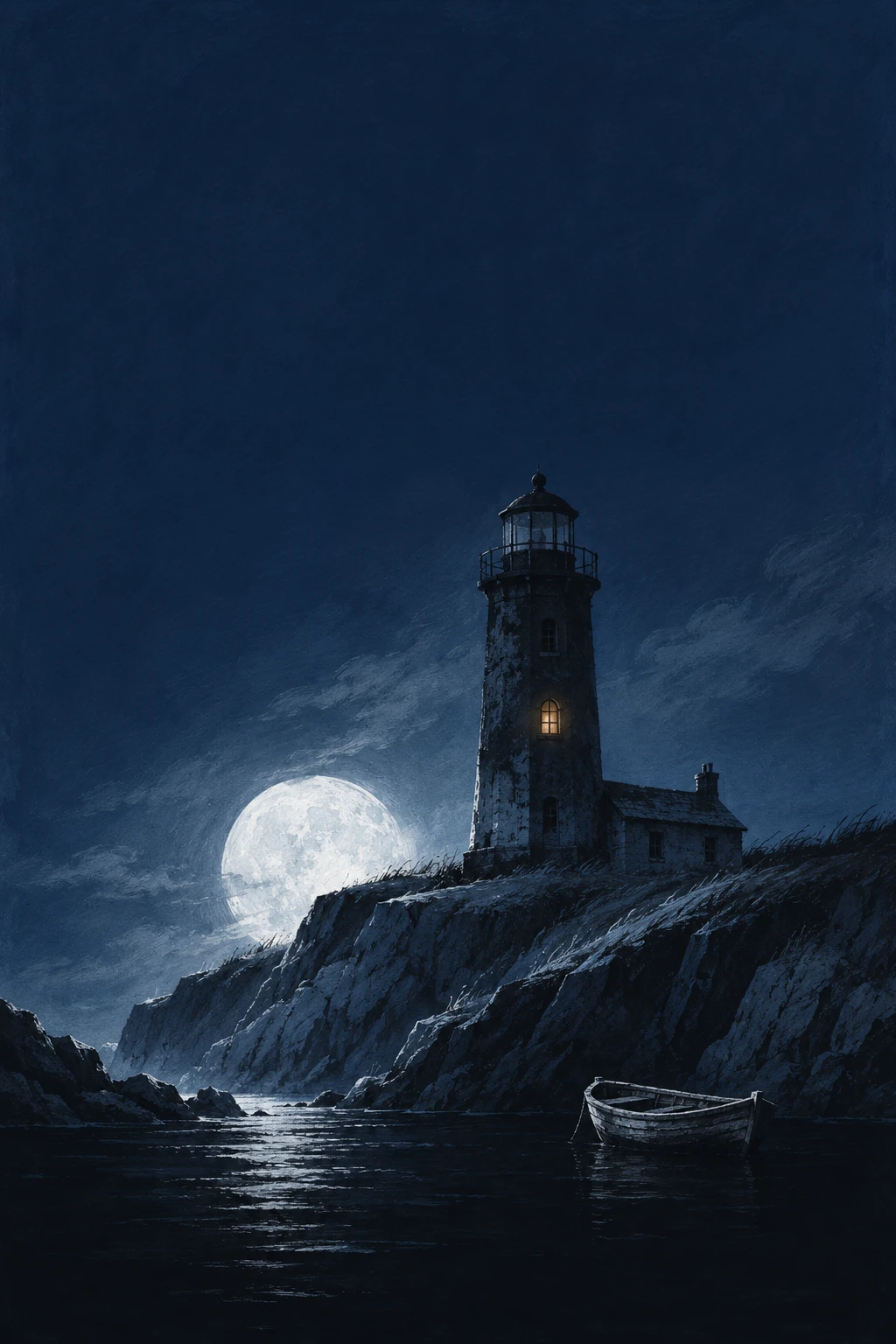
Illustrated coastal mystery; cool, quiet negative space makes the darkness readable at thumbnail size.
The lighthouse sits between the low moon and rowboat. The deep blue upper third has room for pale type.
Complete prompt
Task: Create flat front-cover artwork for a fictional book, with room for the designer to add typography later.
Subject: A single dark lighthouse above an inlet, a rowboat and a white moon.
Context: A gothic mystery about a keeper who vanishes from a remote headland.
Style: Gouache and rough ink, midnight blue with a restrained moon-white accent.
Composition: Place the lighthouse and cliff below the vertical midpoint. Keep a calm expanse of uniform night sky in the top third and near-black water along the bottom edge for separate type.
Lighting: Cold moonlight behind the cliff and one weak amber lamp halfway down the tower.
Constraints: Keep the focal point a single lighthouse. No people, lettering, symbols, frame, mockup, dust jacket, barcode or border.
Output: One full-bleed vertical 2:3 cover concept viewed straight on, with clean artwork to the edges. Keep it text-free.
What to inspect
The moon is the brightest object. Keep a future pale title above its halo.
Adjustable parameters
Shift the moon toward the cliff or reduce its halo. Test a short title against the upper sky.
Failure correction
Narrow the moon halo if it competes with a light title.
Children’s garden story
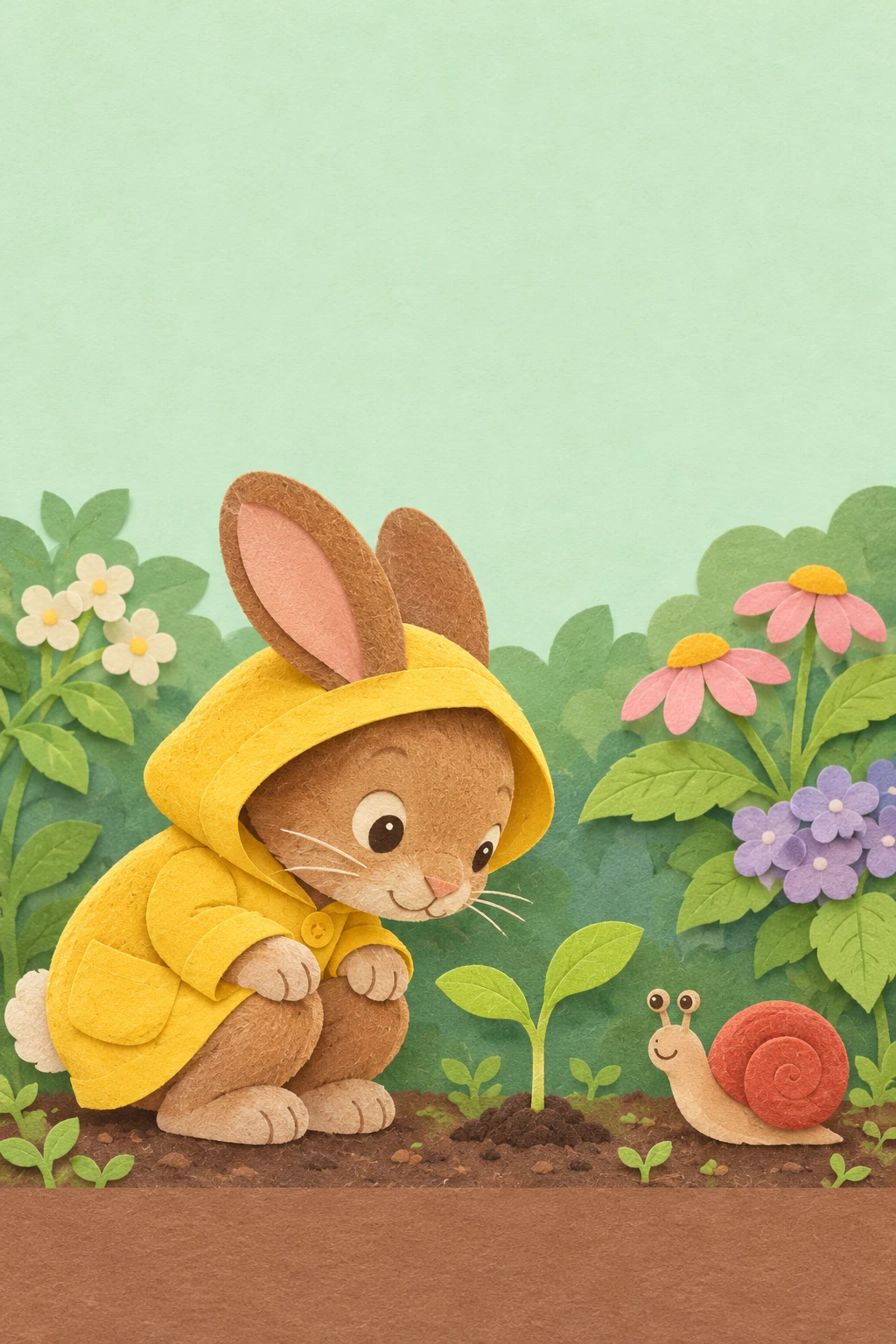
Picture book for an early reader; retain the small subject’s expressive silhouette.
The rabbit and snail sit below a broad mint field. A strip of bare soil gives the author line a second option.
Complete prompt
Task: Create flat front-cover artwork for a fictional book, with room for the designer to add typography later.
Subject: A small brown rabbit in a yellow raincoat crouching beside a green sprout and a red snail.
Context: A picture book about noticing tiny changes in a shared garden.
Style: Soft cut-paper collage with paper fibers and rounded, friendly silhouettes.
Composition: Place the rabbit and sprout in the lower middle and the snail off to the right. Leave the upper third a pale mint field with no shapes and a small plain strip at the bottom.
Lighting: Soft overcast daylight, with gentle shadows under the rabbit and leaves.
Constraints: Use only one rabbit and one snail. Keep eyes and paws readable. No letters, typography, frame, book mockup or visual clutter.
Output: One full-bleed vertical 2:3 cover concept viewed straight on, with clean artwork to the edges. Keep it text-free.
What to inspect
The highest leaves enter the lower edge of the title area. Put long type above them.
Adjustable parameters
Vary the raincoat color or swap the sprout for a seedling. Keep the upper mint field clear.
Failure correction
Move leaves away from the upper third if a long title needs two lines.
Contemporary romance
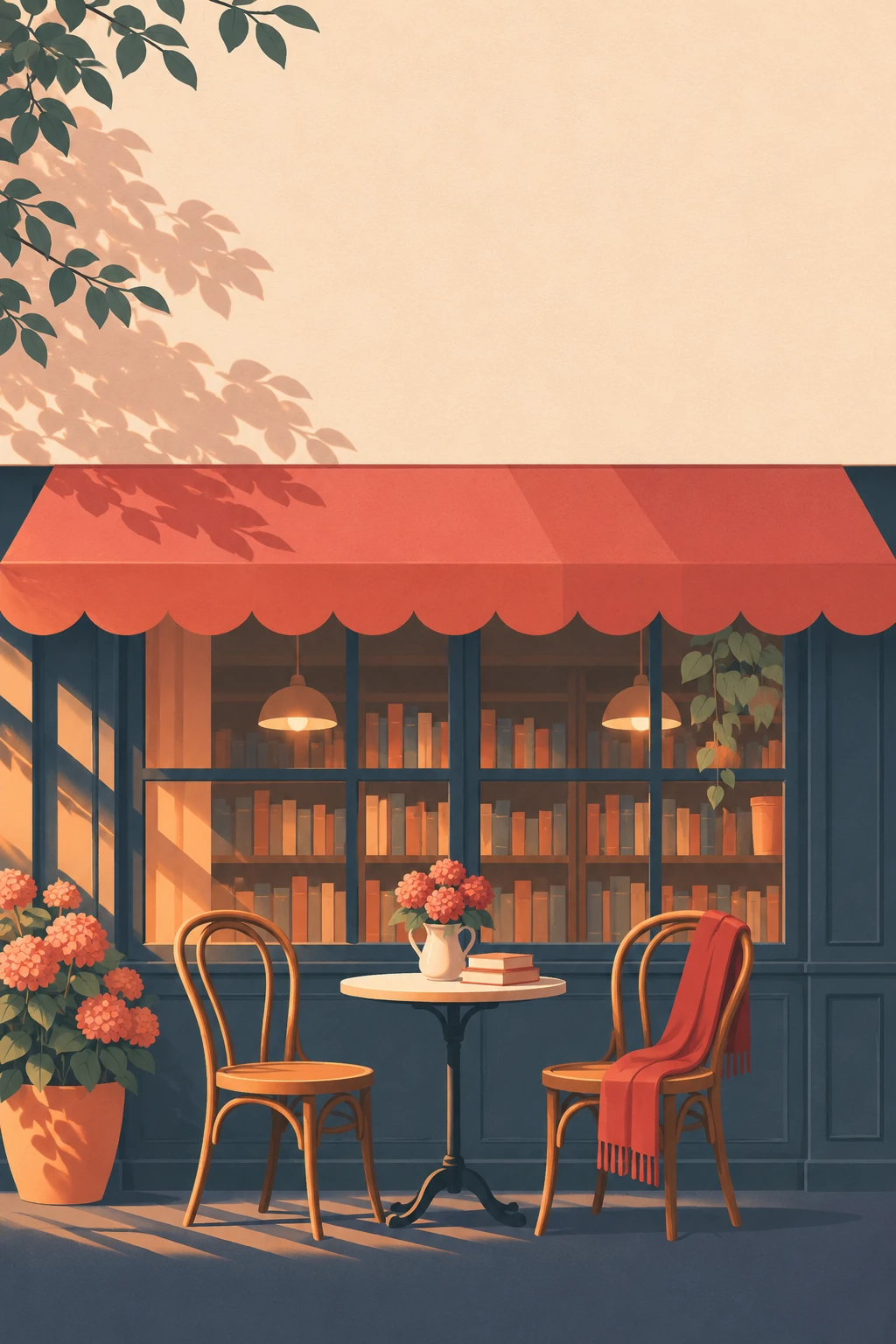
Contemporary romance; shared objects signal a relationship without showing faces.
Two chairs and a scarf carry the romance cue. The central and right part of the pale wall leaves more space for lettering than the shadowed left edge.
Complete prompt
Task: Create flat front-cover artwork for a fictional book, with room for the designer to add typography later.
Subject: Two empty bentwood chairs across a small table under a bookshop awning, one red scarf on a chair.
Context: A contemporary romance about two regulars who never arrive on the same day.
Style: Flat editorial illustration with dusty coral, ink blue and cream.
Composition: Show the scene straight on, grouped in the lower half. Keep the upper third a calm cream wall and the lower edge muted navy for independent type.
Lighting: Late-afternoon warmth from left, with clean shadow shapes.
Constraints: No people, book title, readable shop signage, lettering, merchandise mockup, border or book rendering.
Output: One full-bleed vertical 2:3 cover concept viewed straight on, with clean artwork to the edges. Keep it text-free.
What to inspect
Leaves and shadows enter the upper-left corner. Center or right-align the title if you keep this version.
Adjustable parameters
Move the scarf to change the visual emphasis, or swap the wall color while retaining contrast.
Failure correction
If the awning touches the title zone, lower it to the middle and reduce its scale.
Space opera
Space opera; show relative scale with one small ship and a broad curved horizon.
The spacecraft is tiny next to the orange planet. Almost black space in the upper left remains free of detail.
Complete prompt
Task: Create flat front-cover artwork for a fictional book, with room for the designer to add typography later.
Subject: A small single-person spacecraft facing a huge ringed amber planet from an almost black orbit.
Context: A space opera about a lone pilot crossing the planet’s rings.
Style: Cinematic graphic illustration with large silhouettes, orange bands, deep violet and fine grain.
Composition: Place the planet’s curved limb across the lower right half. Put the tiny spacecraft to its left. Reserve the upper left third as plain black-violet sky and a short dark strip along the bottom.
Lighting: Warm reflected light on the planet-facing hull with deep shadow on the opposite side.
Constraints: Keep exactly one ship and one ringed planet. No text, small stars in the title area, book object, border, watermark or signature.
Output: One full-bleed vertical 2:3 cover concept viewed straight on, with clean artwork to the edges. Keep it text-free.
What to inspect
Keep long type away from the bright rings and planet edge.
Adjustable parameters
Change the planet accent color or place the ship lower. Keep one ship and one large curve.
Failure correction
If stars interrupt pale type, reduce the number of stars in the title zone to zero.
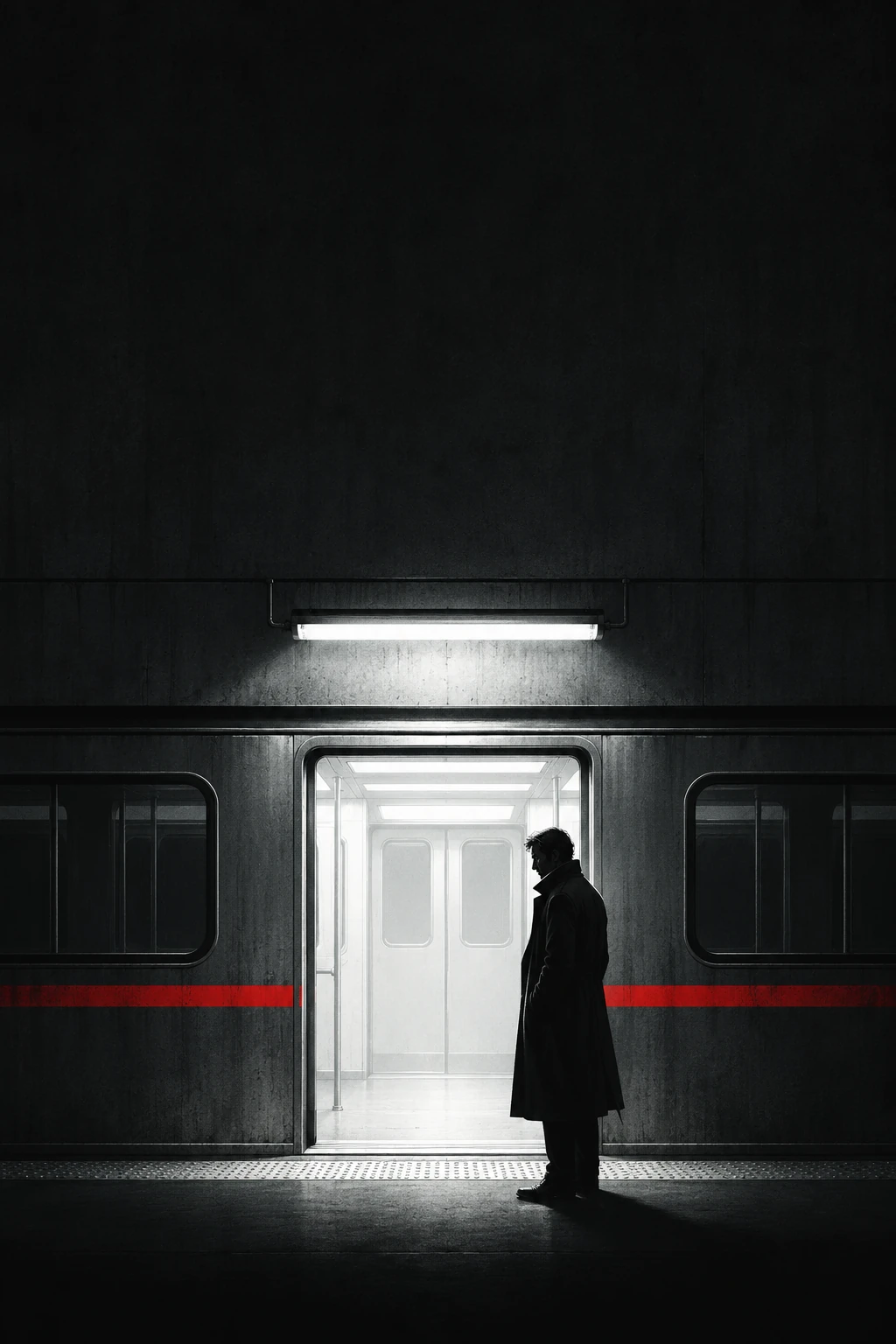
Urban crime thriller
Urban thriller; high contrast and empty space suggest tension with minimal detail.
The hard overhead light separates one profile from the open doorway. Dark space above the carriage can take a high-contrast title.
Complete prompt
Task: Create flat front-cover artwork for a fictional book, with room for the designer to add typography later.
Subject: A solitary dark-coated figure in profile waiting beside a bright letterless subway platform doorway.
Context: A crime thriller about a witness who boards the wrong train.
Style: Hard-edged noir illustration, charcoal and cold white with a small traffic-red accent.
Composition: Position the figure slightly right of center, both doorway and figure below the midpoint. Keep the upper quarter a broad uninterrupted wall shadow and keep the bottom edge dark.
Lighting: A single stark overhead tube lighting the doorway and leaving the figure mostly in shadow.
Constraints: No signage, station maps, gun, letters, logo, running figure or foreground objects. No wrap, spine or three-dimensional book mockup.
Output: One full-bleed vertical 2:3 cover concept viewed straight on, with clean artwork to the edges. Keep it text-free.
What to inspect
The bright doorway draws the eye first. Reduce its intensity if the subject needs more emphasis.
Adjustable parameters
Try a smaller red stripe or a warmer interior light. Keep the figure readable against the doorway.
Failure correction
Reduce the accent or brightness if the doorway takes attention away from the figure.
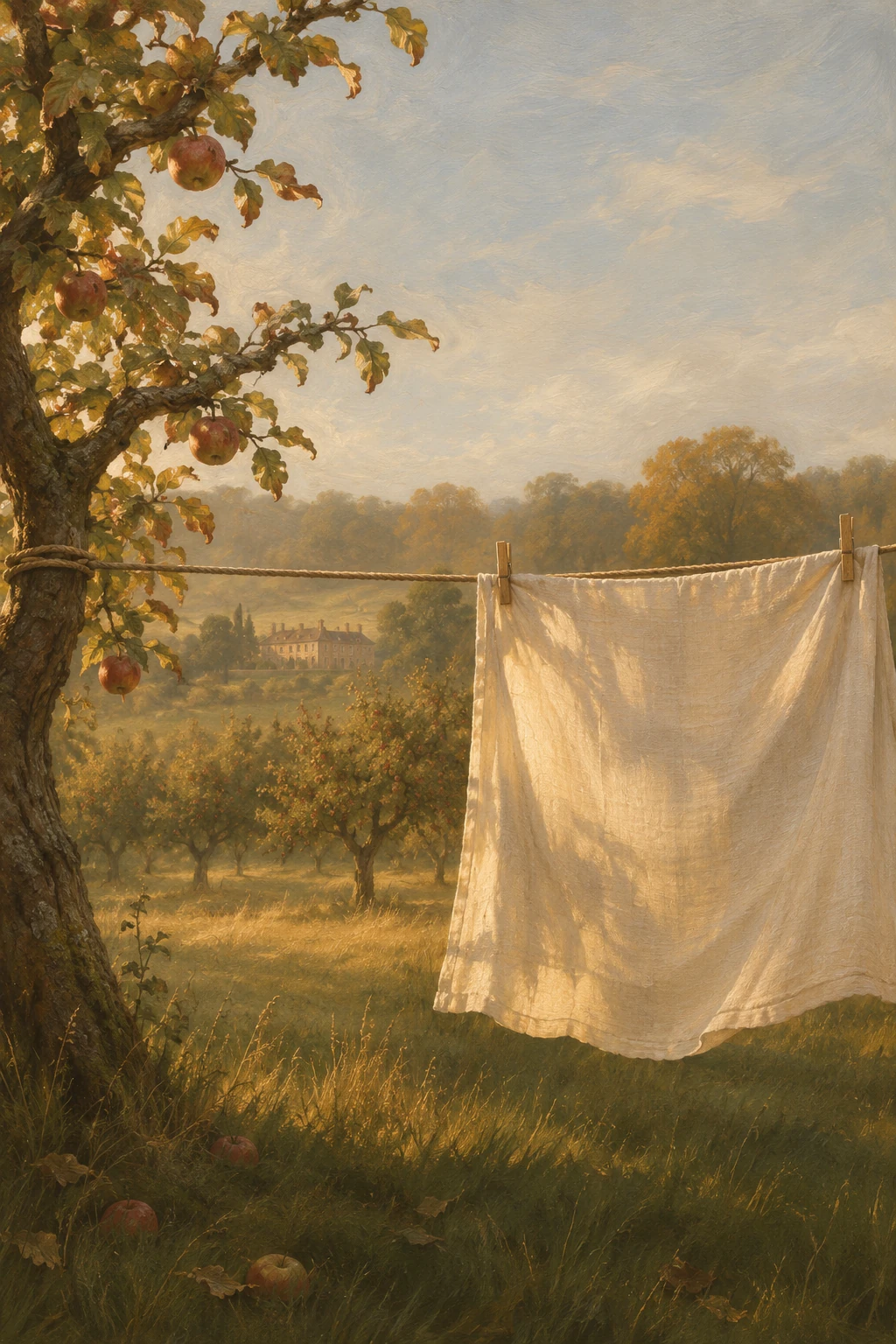
Historical family saga
Historical family story; use place and everyday objects to suggest an era without type.
Golden light reveals the sheet and apples. The right side of the upper sky is the clearest space for the title.
Complete prompt
Task: Create flat front-cover artwork for a fictional book, with room for the designer to add typography later.
Subject: One pale linen sheet on a clothesline at the edge of an orchard with faded red apples.
Context: A historical family saga about letters hidden in laundry on a rural estate.
Style: Painterly oil study with matte texture, olive green and warm straw.
Composition: Set the clothesline across the middle of the frame and keep the sheet to the right. Leave open soft sky across the upper third and a dark grass band at the bottom.
Lighting: Low autumn sun raking across the sheet and softening the distant trees.
Constraints: No text, dates, electric lines, vehicles, visible brands, printed writing or book product mockup.
Output: One full-bleed vertical 2:3 cover concept viewed straight on, with clean artwork to the edges. Keep it text-free.
What to inspect
An apple branch crosses the upper left. Use a narrower block of lettering or move the branch outward.
Adjustable parameters
Move the sheet farther right or change the season, preserving the contrast between the sheet and orchard.
Failure correction
Keep period cues in props and materials rather than introducing model-generated dates.
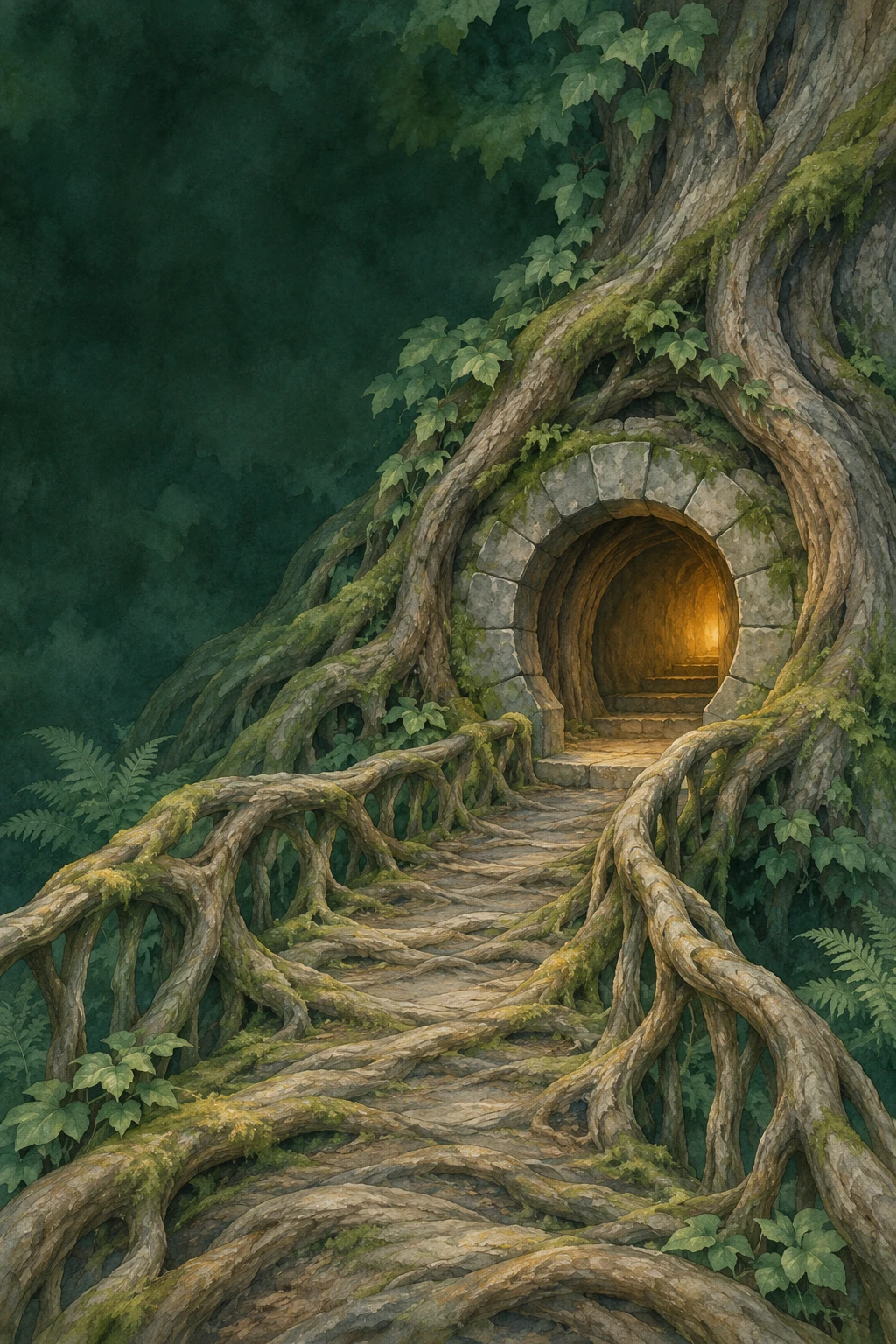
Quest fantasy
Quest fantasy; use the path and threshold to imply a destination.
The root bridge leads to one lit circular doorway. The darkest foliage in the upper left gives type more contrast.
Complete prompt
Task: Create flat front-cover artwork for a fictional book, with room for the designer to add typography later.
Subject: A bridge of roots leading toward a round stone doorway set inside one ancient tree.
Context: A quest fantasy about finding an entrance to a settlement hidden in the woods.
Style: Hand-painted ink and watercolor with deep jade, gray stone and a muted gold accent.
Composition: Let the bridge lead from the lower edge to the center-right doorway. Reserve the upper left third as soft dark foliage without visible branch detail.
Lighting: A small warm glow inside the doorway against cool forest shade.
Constraints: No figures, runes, writing, floating objects, extra doors, book spine, border or signature.
Output: One full-bleed vertical 2:3 cover concept viewed straight on, with clean artwork to the edges. Keep it text-free.
What to inspect
The middle and bottom have strong root texture. Move author type to a quiet region or give it a backing.
Adjustable parameters
Vary the doorway glow or root color. Keep the path connected visually to the threshold.
Failure correction
Simplify foliage behind a future long title and preserve the doorway halo as the focal point.
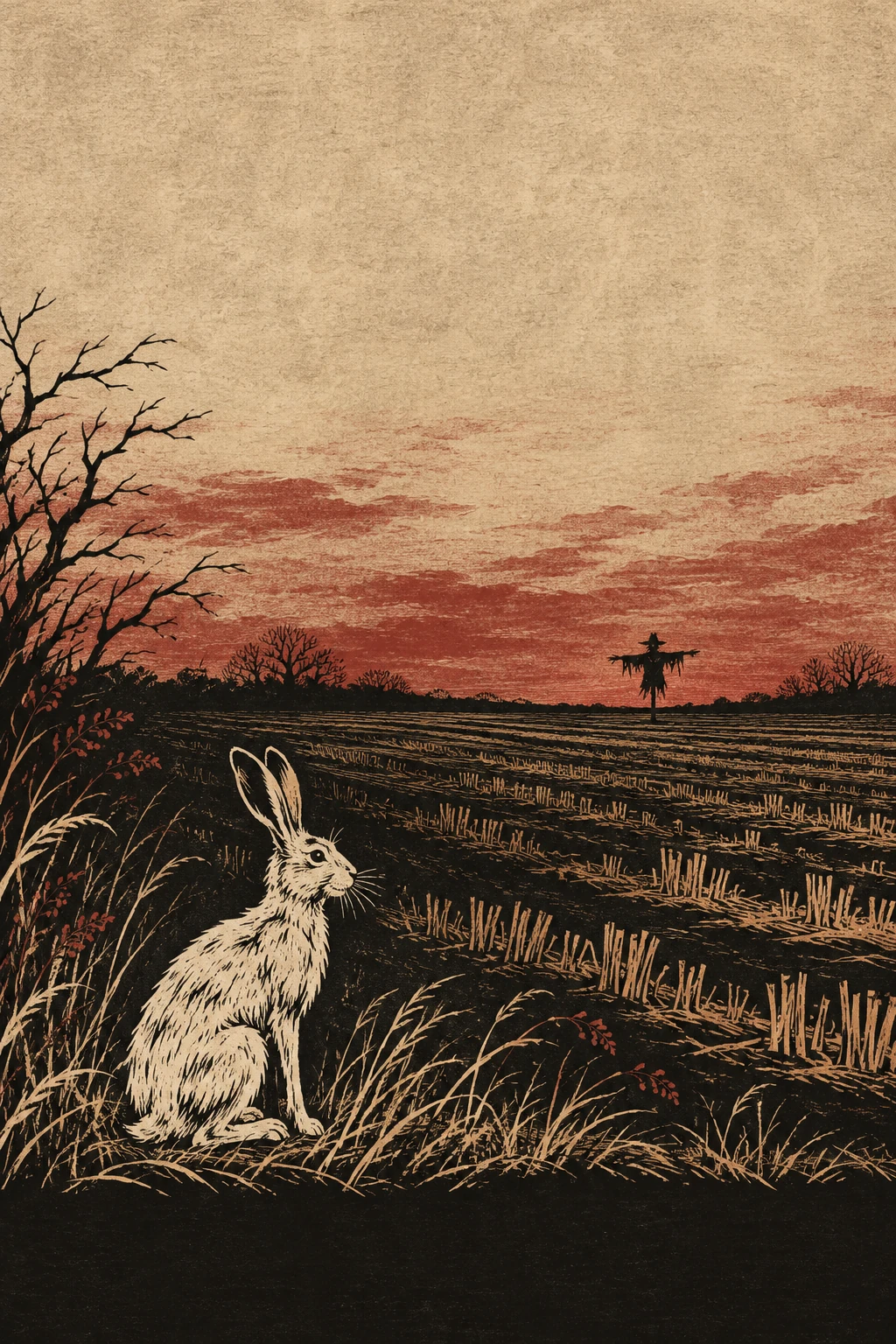
Folk horror
Folk horror; keep the abandoned landscape strong enough to read before the small clue.
In the woodcut scene, the hare reads first and the scarecrow stays on the horizon. The palest sky is above the cloud bank.
Complete prompt
Task: Create flat front-cover artwork for a fictional book, with room for the designer to add typography later.
Subject: A white hare at the edge of an empty harvested field with one black scarecrow far behind it.
Context: A folk horror story about something seen at the village boundary.
Style: Rough woodcut-inspired illustration using ink black, parchment and muted blood-red.
Composition: Set the hare and field textures below the middle. Put the scarecrow far below the upper third. Leave a relatively even pale sky above and a quiet black strip at the bottom.
Lighting: Low cloudy dusk with dim side light on the grass.
Constraints: No injury, lettering, hand-drawn marks resembling type, frame, watermark or mockup.
Output: One full-bleed vertical 2:3 cover concept viewed straight on, with clean artwork to the edges. Keep it text-free.
What to inspect
At very small sizes the scarecrow may disappear. Keep the hare large enough to carry the thumbnail.
Adjustable parameters
Change the position of the horizon or the darkest ink color. Keep the scarecrow far behind the hare.
Failure correction
If the scarecrow becomes a second foreground subject, reduce it to a small distant silhouette.
Literary poetry
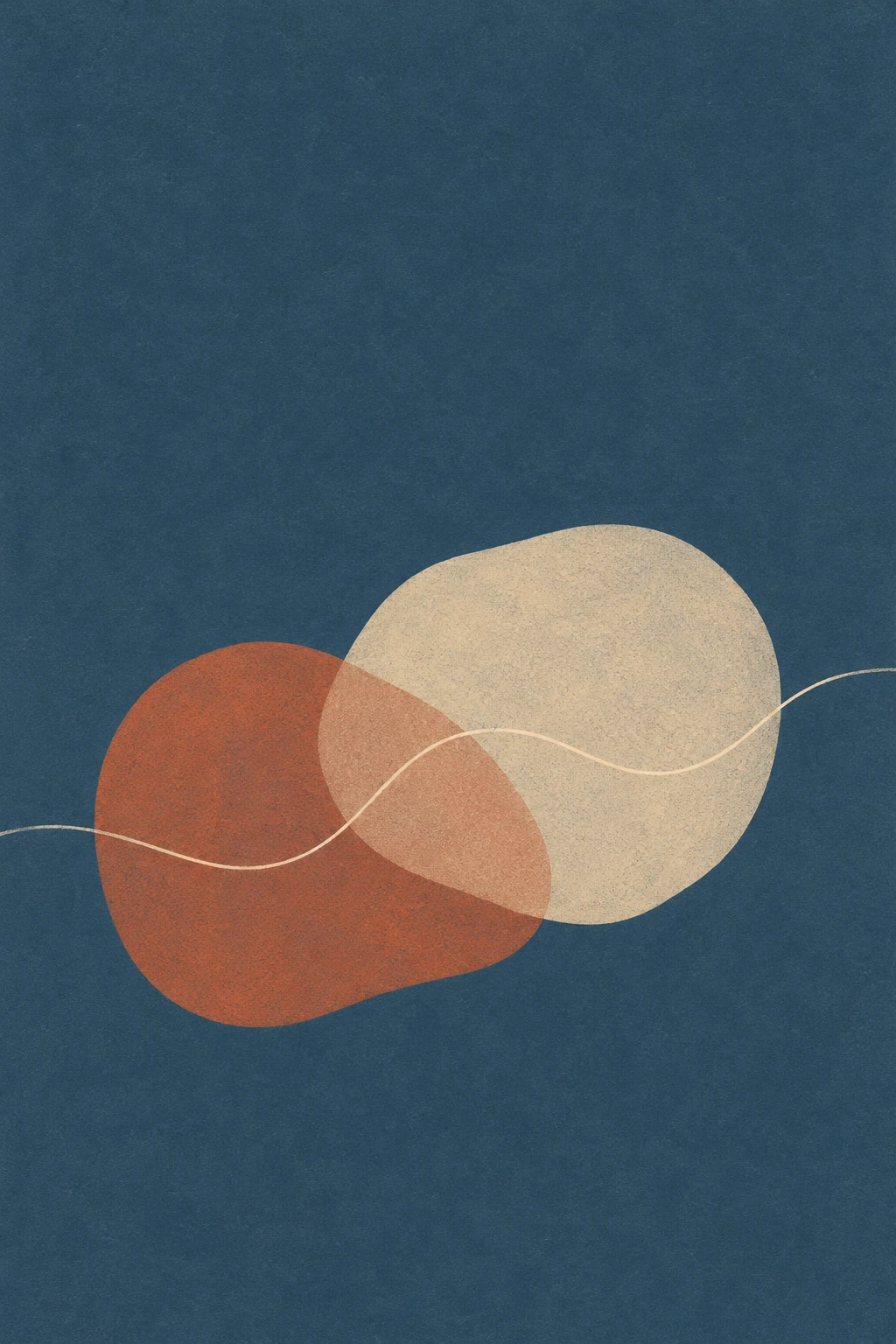
Poetry collection; use controlled color and one repeated shape to set the mood.
Two circles of color and one cream line sit between quiet upper and lower blue areas.
Complete prompt
Task: Create flat front-cover artwork for a fictional book, with room for the designer to add typography later.
Subject: A single thin abstract line weaving through two overlapping translucent shapes, one rust and one cream.
Context: A poetry collection about leaving home and returning to it.
Style: Restrained abstract silkscreen with soft paper texture and a muted ink-blue background.
Composition: Keep both floating forms centered below the midpoint with generous space around them. Reserve the upper third and narrow bottom quarter as quiet blue fields.
Lighting: Flat diffuse illustration with restrained overprint effects and no cast shadow.
Constraints: No letters, glyphs, calligraphy, realistic scenery, frame, printed-book mockup or watermark.
Output: One full-bleed vertical 2:3 cover concept viewed straight on, with clean artwork to the edges. Keep it text-free.
What to inspect
The curves are hand-shaped rather than geometric. Match any future lettering baseline by eye.
Adjustable parameters
Switch one shape or accent color and keep the fine line away from both type zones.
Failure correction
Remove extra marks anywhere the type will sit. Keep one line as the only fine detail.
Climate fiction
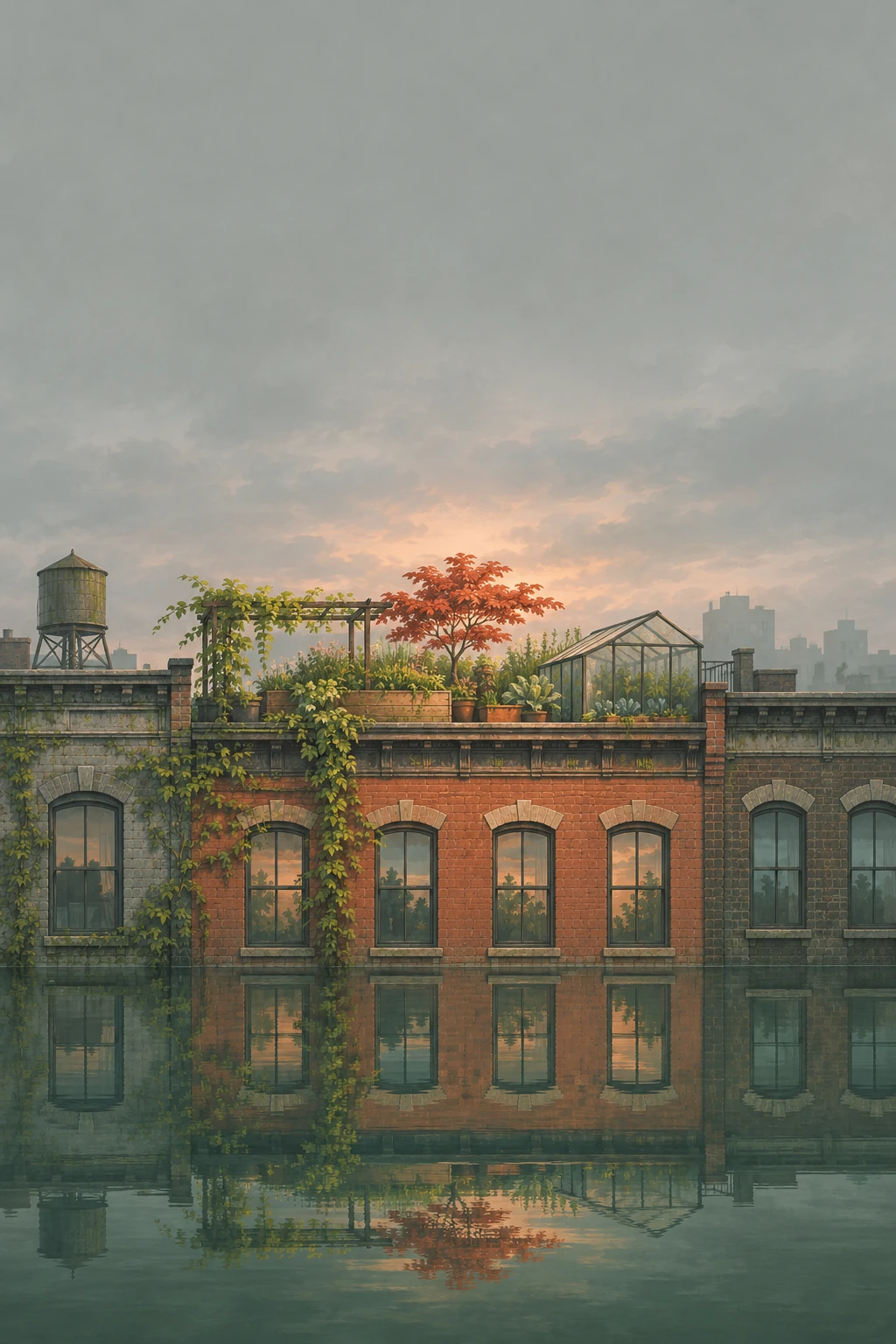
Climate fiction; use the waterline and terrace garden to convey both risk and adaptation.
The bright rooftop tree marks the story clue against a calm gray sky. The reflections soften toward the bottom.
Complete prompt
Task: Create flat front-cover artwork for a fictional book, with room for the designer to add typography later.
Subject: The upper floors of an old brick city block reflected in still floodwater, with a small rooftop garden.
Context: A climate fiction novel about rebuilding a neighborhood above changing water levels.
Style: Atmospheric editorial illustration with slate green water, gray sky and one warm terracotta accent.
Composition: Place the roofline across the lower half and the brightest plant near the vertical center. Reserve an open muted gray sky in the upper third, and deep still water at the bottom.
Lighting: Gentle sunrise light behind cloud, without a bright sun disk.
Constraints: No people, advertising signs, letters, logos, book rendering, frame or comparison panels.
Output: One full-bleed vertical 2:3 cover concept viewed straight on, with clean artwork to the edges. Keep it text-free.
What to inspect
The reflected roof remains visible near the bottom. Position a thin author line against a darker part of the water.
Adjustable parameters
Try another garden accent or alter the water color. Keep the skyline low for a longer title.
Failure correction
Remove ripples from the footer strip if author type needs more contrast.
Start with one image that belongs to the story
Write what changes for the character, then underline one thing a reader can see. A family inheritance might become a sheet hanging in an orchard. A missing lighthouse keeper gives you a lens flare, an empty boat or the lighthouse itself. Choose one clue and keep the rest of the image calm. If the composition needs a paragraph to explain it, simplify the scene before asking for another variation.
Give the model concrete genre cues. In folk horror, texture and a remote shape can do more work than a face screaming at the viewer. A romance can use two empty chairs, an object left behind and warm daylight. Readers associate different colors and types of imagery with a genre, but the story object helps the cover stay specific. If the first image feels generic, change the object or point of view before adding more adjectives.
For a set of related books, note which choices you intend to repeat. You might keep the title zone, lighting direction and color contrast while swapping the setting. Sketch two pages side by side in your layout file and see whether they look related at the same display size. Track which change affected legibility before making a third or fourth pass.
Plan the book cover layout before you add type
Reserve real room for words. A quiet field of sky, wall or water gives you more control than a prompt that simply says leave space for text. Tell the model where all fine detail should stop. For a short title a quarter of the cover may work. A long title plus a subtitle needs a larger field. If you use the upper left, put the strongest light or object on the opposite side so the title and focal point have separate jobs.
Add actual title and author text in a layout tool. Start with one type family and build hierarchy with size, weight and spacing. Test a two-line title before a three-line one. Check the visible letters against the background under each word, not just the average color of the image. If a cloud or bright edge cuts through a letter, move the line, darken the local background in the layout, or ask for a quieter image region.
Look at the result at a narrow storefront thumbnail around 120 to 150 pixels wide. Start by reading the title and identifying the focal object. Then try a grayscale view to see whether brightness is doing enough work without color. A complicated doorway, fringe of leaves, or row of little stars should not compete with small type. Compare two versions at the same size and keep the one whose title reads sooner.
Fix the common cover art failures
When the model inserts fake letters or draws a photographed book, ask for a single flat illustration, edge to edge, seen straight on, with no writing or mockup. Avoid instructions like add an embossed cover or show the jacket unless you actually need that presentation. Those phrases often turn the output into an object on a table. Inspect the edges and remove any mock framing before placing the artwork.
If the cover reads like a poster for a generic genre, change one piece of the brief. Use a rooftop garden against the flood line or a specific prop from the first chapter. Keep the title area and crop unchanged between passes so the comparison shows whether the story detail helped. If the composition is still busy, remove a competing figure or widen the plain background.
If an illustration looks good full size but disappears in a store listing, enlarge a meaningful silhouette and limit accents to one color. A space-opera cover can keep the curve of the planet and a single small ship. If the design needs tiny marks to be effective, move those marks to the interior or back cover. View the main field in grayscale and check again after reducing the image.
Turn cover artwork into a file you can proof
A front cover concept and a full print wrap have different geometry. For an ebook, start from the cover dimensions and format required by the retailer. For a print book, get the current template for the chosen trim, paper and page count before you lay out the front, spine and back. The printer may specify safe margins, bleed, barcode location and export settings. The image crop shown here is a preview proportion and does not specify any of those values.
Keep an editable version of the layout with the type, illustrations and layers separate. Use the trim guide to check that essential faces and objects stay inside the safe area after cropping. Extend only expendable background into bleed. Review a print proof for color, paper contrast and small type, and inspect digital exports at their display size. Check the artist asset, typeface and image tool terms for your intended distribution before releasing a cover.
Frequently asked questions
What should AI book cover art prompts include?
Specify the book genre, one visible story clue, the illustration style, the crop and where the title and author name need quiet space. Ask for one text-free flat front-cover concept so you can place real type after generation.
Why make a text-free book cover first?
With an art-only file, you can spell-check the exact title, set type that suits the genre and adjust the hierarchy at thumbnail size. Keeping the title editable also makes later corrections easier.
Can I use a 2:3 image as my final cover?
A vertical 2:3 image gives you a useful starting crop. The actual trim and safe area depend on the retailer or printer. A print wrap also needs space for the spine, back and any required barcode, so obtain the correct template before laying out the file.
How do I make fiction book cover artwork readable at a tiny size?
Use one strong silhouette, a simple value structure and quiet areas where letters will go. Shrink the layout to a storefront thumbnail and check whether you can read the title and identify the main subject without zooming.
How can I adapt a book cover design prompt for a series?
Repeat the type zones, basic value contrast and a consistent visual grammar, such as a single focal object in the lower half. Change the story clue, secondary palette or backdrop between books. Compare the covers at the same small size.
Can I use the sample images as print-ready artwork?
The examples show what each prompt can produce as a visual concept. Check crop, resolution, type, bleed, color and usage rights for the actual book before exporting, and proof the final result at its intended size.