Christmas wrapping paper prompts: 10 gift wrap patterns
Christmas wrapping paper prompts describe a flat design that can repeat across a sheet of paper. Specify the holiday motifs, the palette, their relative size and the background along every edge. Ask for one square repeat tile, then duplicate the saved image into a two by two arrangement to inspect where the copies meet. A useful wrapping paper pattern keeps its spacing and color consistent across those joins. Choose the physical size of the tile before laying out a page, and print a small proof to check motif size, contrast and paper color. The prompts below provide starting points for that workflow. Assess each result at its actual delivered dimensions before preparing gift wrap patterns for a printer.
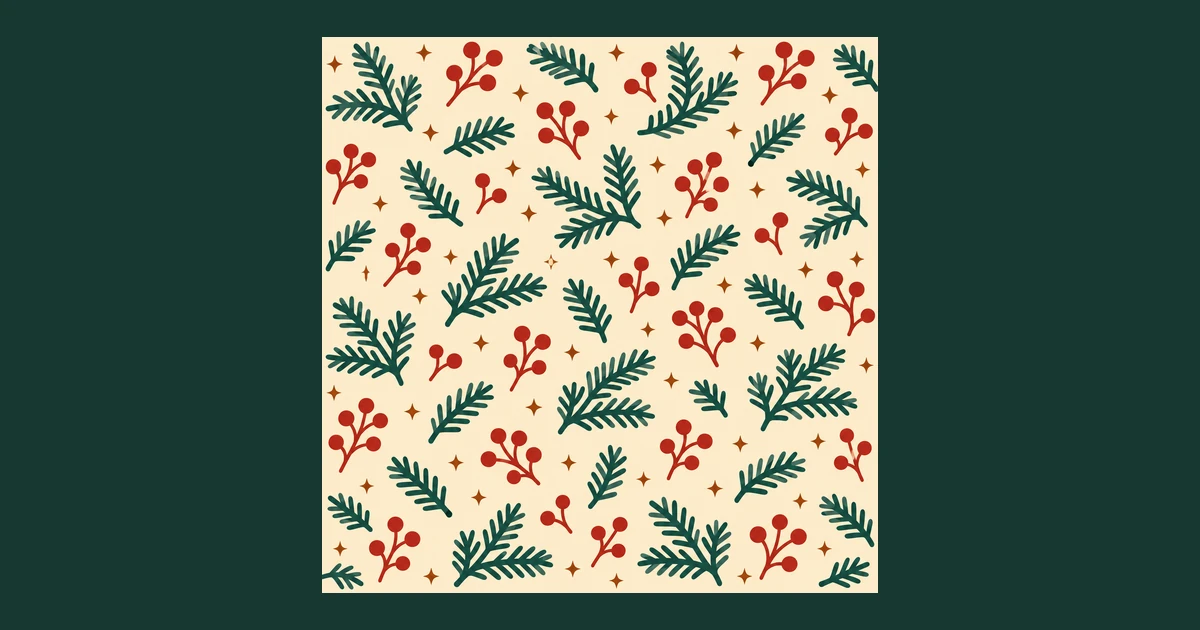
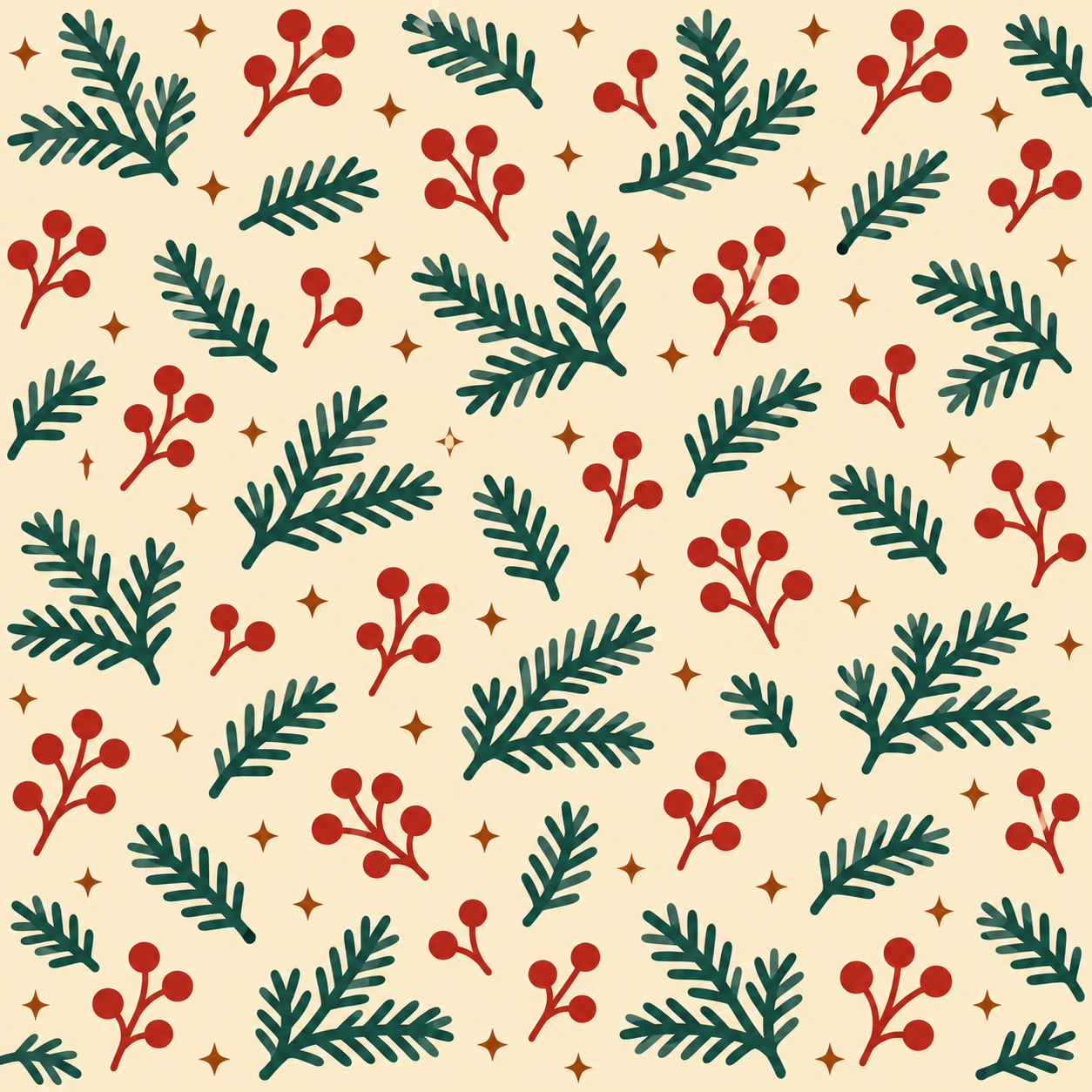
Nordic gift wrap for a rectangular parcel with plain twine.
Needles and berry clusters remain legible at small size.
Complete prompt
Task: Create a flat repeat-ready Christmas wrapping paper pattern swatch for a straight horizontal and vertical repeat.
Subject: Sprigs of blue-green fir, red winter berries, and tiny cream four-point stars.
Context: Nordic gift wrap for a rectangular parcel with plain twine.
Style: Flat folk-art cut shapes, evergreen, brick red, and oatmeal cream.
Composition: Use small alternating sprigs and berries, evenly tossed. Keep all motifs inside the square. Leave only a very narrow uninterrupted oatmeal edge on every side, with no drawn border.
Lighting: Uniform matte colors with no gradients, shadows, or vignettes.
Constraints: Simple silhouettes, no text, hands, ribbon, wrapped box, watermark, or perspective.
Output: One opaque square 1:1 flat artwork tile extending to the very edge, straight on, exactly one tile; do not draw a preview grid, labels or any outlined border.
What to inspect
At the left/right join, one small motif touches the edge. The background stays close in tone. Zoom in before using the repeat across a large sheet.
Adjustable parameters
Fir scale, rotation, cluster spacing and cream ground.
Failure correction
Use a slightly smaller sprig near the corner if adjacent tiles create a dark knot.
Golden stars on navy
An understated celestial Christmas wrap for sharply folded small boxes.
Small stars and crescent moons balance the dark field.
Complete prompt
Task: Create a flat repeat-ready Christmas wrapping paper pattern swatch for a straight horizontal and vertical repeat.
Subject: Tiny eight-point stars, round dots, and slender crescent moons.
Context: An understated celestial Christmas wrap for sharply folded small boxes.
Style: Gold-ink look drawn as flat ochre, ivory, and muted pale blue on solid very dark navy.
Composition: Offset the moon and star positions across a scatter field, with no central star. Keep a narrow plain navy safety margin on each edge and all shapes clear of the margins.
Lighting: Uniform flat lighting without reflected foil, glare, or shading.
Constraints: No actual metallic texture, lettering, constellation lines, border, room, folded paper, or mockup.
Output: One opaque square 1:1 flat artwork tile extending to the very edge, straight on, exactly one tile; do not draw a preview grid, labels or any outlined border.
What to inspect
Neither seam showed a distinct tone step in the screen preview. Scan for a tight group of crescents across the four-tile intersection.
Adjustable parameters
Navy shade, star size, number of crescents and gold accent.
Failure correction
If the darkest join reads as a band, shrink the blank margin and move small dots nearer the edges.
Gingerbread and little houses
Playful gift wrap with clear motifs even when the folded parcel hides half the tile.
The revised swatch keeps cookie roofs and stars clear of the joins.
Complete prompt
Task: Create a flat repeat-ready Christmas wrapping paper pattern swatch for a straight horizontal and vertical repeat.
Subject: Alternating gingerbread houses and stars piped with simple curved white details.
Context: Playful gift wrap with clear motifs even when the folded parcel hides half the tile.
Style: Bold cookie-brown linocut silhouettes with cream icing and tiny muted cherry accents.
Composition: Distribute modest houses at slight alternating rotations and fill selected gaps with cookie stars. Use a genuinely identical, completely uniform vanilla cream background at every point of the entire canvas. Keep at least 5% of the canvas clear of all cookie shapes on every edge; no clipped motif, patterned trim, divider line or colored band on any edge.
Lighting: Even flat ink coverage with no illumination gradient, textured paper, perimeter line, or shadow.
Constraints: No written icing labels, actual plate, food photograph, cutout crop, logo, cookies falling beyond the artwork, or frame.
Output: One opaque square 1:1 flat artwork tile extending to the very edge, straight on, exactly one tile; do not draw a preview grid, labels or any outlined border.
What to inspect
Both joins blend in the screen proof. The blank rhythm is wider across the joins, which emphasizes the tile at full-sheet scale.
Adjustable parameters
Cookie size, icing contrast and spacing between motifs.
Failure correction
Shrink the houses if corners and tape hide the cookie roofs.
Woodcut woodland
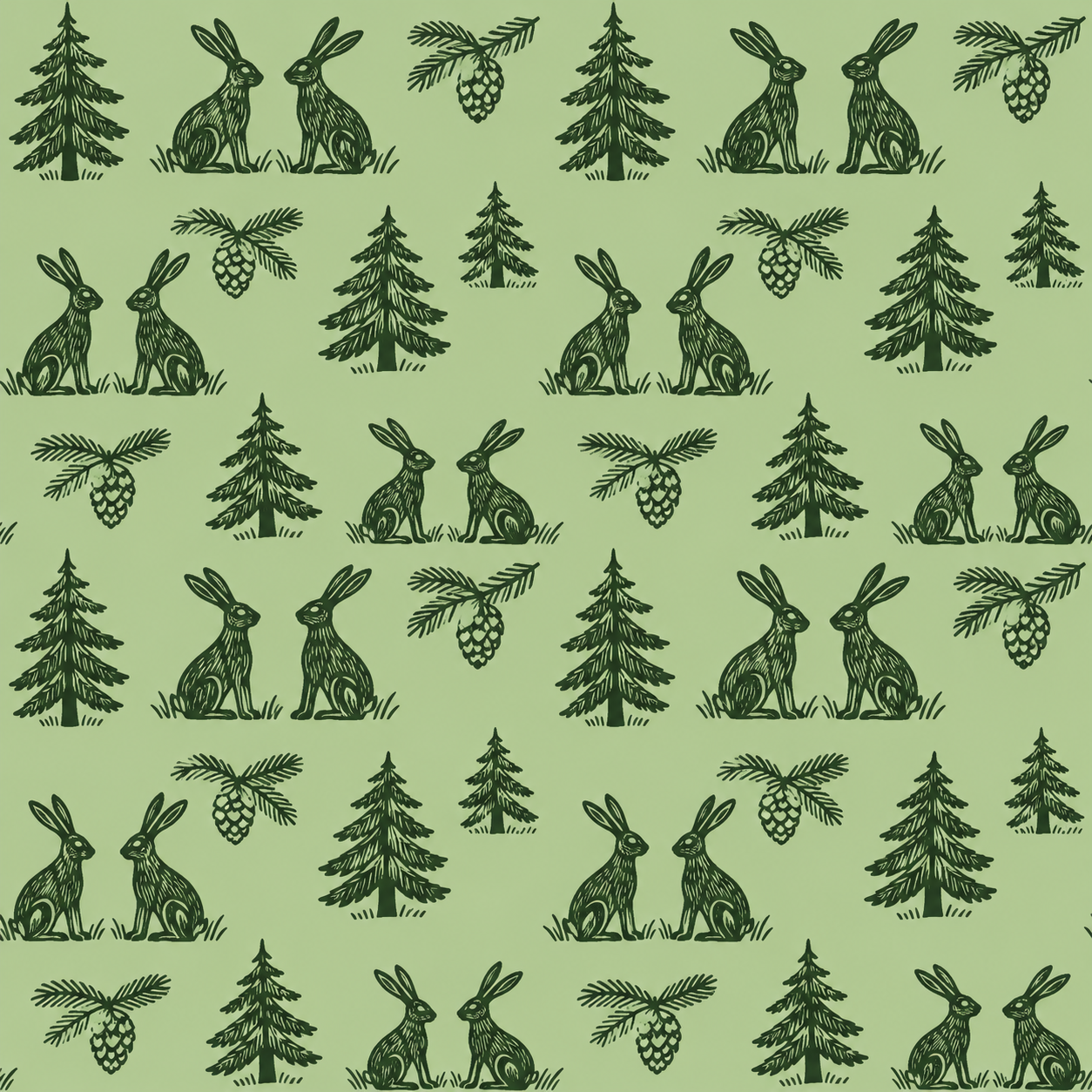
A quiet winter woodland gift wrap appropriate for medium or long parcels.
Woodcut details stay inside the silhouettes while the dense green print holds together.
Complete prompt
Task: Create a flat repeat-ready Christmas wrapping paper pattern swatch for a straight horizontal and vertical repeat.
Subject: Small paired silhouettes of hares, pinecones, and fir trees.
Context: A quiet winter woodland gift wrap appropriate for medium or long parcels.
Style: Flat one-ink woodcut on a uniform light sage field, with carved texture confined inside the motifs.
Composition: Stagger diagonal groupings and alternate which way the two hare silhouettes face. Keep all ink inside the square and an uninterrupted narrow sage edge.
Lighting: Uniform colors across the background, no shadows.
Constraints: No scenic horizon, footprints reaching the edges, paper wrinkles, labels, frame, or box.
Output: One opaque square 1:1 flat artwork tile extending to the very edge, straight on, exactly one tile; do not draw a preview grid, labels or any outlined border.
What to inspect
Similar dark motifs draw the eye near the side join. Check the join at full scale and separate any adjacent dark silhouettes.
Adjustable parameters
Tree height, hare rotation and percentage of open sage ground.
Failure correction
Shrink or rotate the tallest two trees if they form rigid stripes when the tile is repeated.
Mid-century bauble scatter
Vintage-inspired wrapping paper for a holiday swap.
Repeated baubles, stripes and stars are legible without type.
Complete prompt
Task: Create a flat repeat-ready Christmas wrapping paper pattern swatch for a straight horizontal and vertical repeat.
Subject: Small teardrop and round ornaments with abstract interior stripes and stars.
Context: Vintage-inspired wrapping paper for a holiday swap.
Style: Flat mid-century screen-print illustration with tomato red, teal, warm cream and dusty chartreuse on a uniform pale cream ground.
Composition: Scatter medium and small baubles in staggered positions. Draw every hanging loop and teardrop fully within the interior. Leave at least 4% of the tile free of all marks on every side with the same uninterrupted cream as the ground. Leave no border.
Lighting: Solid matte spot colors and a uniform pale cream background at the same brightness from edge to edge. No tint bands, cast shadows or shine.
Constraints: No tree branches, diagonal wrapping fold, actual metal, word marks, border, or boxes.
Output: One opaque square 1:1 flat artwork tile extending to the very edge, straight on, exactly one tile; do not draw a preview grid, labels or any outlined border.
What to inspect
The revised artwork keeps hanging loops and teardrops inside the swatch. Look at the cream interval where four copies meet before committing to a large print.
Adjustable parameters
Ornament size, contrast between spot colors and the proportion of open cream.
Failure correction
Reduce the largest ornament size if the wrap reads as a single repeated logo from across the room.
Candy cane mini print
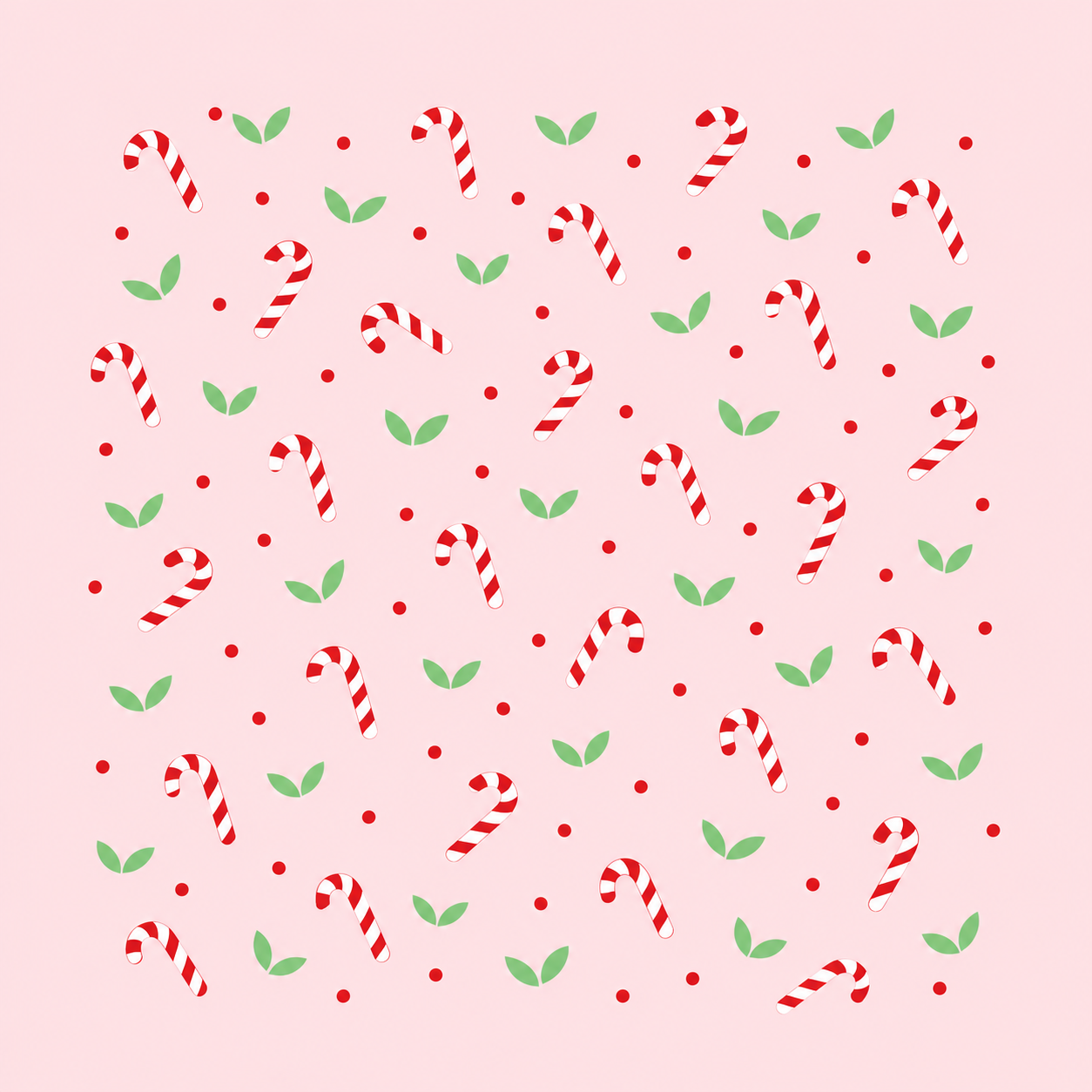
An all-direction mini print to suit small stocking fillers and irregular folds.
The revised mini print leaves the cane hooks and green leaves intact.
Complete prompt
Task: Create a flat repeat-ready Christmas wrapping paper pattern swatch for a straight horizontal and vertical repeat.
Subject: Small candy canes, red dots and mint-green leaves.
Context: An all-direction mini print to suit small stocking fillers and irregular folds.
Style: Flat two-ink stationery illustration on a uniform pale blush field, crisp bright red and restrained mint.
Composition: Show small intact canes in many rotations in loose staggered scattering, pale green paired leaves and small red dots. Keep the outer 6% of the square completely free of objects on all four sides, with exactly the same uniform pale blush color as the entire background. Leave no compositional focal point.
Lighting: Flat uniform background color at every pixel outside the shapes. No shadow, paper texture, vignette, light patch, perimeter rule or tinted stripe.
Constraints: No candies with brands or text, tissue texture, folded paper, hard outside frame, or centered badge.
Output: One opaque square 1:1 flat artwork tile extending to the very edge, straight on, exactly one tile; do not draw a preview grid, labels or any outlined border.
What to inspect
The ground stays consistent across both joins in the preview. The safety margins make the overall repeat easier to spot at large scale.
Adjustable parameters
Motif size, rotations, blush intensity and empty edge width.
Failure correction
Rotate two canes if all hooks end up pointing to the same group in the repeated layout.
Paper-cut winter birds
Small ornaments of color for gift wrap without a recognizable character.
The bird silhouettes read from either wrapping direction.
Complete prompt
Task: Create a flat repeat-ready Christmas wrapping paper pattern swatch for a straight horizontal and vertical repeat.
Subject: Little red birds, simple navy twigs and oat-colored seed clusters.
Context: Small ornaments of color for gift wrap without a recognizable character.
Style: Scissor-cut paper silhouettes in terms of shape only, using pure flat colors with sharp edges. Do not simulate cut paper texture. Use one solid pale sky-blue background.
Composition: Use small bird motifs at alternating orientations, two small twigs, and occasional seed clusters. Keep the outer 6% of the square free of all art on all four sides, with a single pale solid sky-blue ink field (#B7D5DC) of exactly the same color everywhere, including all four edges.
Lighting: Flat uniform background color at every pixel outside the shapes. No shadow, paper texture, vignette, light patch, perimeter rule or tinted stripe.
Constraints: No readable text, collage drop shadow, trees crossing the boundary, gift box, full illustration scene, or frame.
Output: One opaque square 1:1 flat artwork tile extending to the very edge, straight on, exactly one tile; do not draw a preview grid, labels or any outlined border.
What to inspect
Inspect both joins of the blue field and adjust edge density if a rectangle persists in the full-sheet proof.
Adjustable parameters
Bird size, twig length, edge clearances and blue ink coverage.
Failure correction
Reduce dark twig length if two repeats make a heavier bar along the join.
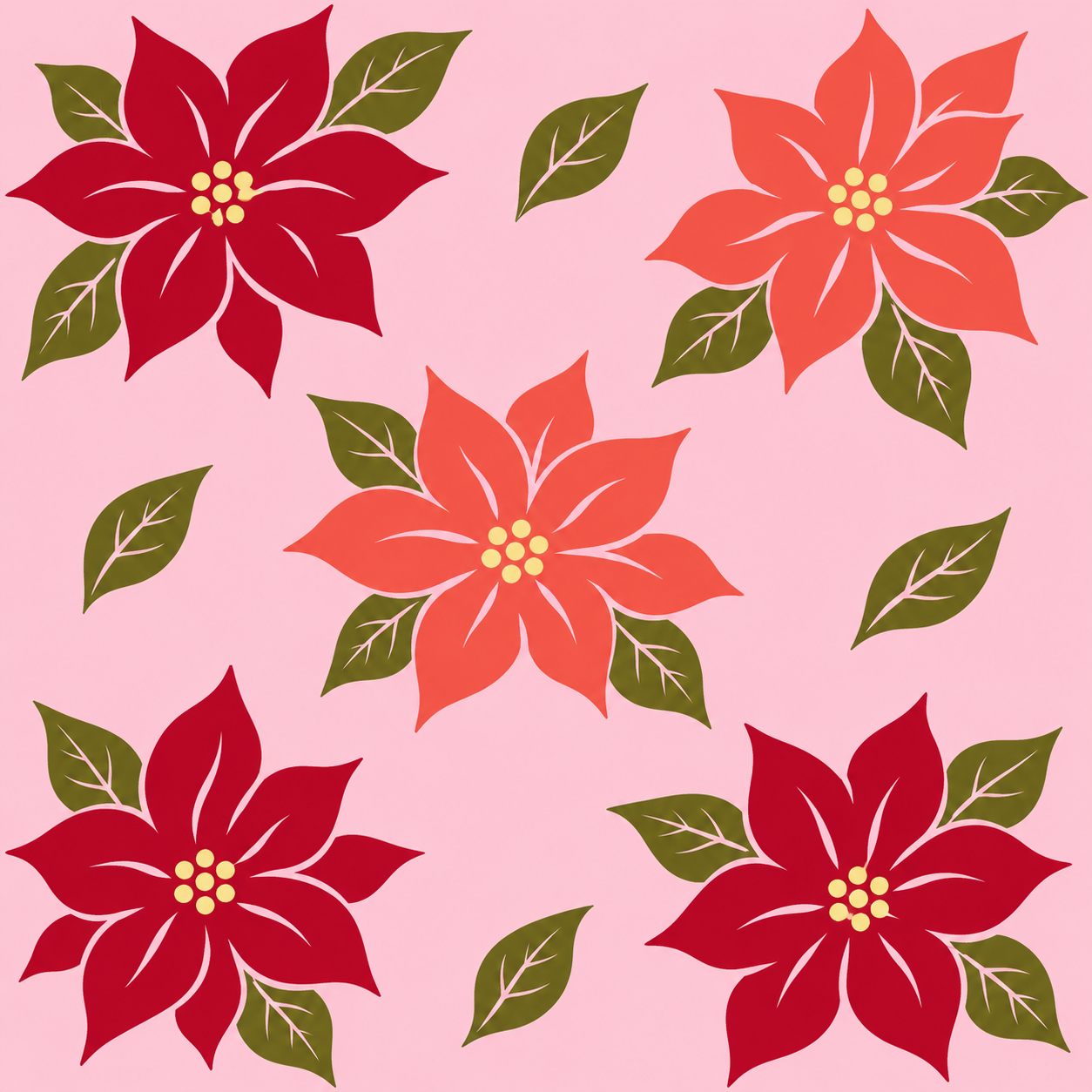
Poinsettia blocks
A bold botanical Christmas wrap for a large rectangular parcel.
A loose diagonal of bold flowers works well on a larger parcel.
Complete prompt
Task: Create a flat repeat-ready Christmas wrapping paper pattern swatch for a straight horizontal and vertical repeat.
Subject: Graphic poinsettia heads and a few detached leaves.
Context: A bold botanical Christmas wrap for a large rectangular parcel.
Style: Flat block-print flowers in cranberry and coral with olive leaves on a uniform pale pink background.
Composition: Use medium flowers across a loose diagonal rhythm, with some open intervals between the blocks. Keep leaves away from all edges and leave only a very narrow plain background margin.
Lighting: Uniform flat colors over the whole tile without gradient or shadow.
Constraints: No photo, lettering, print simulated on cloth or framed paper, edge trim marks, or box.
Output: One opaque square 1:1 flat artwork tile extending to the very edge, straight on, exactly one tile; do not draw a preview grid, labels or any outlined border.
What to inspect
The screen proof does not show a clear background band. Leaves may look crowded where four copies meet.
Adjustable parameters
Flower scale, leaves per cluster, diagonals and color contrast.
Failure correction
Lighten or shrink leaves if dark corners bunch together between tiles.
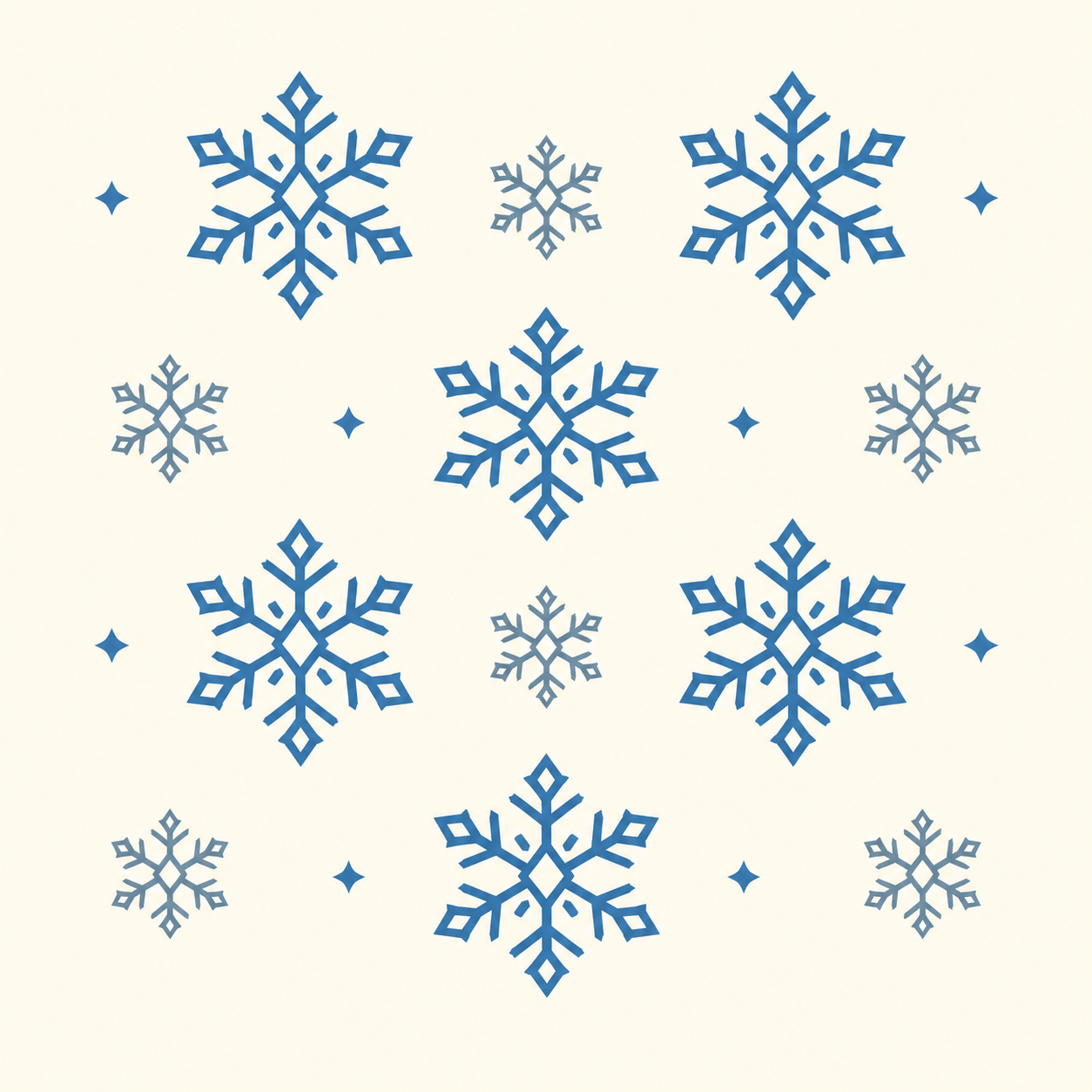
Quiet snowflakes
Low-ink winter gift paper for everyday holiday giving.
Small and large snowflakes stay separate in the revised swatch.
Complete prompt
Task: Create a flat repeat-ready Christmas wrapping paper pattern swatch for a straight horizontal and vertical repeat.
Subject: Small blue geometric snowflake medallions and occasional four-point ice dots.
Context: Low-ink winter gift paper for everyday holiday giving.
Style: Flat cool blue and blue-gray geometric line shapes on a uniform off-white ground.
Composition: Mix just two scale levels in staggered positions. Keep snowflakes well away from the outer 5% of the canvas on every side. Maintain exactly the same opaque pale ivory background across the entire square, including all four edges. No blue side stripe, edge decorations or frame.
Lighting: Even matte blue ink only inside the shapes, entirely uniform ivory everywhere else.
Constraints: No simulated paper grain, typography, star over a snowy landscape, frame, folds or labels.
Output: One opaque square 1:1 flat artwork tile extending to the very edge, straight on, exactly one tile; do not draw a preview grid, labels or any outlined border.
What to inspect
Both joins look quiet on screen. The sparse swatch still shows regular intervals at larger scale, and thin blue detail needs a proof.
Adjustable parameters
Stroke thickness, scale range, blue tone and palette count.
Failure correction
Increase stroke weight before printing if thin blue lines disappear on a small test swatch.
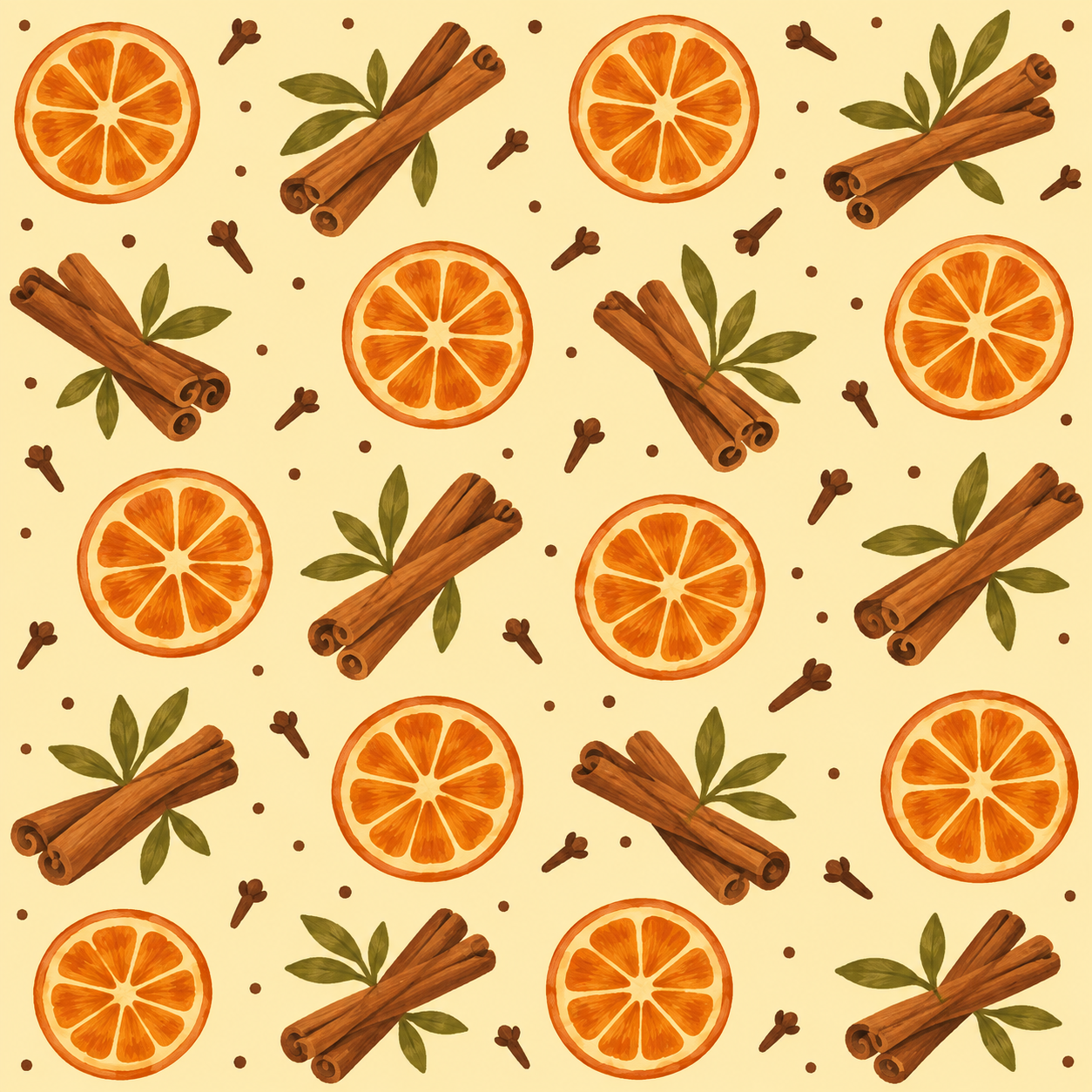
Oranges and spice
A warm handcrafted wrap for food gifts using illustrated seasonal kitchen motifs.
Repeated citrus circles and cinnamon keep separate outlines.
Complete prompt
Task: Create a flat repeat-ready Christmas wrapping paper pattern swatch for a straight horizontal and vertical repeat.
Subject: Small orange cross-sections, cinnamon-stick bundles and tiny clove dots.
Context: A warm handcrafted wrap for food gifts using illustrated seasonal kitchen motifs.
Style: Flat gouache-like silhouettes, burnt orange, cocoa brown and olive on a solid light butter ground; brush texture only inside shapes.
Composition: Alternate the round citrus slices with diagonal spice bundles, leaving scattered dots rather than a straight grid. Keep every motif inside a narrow bare outer margin on the uniform butter background.
Lighting: Uniform even matte color, no shadow or photo highlights.
Constraints: No lettering, realistic plate, tied gift, dimensional surface, textured background, barcode, or frame.
Output: One opaque square 1:1 flat artwork tile extending to the very edge, straight on, exactly one tile; do not draw a preview grid, labels or any outlined border.
What to inspect
The edge color is consistent across both joins in the screen proof. Check whether the diagonal spice bundles repeat too rigidly over a long sheet.
Adjustable parameters
Citrus diameter, clove count, dark-to-light balance and spice angle.
Failure correction
Subtract clove dots if the pattern remains cramped when viewed at folded parcel size.
Build one clear repeat tile
Start with a motif that will remain recognizable after wrapping. A broad evergreen branch, a small toy silhouette or a simple ribbon can work across different gift sizes. Describe the shapes and their spacing before choosing decorative texture. Use fewer details for tiny gifts, where a large illustration may disappear around a corner. For a coordinated set, write down the main colors and the relative size of the motifs so those choices remain consistent between attempts.
Keep the composition flat and evenly lit across the full image. Ask for a single artwork covering the square, with the motifs distributed throughout it. Lighting, shadows and paper folds can introduce a bright band or a dark corner that becomes conspicuous when repeated. If you want a watercolor or block print finish, keep that treatment within the motifs and review whether any background texture creates a repeating patch.
A quiet margin can help keep shapes away from the boundary. Describe the same ground color at the left, right, top and bottom, and leave room around the outermost motifs. After generation, inspect whether the margin becomes an obvious frame in repetition. An intentional regular gap may suit a simple scatter design, while a dense pattern needs more careful spacing to avoid a visible grid.
Run a seam test in both directions
Use the original downloaded file for the seam test. Place four identical copies in a two by two layout, aligned exactly with their edges touching. Keep each copy at the same size and orientation. View the result at full resolution first, then reduce it to the scale you expect on paper. This gives you both a close inspection of the joins and a view of the overall rhythm.
Compare the right edge of one copy with the left edge of its neighbor. Then compare the bottom edge of the upper copy with the top edge below. Follow the joins through the whole preview, including the central intersection where four corners meet. Look for clipped branches, sudden changes in brightness, mismatched texture, and shapes that unexpectedly join into a different object. Check the empty spaces as carefully as the illustrated areas.
Fix the cause you can identify. A dark edge suggests that the background or lighting needs more control. A row of empty boxes suggests that the outer spacing needs attention. A branch that stops at the seam needs a different placement or a deliberate continuation. Change one instruction at a time and repeat the same inspection on the next saved output. Keep the earlier version available for comparison.
Choose color and motif scale for the gift
Look at the pattern across a whole sheet before settling on a palette. A strong accent repeated many times can dominate a design that looked balanced in one tile. Reduce the number of small contrasting marks if the sheet becomes noisy. Try a grayscale view to see whether a pale motif blends into its background, then return to color and check whether the main shapes still read.
Decide how wide one repeat should be on the finished paper. For a small favor box, compact motifs can appear several times on each visible face. For a large box, a larger repeat can give the design more breathing room. Measure a representative motif in the layout and compare that measurement with the gift. Fold a paper sample around a similarly sized object to see which details remain visible.
Keep the color choices for a set written down in your design notes. Reuse the same ground, main ink and accent color when adapting the wrapping paper pattern for a second occasion. Check the actual outputs beside each other. Named colors help communicate the plan, while the saved images show whether the backgrounds and accents are close enough to use together.
Make a print proof at the intended size
Read the saved file dimensions before calculating print size. Divide the image width in pixels by the physical width of one tile in inches. A tile measuring 1,200 pixels across supplies 300 pixels per inch at four inches wide and 150 at eight inches wide. Repeating that tile across a larger page preserves those values when each copy keeps the same physical size.
Build the sheet in a layout tool and use the printer's requested page size, margins, color settings and export format. Keep a copy of the layout so the tile scale is easy to adjust. Print a small sample at its assigned size, then inspect fine lines, dark areas, color contrast and the joins. Compare it with the screen under ordinary room light and check how the paper behaves when folded.
Frequently asked questions
What should Christmas wrapping paper prompts include?
Name the motif family, a short palette, the illustration style, the relative motif size and one consistent background across the edges. Ask for a single flat square artwork and save the file for a repeat inspection.
How do I check whether a wrapping paper pattern repeats?
Place four identical copies edge to edge in a two by two layout. Check the left and right joins, the top and bottom joins and the central corner intersection. Review the result at full resolution and at the planned print scale.
Why can a repeat tile look good alone and show seams?
A single image can hide edge differences in lighting, ground color, texture and spacing. Those differences become adjacent when copies touch. Inspect the joins to decide which part of the brief needs adjustment.
Can I print gift wrap patterns on A4 or US Letter paper?
Set the correct paper size and the physical tile width in your layout tool, account for the printer's margins and print a sample at the assigned scale. Small sheets can suit small gifts or be joined after checking their alignment.
How do I calculate a suitable print size?
Divide the saved tile width in pixels by the desired tile width in inches to find the effective pixels per inch. Compare that value with your printer's requirements and judge a physical sample before preparing the full sheet.
Can these prompts make matching tags or cards?
Reuse the palette and motif family as the design brief. Plan a separate tag or card layout with room for names and greetings, then add the final wording in a layout tool. Proof its writing area and cut size individually.