Old Photo Restoration: 15 Tested Before-and-After Prompts
Old photo restoration uses AI to repair fading, scratches, tears, stains, exposure problems, and missing paper while preserving the source photograph’s identity and period character. A reliable prompt names the exact defect, treats the source as the authoritative reference, locks faces, clothing, pose, crop, grain, and lighting, and tells the model not to invent details the source cannot support. The 15 copy-ready prompts below were tested with GPT Image 2 using fully synthetic, rights-cleared archival scenes, then reviewed as matched before-and-after composites. They cover portraits, groups, colorization, water damage, creases, low resolution, exposure recovery, color casts, mold, missing corners, streets, and landscapes. For irreplaceable originals, keep an untouched master, compare faces and objects at 100%, and label uncertain reconstruction as interpretation rather than recovered fact.
Use these tested prompts to diagnose one defect at a time, preserve identity and period character, and separate supported repair from speculative reconstruction.
Restoration is not recovered history
Repair removes or reduces visible damage supported by the surviving photograph. Reconstruction fills a missing region with a plausible guess. The examples below use fully synthetic people and scenes so no private family image or unlicensed archive was used. When a real scan lacks facial, textual, or object detail, keep the uncertain area soft, document the edit, and never present a generated guess as authenticated evidence.
Four steps for conservative old photo restoration
- Protect the sourceScan the original at the highest practical resolution, keep an untouched master, and work only from a rights-cleared duplicate.
- Diagnose one defectName fading, scratches, tears, stains, blur, exposure, or color cast precisely instead of asking for a vague full makeover.
- Lock evidenceRequire the same faces, apparent ages, pose, clothing, object count, crop, lighting, grain, and period character unless a change is explicitly requested.
- Review at 100%Compare eyes, teeth, hands, edges, repeated objects, and missing regions; rerun any result that substitutes identity or invents unsupported history.
Old photo restoration parameter guide
| Goal | Source condition | Adjust | Preserve | Avoid |
|---|---|---|---|---|
| Surface repair | Scratches, dust, folds, mold | Defect type, severity, grain retention | Faces, objects, paper character | Plastic smoothing and erased texture |
| Tone recovery | Fading, yellowing, exposure loss | Black point, highlight recovery, local contrast | Original light direction and tonal mood | HDR contrast and invented highlight detail |
| Colorization | Monochrome or shifted color | Palette evidence, saturation, skin tones | Identity, grain, period materials | Modern fashion colors and orange skin |
| Detail enhancement | Small print, blur, low resolution | Edge clarity, texture, output scale | Pores, wrinkles, facial geometry | Face replacement and invented teeth |
| Reconstruction | Tears or missing corners | Repair mask and reference boundaries | All surviving evidence | Claims that guessed detail is recovered fact |
Failure corrections before you rerun
The restored face becomes a different person
Why it happens: A broad enhancement request gives the model permission to redesign weak facial detail.
Prompt correction: Add: preserve exact eye spacing, eyelids, nose width, mouth shape, jawline, wrinkles, apparent age, expression, and head angle; do not beautify or replace the face.
Skin and paper look plastic
Why it happens: Aggressive denoising removes pores, film grain, and fiber texture together with defects.
Prompt correction: Add: remove isolated damage only; retain natural skin texture, fine film grain, optical softness, and a subtle archival paper character.
Colorization looks modern or oversaturated
Why it happens: The prompt asks for color without defining historical evidence or a restrained palette.
Prompt correction: Name only supported colors, request muted period-plausible dyes and materials, preserve the original light, and prohibit cinematic teal-orange grading.
Missing areas gain invented people or objects
Why it happens: The reconstruction region includes content that the surviving photograph cannot support.
Prompt correction: Limit reconstruction to repeated background geometry or texture, preserve every surviving edge, and keep uncertain regions soft instead of inventing faces, signs, or objects.
15 copy-ready old photo restoration prompts
Each visible prompt below generated the result shown in the same card. The outputs are synthetic before-and-after demonstrations, not claims about recovered historical color or missing detail. Replace the fictional scene with your rights-cleared source and keep the evidence-preservation constraints.
Faded Studio Portrait
For a family archivist correcting low contrast and yellowing without changing a person’s identity.
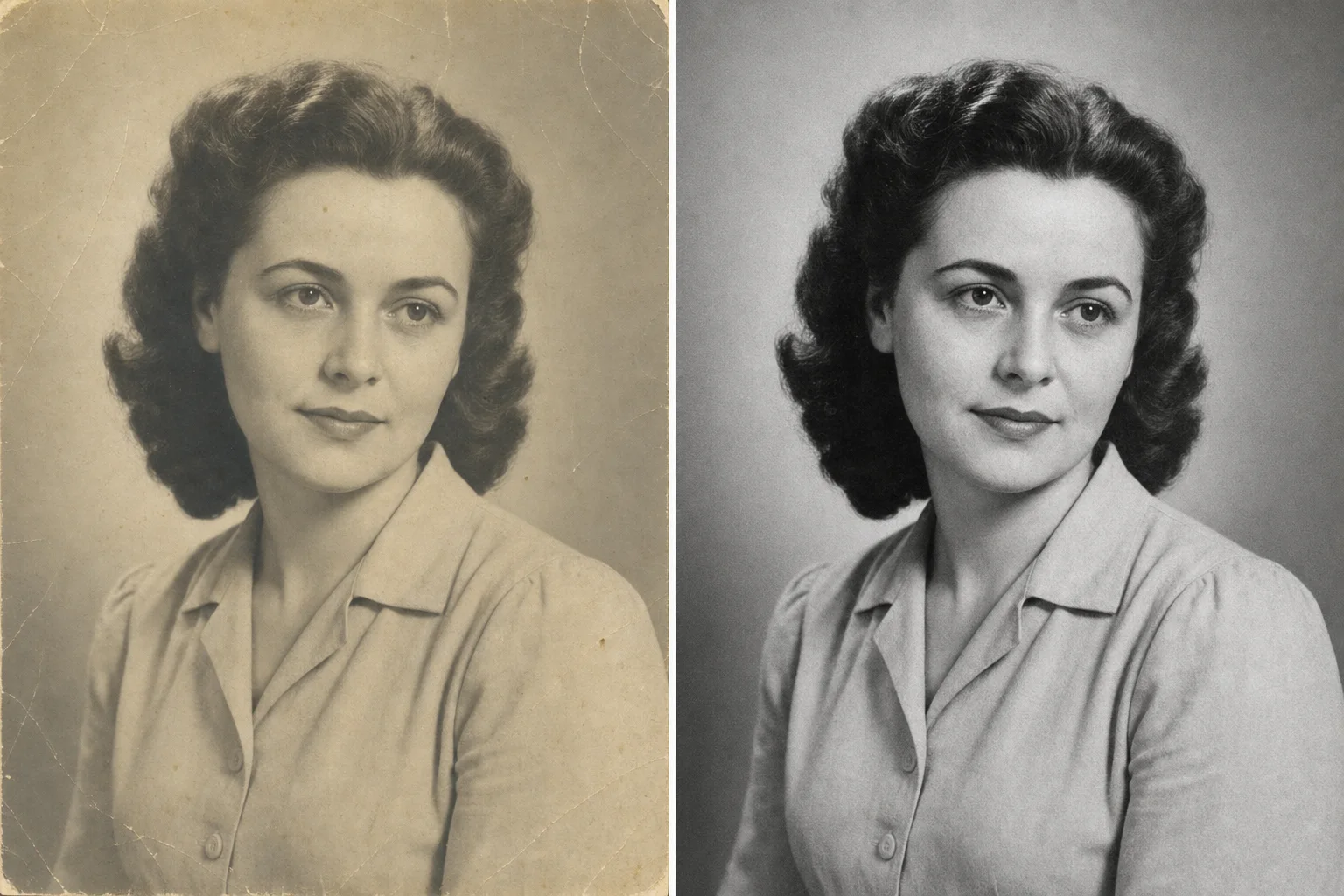
A balanced grayscale portrait with stronger tonal range while the face, blouse, pose, and studio light remain unchanged.
Task: Create a convincing side-by-side old photo restoration demonstration. Subject: a fully fictional 1940s studio portrait of an adult woman with softly waved dark hair, a plain collared blouse, and a calm expression, with no resemblance to any real person. Context: an educational comparison showing how to restore a faded, low-contrast family archive portrait while respecting the original identity. Style: photorealistic archival photography with authentic silver-gelatin grain on the damaged version and conservative high-resolution restoration on the repaired version. Composition: duplicate the same chest-up portrait in one 3:2 landscape frame, damaged original on the left and restored version on the right, equal panels separated by a thin neutral divider, with identical face, pose, crop, and background. Lighting: preserve soft frontal studio light and gentle background falloff. Constraints: make the left panel visibly faded with mild yellowing and surface wear; on the right remove damage and restore tonal range and detail without changing facial geometry, apparent age, hair, clothing, background, or pose; no beauty retouching, invented jewelry, text, labels, logos, or watermark. Output: one 1536×1024 before-and-after composite with complete panels and natural restoration.
- Adjustable parameters
- Fade level, paper tone, grain strength, black point, output size
- Failure correction
- If the face becomes younger, lock wrinkles, jawline, eye spacing, mouth shape, and apparent age before rerunning.
- Review focus
- facial geometry, hair silhouette, blouse collar, grain, and highlight restraint
- Tested model
- GPT Image 2
Scratched Family Group
For repairing scratches across several faces while preserving the original five-person arrangement.
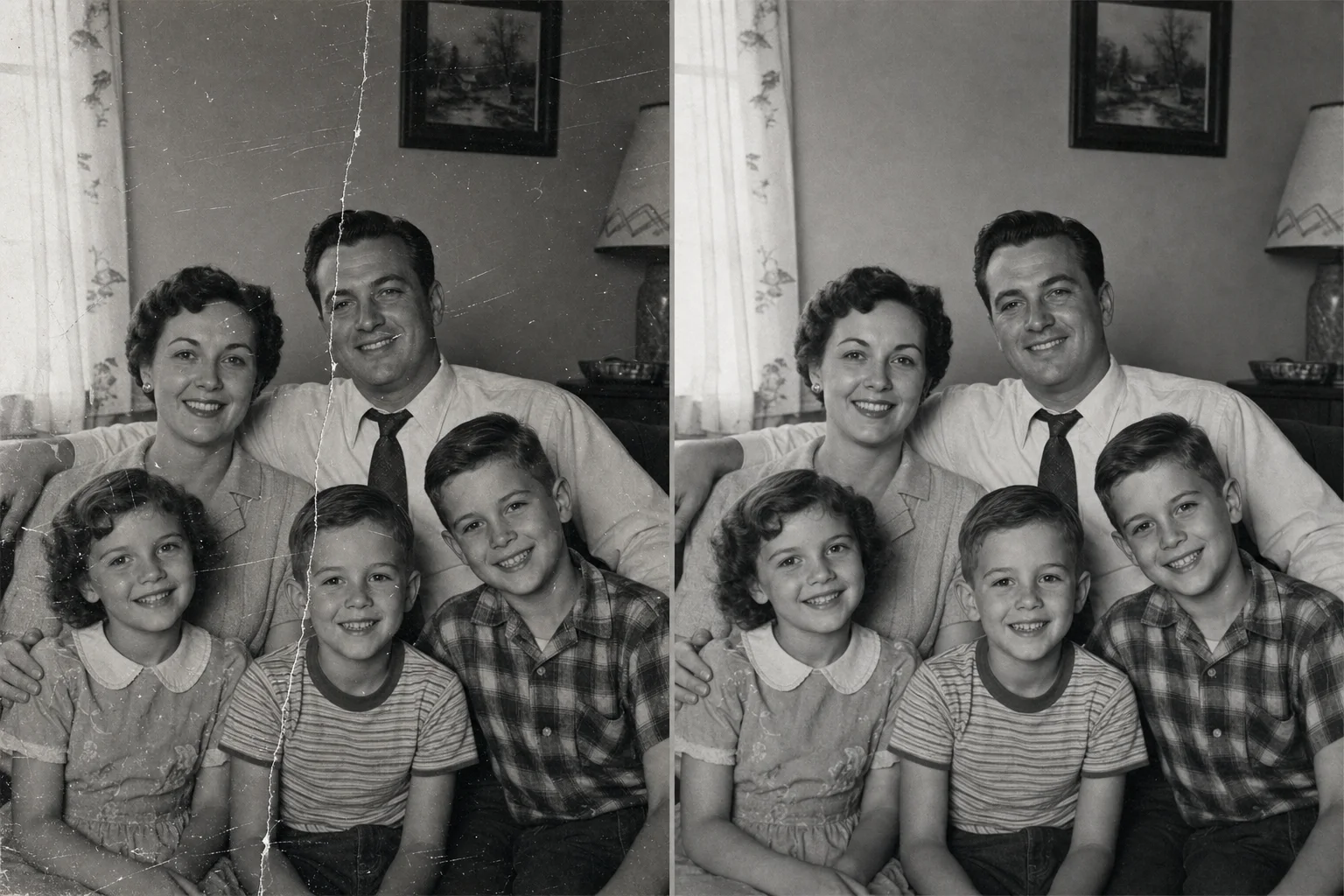
A cleaner family photograph with all five people, expressions, clothing, and living-room details preserved.
Task: Create a side-by-side old photo restoration demonstration for scratch repair. Subject: a fully fictional 1950s family group of two adults and three children posed closely in a modest living room, with no resemblance to any real people. Context: a preservation guide example for repairing a scratched family photograph without rewriting faces or relationships. Style: photorealistic mid-century black-and-white snapshot, authentic film grain, conservative archival restoration rather than glossy modern portraiture. Composition: show the exact same five-person waist-up group twice in one 3:2 landscape frame, scratched original on the left and repaired version on the right, equal panels, thin neutral divider, identical body placement, expressions, clothing, furniture, and crop. Lighting: retain soft window light from camera left with gentle indoor shadows. Constraints: add several visible emulsion scratches, dust marks, and one narrow crease only to the left panel; on the right repair those defects while preserving every face, hand, garment, chair, wall detail, grain pattern, and tonal character; do not add or remove people, alter ages, beautify faces, colorize, invent text, show logos, or add a watermark. Output: one 1536×1024 comparison composite with a clearly damaged left panel and faithfully repaired right panel.
- Adjustable parameters
- Scratch count, dust density, crease width, grain retention, repair strength
- Failure correction
- If a child’s face changes, state the five-person count and lock each person’s face, age, expression, and row position.
- Review focus
- person count, facial identity, hands, wall picture, furniture, and scratch removal
- Tested model
- GPT Image 2
Torn Wedding Photo
For repairing paper tears through simple clothing and backdrop areas without redesigning the couple.
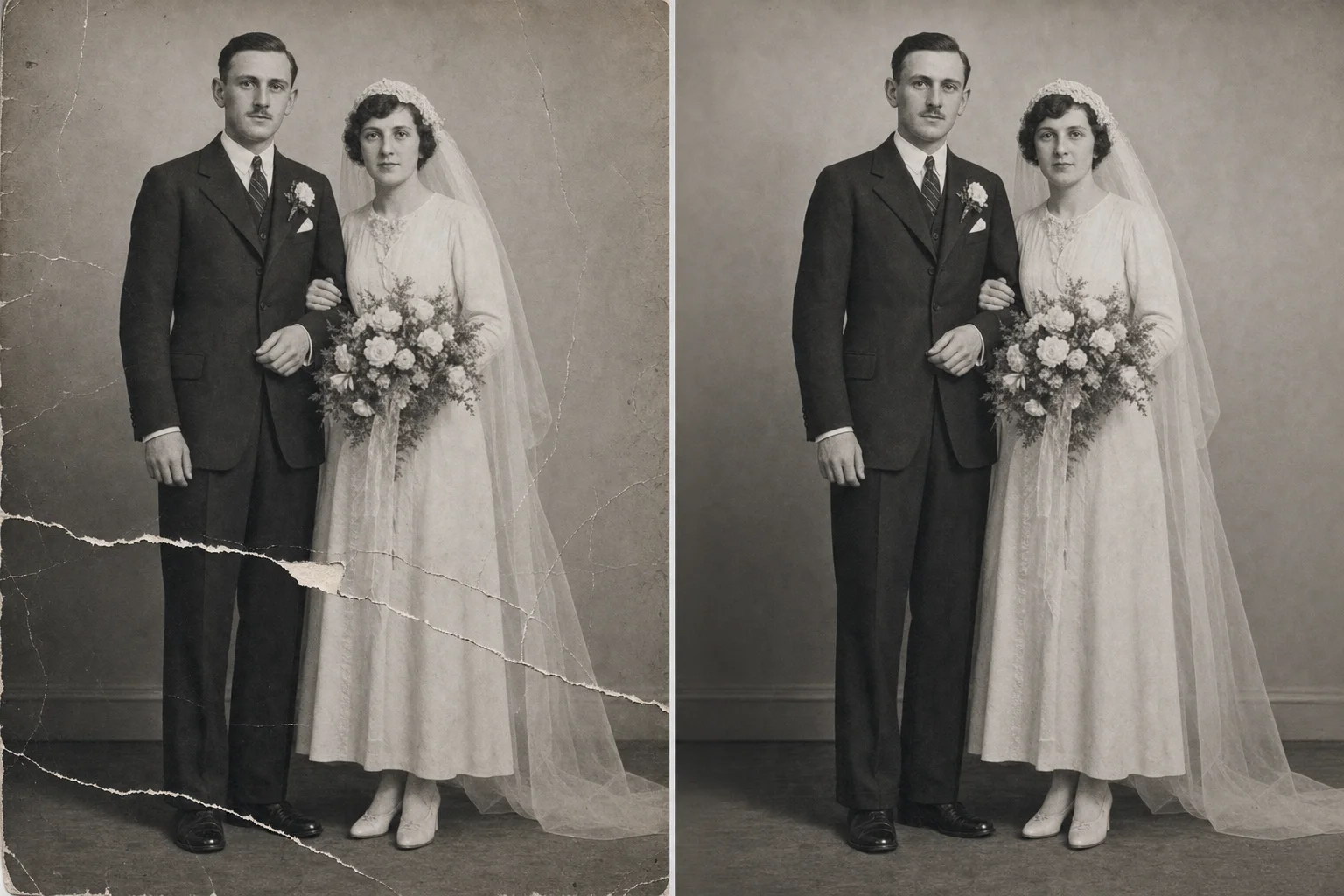
Continuous garment and backdrop edges with the couple, bouquet, pose, and period character left intact.
Task: Create a side-by-side old photo restoration demonstration for a torn wedding photograph. Subject: a fully fictional adult couple in simple late-1930s wedding clothes, standing together against a plain studio backdrop, with no resemblance to real people and no recognizable fashion brand. Context: an educational archive example showing conservative tear repair while preserving the couple’s identity and period details. Style: photorealistic black-and-white studio photography with subtle fiber-paper texture and restrained archival restoration. Composition: repeat the same full-length couple in equal left and right panels inside one 3:2 landscape frame; the left is the torn source and the right is the repaired result, separated by a slim neutral divider, with identical pose, hands, garments, flowers, floor line, and framing. Lighting: preserve broad frontal studio illumination with soft shadow behind the couple. Constraints: place two jagged paper tears and a small missing strip across lower clothing and background on the left only; reconstruct only the interrupted fabric edges and plain backdrop on the right, without changing faces, body proportions, bouquet count, clothing design, posture, or historical character; no colorization, extra guests, decorative borders, labels, text, logos, or watermark. Output: one 1536×1024 faithful before-and-after restoration composite.
- Adjustable parameters
- Tear path, missing-strip width, paper texture, grain, repair mask
- Failure correction
- If clothing is redesigned, restrict the mask to the tear and require surviving seams and fabric edges to continue directly across it.
- Review focus
- faces, hands, bouquet count, garment seams, floor line, and repaired tear boundaries
- Tested model
- GPT Image 2
Black-and-White Child Portrait Colorization
For cautious colorization using a muted, period-plausible palette without changing a child’s face.
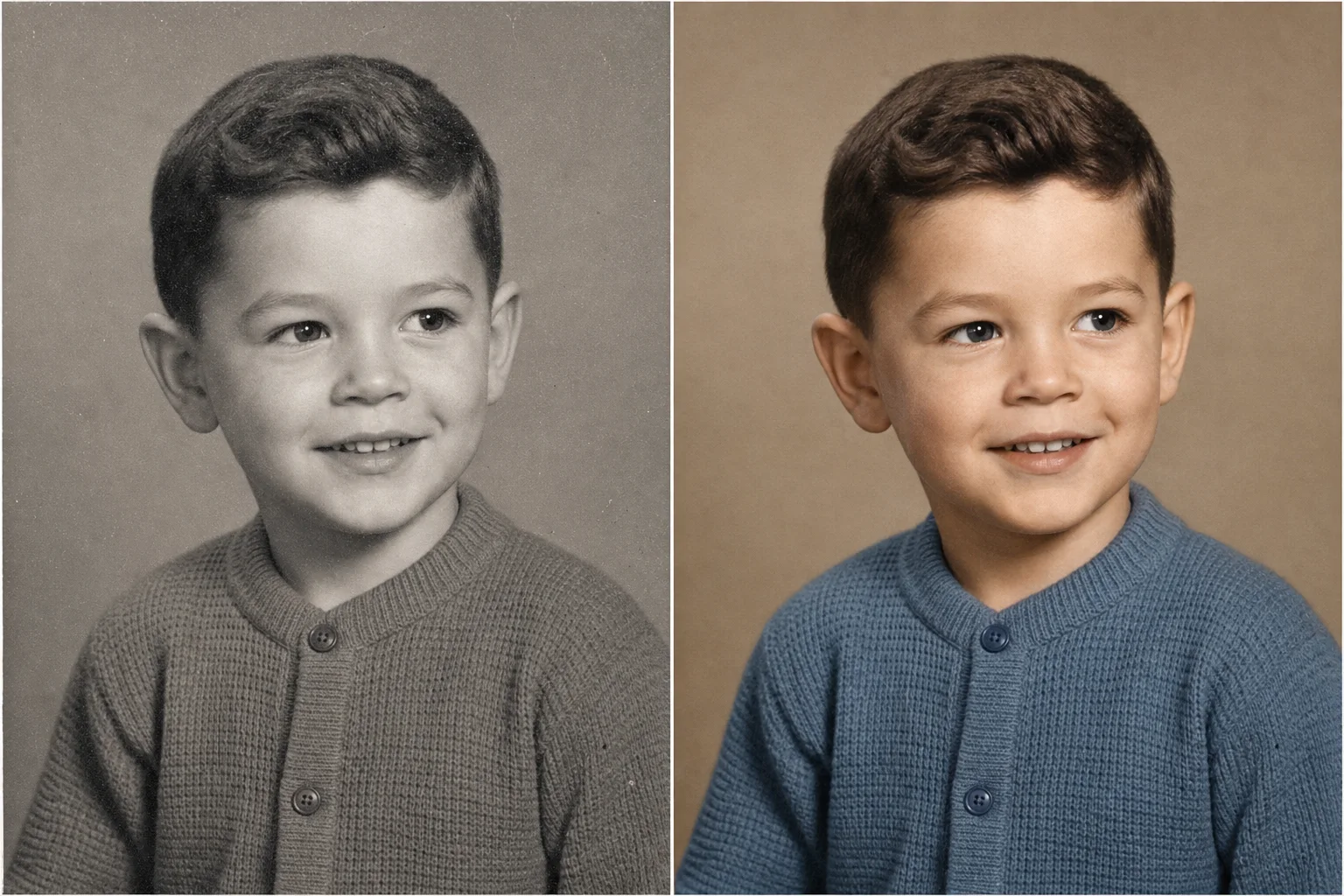
A restrained color interpretation with the same expression, eye direction, cardigan knit, and studio lighting.
Task: Create a side-by-side old photo restoration and colorization demonstration. Subject: a fully fictional early-1960s black-and-white studio portrait of one child wearing a simple knitted cardigan, with no resemblance to any real child. Context: an educational example showing careful colorization that preserves identity, period, and photographic character. Style: photorealistic mid-century portrait photography; authentic monochrome film grain on the source and restrained historically plausible color on the restoration. Composition: duplicate the exact same chest-up portrait in one 3:2 landscape frame, original black-and-white image on the left and restored colorized image on the right, equal panels with a thin neutral divider, identical face, expression, hair, clothing, crop, and background. Lighting: retain soft frontal studio light and the same shadow placement in both panels. Constraints: on the right repair minor dust and fading, use muted natural skin tones, dark brown hair, a dusty-blue cardigan, and a warm neutral backdrop; do not change facial geometry, apparent age, eye direction, knit pattern, or pose; no beauty retouching, modern saturation, invented accessories, text, labels, logos, or watermark. Output: one 1536×1024 faithful black-and-white-to-color before-and-after composite.
- Adjustable parameters
- Evidence-backed palette, saturation, skin tone, garment color, grain
- Failure correction
- If the color feels modern, reduce saturation, name only supported hues, and prohibit cinematic color grading.
- Review focus
- eye direction, facial geometry, skin tone, cardigan knit, and background neutrality
- Tested model
- GPT Image 2
Yellowed Occupational Portrait
For neutralizing paper yellowing while keeping a documentary portrait’s grain and work context.
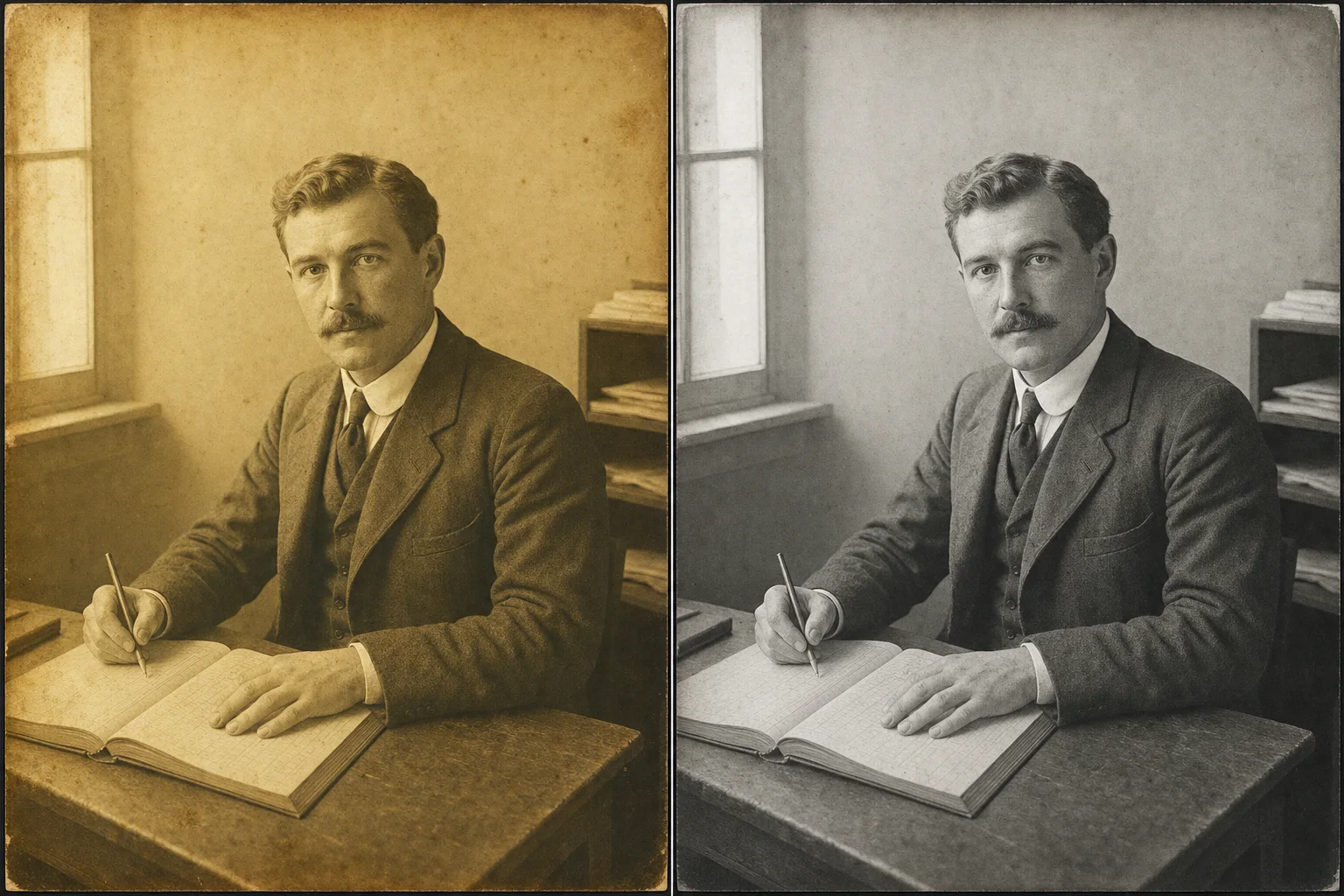
Neutral grayscale, recovered contrast, and reduced foxing without losing the clerk, ledger, desk, or optical softness.
Task: Create a side-by-side old photo restoration demonstration for yellowing and paper discoloration. Subject: a fully fictional 1920s occupational portrait of an adult railway timetable clerk seated at a plain wooden desk with a pencil and unbranded ledger, with no resemblance to any real person. Context: a small archive’s preservation example for correcting severe yellow cast without erasing original photographic texture. Style: photorealistic early-twentieth-century studio-documentary photograph with fine grain, matte fiber-paper surface, and conservative monochrome restoration. Composition: show the exact same seated three-quarter portrait in equal left and right panels within one 3:2 landscape frame, yellowed source on the left and neutral restored result on the right, slim divider, identical face, hands, clothing, desk objects, crop, and background. Lighting: preserve directional window light from upper left and gentle desk shadows. Constraints: make the left panel strongly yellowed with uneven edge darkening and faint foxing; on the right neutralize the cast, recover grayscale contrast, and reduce foxing while retaining fine grain and age-appropriate softness; do not colorize, sharpen into plastic skin, change identity, alter the ledger or pencil, invent readable writing, show logos, or add text or watermark. Output: one 1536×1024 archival before-and-after composite.
- Adjustable parameters
- Yellow cast, foxing level, edge darkening, grayscale contrast, grain
- Failure correction
- If the page becomes too clean, request selective foxing reduction and keep subtle paper texture and edge age.
- Review focus
- face, hands, pencil, ledger geometry, window light, and retained paper character
- Tested model
- GPT Image 2
Water-Stained Picnic Snapshot
For removing tide marks and pale emulsion stains from a candid color snapshot.
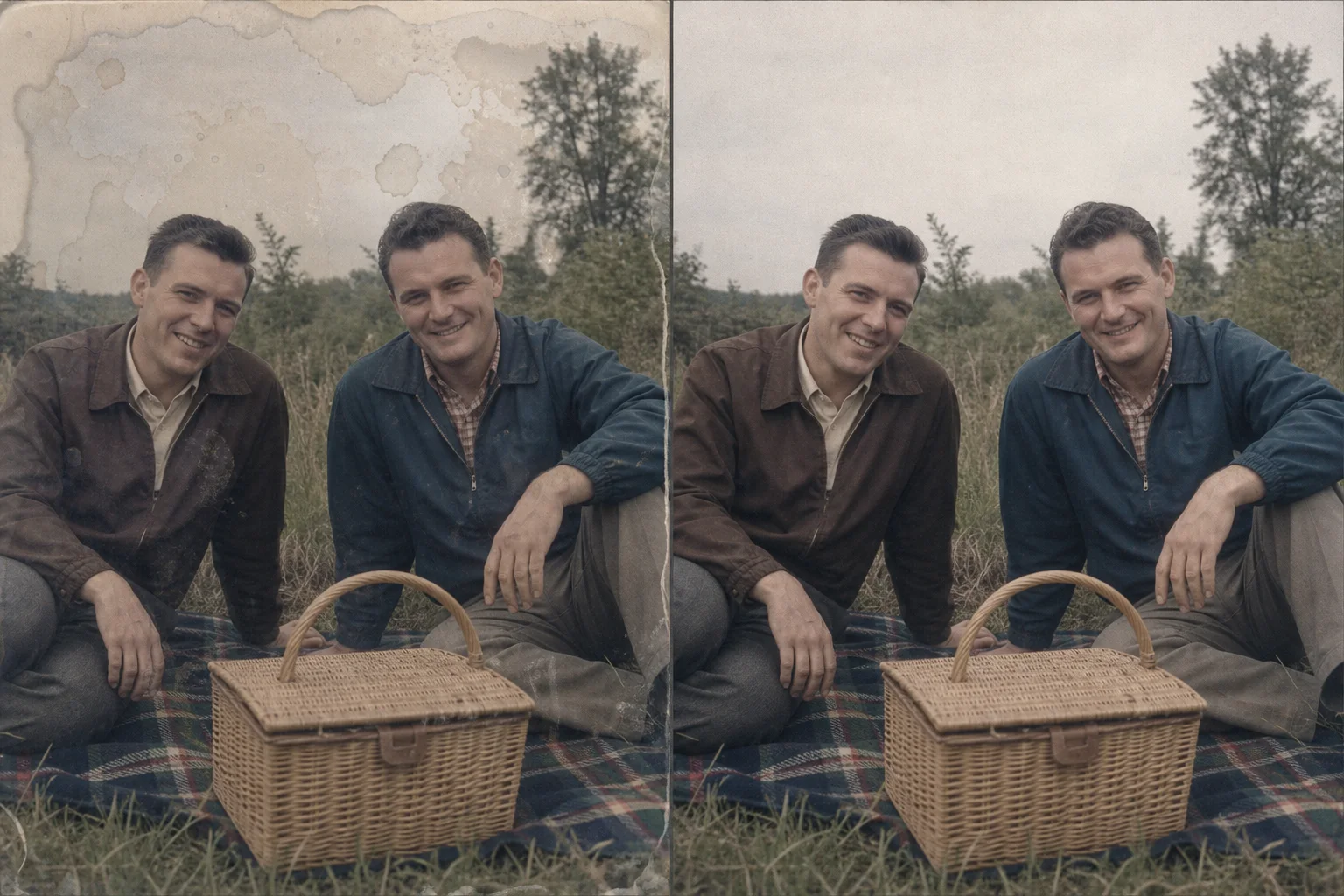
Removed tide marks and blotches while the two friends, basket, blanket, and muted outdoor palette stay consistent.
Task: Create a side-by-side old photo restoration demonstration for water-stain damage. Subject: a fully fictional late-1950s outdoor picnic snapshot of two adult friends seated on a blanket beside a simple wicker basket, with no resemblance to real people. Context: an educational preservation example for repairing tide marks and emulsion stains while keeping the original candid moment intact. Style: photorealistic vintage color snapshot with gentle film grain, slightly muted period color, and natural conservative restoration. Composition: duplicate the exact same waist-up picnic scene in equal left and right panels in one 3:2 landscape frame, damaged source on the left and repaired result on the right, thin neutral divider, identical faces, poses, hands, clothing, basket, grass, and crop. Lighting: preserve soft overcast daylight with low contrast and no dramatic relighting. Constraints: add irregular translucent water tide marks, a few pale blotches, and minor edge waviness only to the left panel; on the right remove those defects and restore local color and contrast without changing expressions, garment colors, object placement, background vegetation, or film character; no extra people, food brands, readable text, labels, logos, heavy saturation, or watermark. Output: one 1536×1024 faithful before-and-after water-damage restoration composite.
- Adjustable parameters
- Tide-mark shape, stain opacity, edge waviness, color balance, grain
- Failure correction
- If vegetation changes, lock the horizon, tree silhouettes, basket, blanket, hands, and every surviving edge before repair.
- Review focus
- faces, hands, basket weave, blanket pattern, vegetation, and stain boundaries
- Tested model
- GPT Image 2
Creased School Group Photo
For repairing crossing fold lines without adding, removing, or rearranging people in a group.
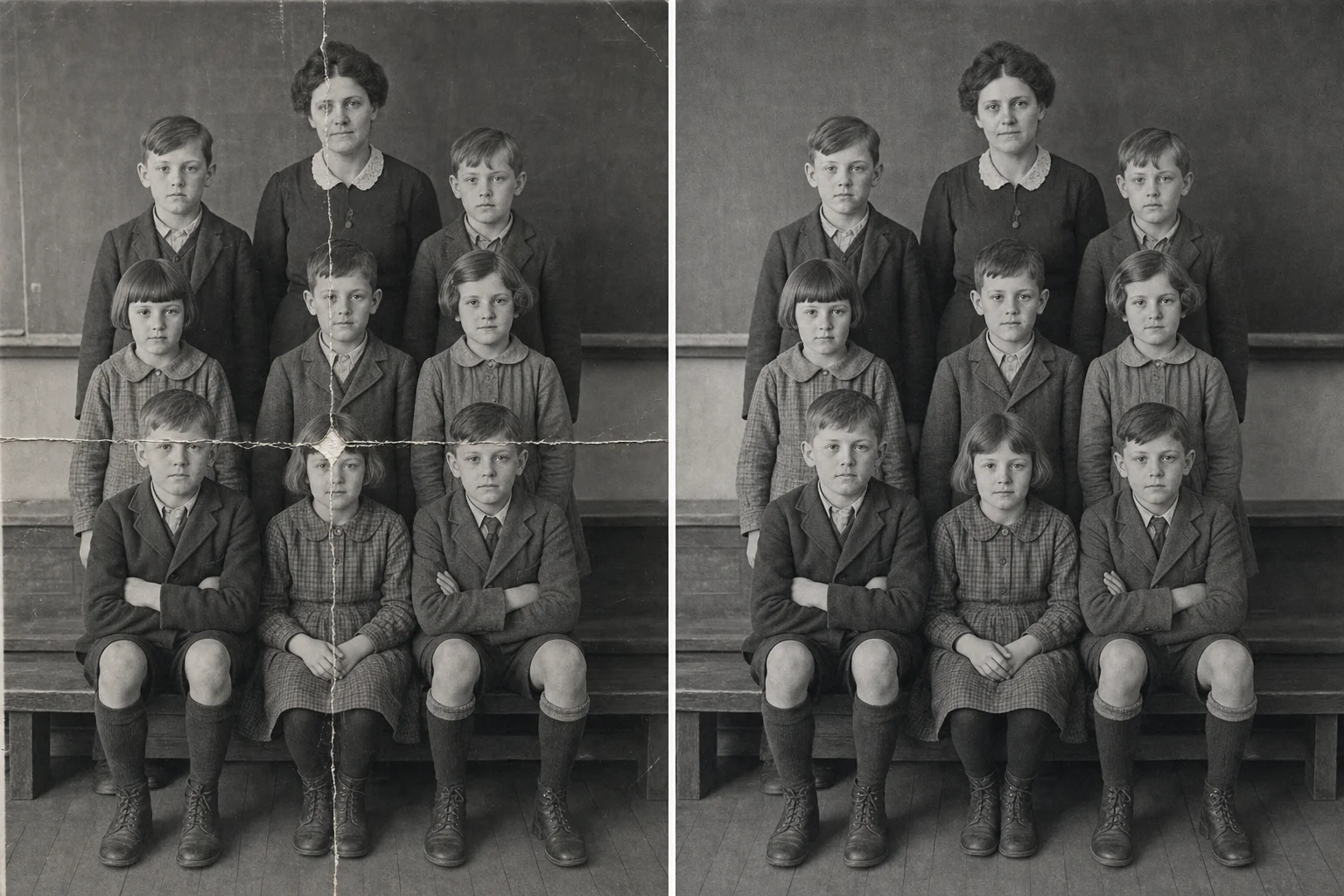
Two fold lines repaired while the teacher, eight children, rows, benches, and chalkboard remain the same.
Task: Create a side-by-side old photo restoration demonstration for a creased school group photograph. Subject: a fully fictional 1930s classroom group of one adult teacher and eight schoolchildren in plain period-appropriate clothes, with no resemblance to any real people and no school insignia. Context: an educational archive example for repairing fold lines while preserving every person and the original group arrangement. Style: photorealistic black-and-white school photography with authentic fine grain, modest tonal range, and conservative restoration. Composition: show the same three-row group twice in one 3:2 landscape frame, creased source on the left and repaired version on the right, equal panels separated by a thin neutral divider, identical person count, faces, poses, clothing, chalkboard, benches, and crop. Lighting: preserve broad frontal daylight with soft, even facial illumination. Constraints: place one vertical and one horizontal fold crease across the left panel with small emulsion loss at their intersection; on the right repair only those defects, preserving all nine people, facial structure, apparent ages, row positions, clothing, room geometry, grain, and tonal character; no added or missing people, invented writing, text, labels, logos, colorization, or watermark. Output: one 1536×1024 faithful school-photo before-and-after composite.
- Adjustable parameters
- Fold position, emulsion loss, group count, grain, tonal range
- Failure correction
- If the group count changes, explicitly require one teacher plus eight children in fixed rows and reject any substituted face.
- Review focus
- nine-person count, row order, faces, clothing, bench edges, and crease intersection
- Tested model
- GPT Image 2
Low-Resolution Face Enhancement
For enlarging a small portrait conservatively without replacing the subject with a smoother face.
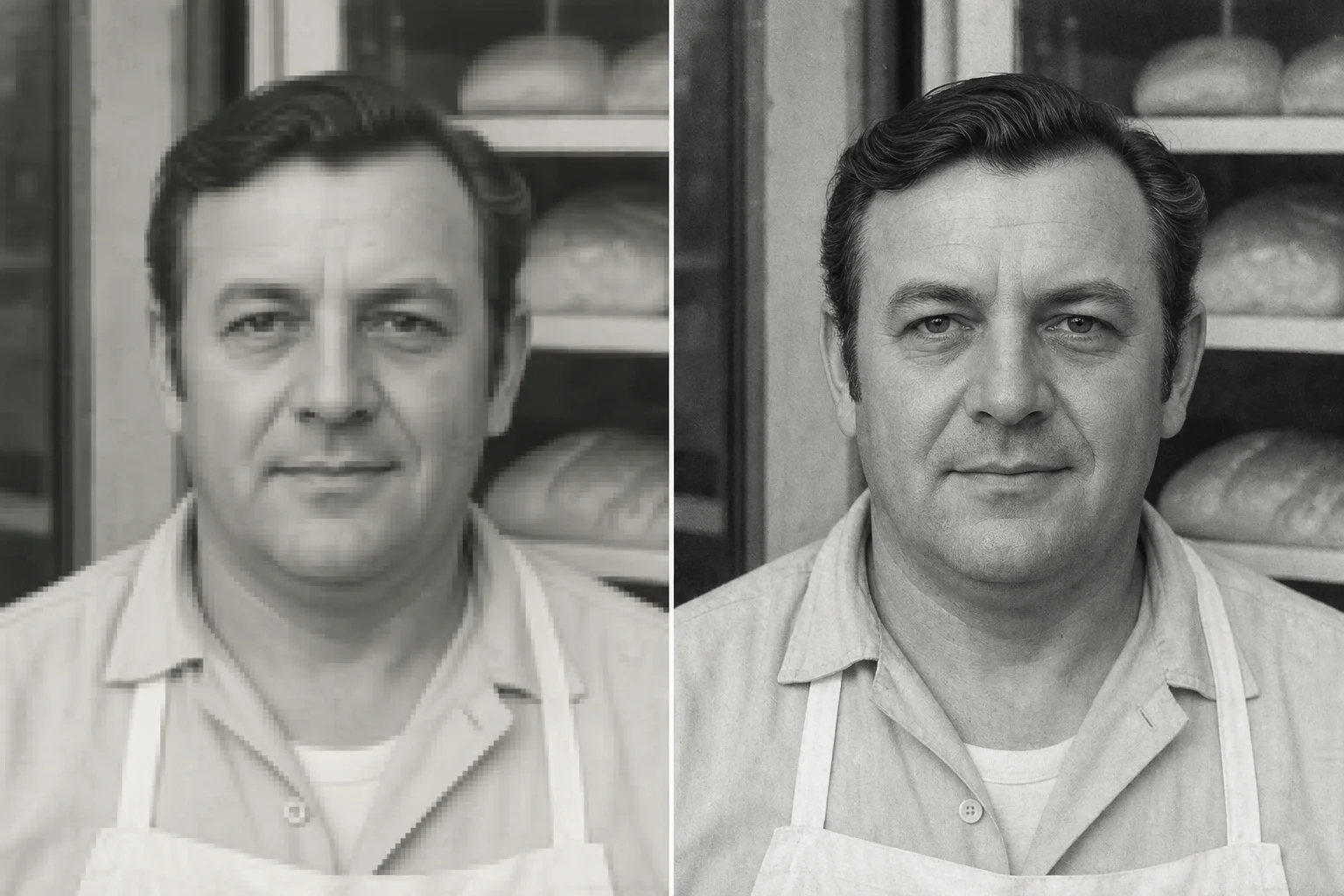
Improved clarity and tonal separation while pores, wrinkles, face geometry, apron, and soft shop light remain natural.
Task: Create a side-by-side old photo restoration demonstration for low-resolution facial enhancement. Subject: a fully fictional mid-1960s head-and-shoulders portrait of an adult neighborhood baker in a plain work shirt and apron, with no resemblance to any real person and no business branding. Context: an educational example showing cautious detail recovery from a small scanned print without inventing a different face. Style: photorealistic monochrome portrait with authentic medium-format grain, natural skin texture, and conservative high-resolution restoration. Composition: duplicate the exact same centered portrait in equal left and right panels inside one 3:2 landscape frame, visibly low-resolution source on the left and enhanced result on the right, separated by a thin neutral divider, with identical face, expression, hair, clothing, crop, and background. Lighting: retain simple frontal shop-window light and the same soft cheek shadows. Constraints: make the left panel pixelated and slightly blurred but still recognizable; on the right improve edge clarity, tonal separation, eyes, hair, and fabric texture only where supported, while preserving pores, wrinkles, facial geometry, apparent age, and grain; no face replacement, beauty retouching, invented teeth, readable text, logos, labels, colorization, or watermark. Output: one 1536×1024 before-and-after enhancement composite.
- Adjustable parameters
- Source scale, blur level, edge clarity, texture recovery, output size
- Failure correction
- If the model invents teeth or smooths skin, prohibit face replacement and lock mouth shape, wrinkles, pores, and apparent age.
- Review focus
- eye spacing, mouth shape, wrinkles, hairline, apron edges, and retained grain
- Tested model
- GPT Image 2
Overexposed Coastal Photo
For recovering plausible highlight separation while leaving truly blank areas soft.
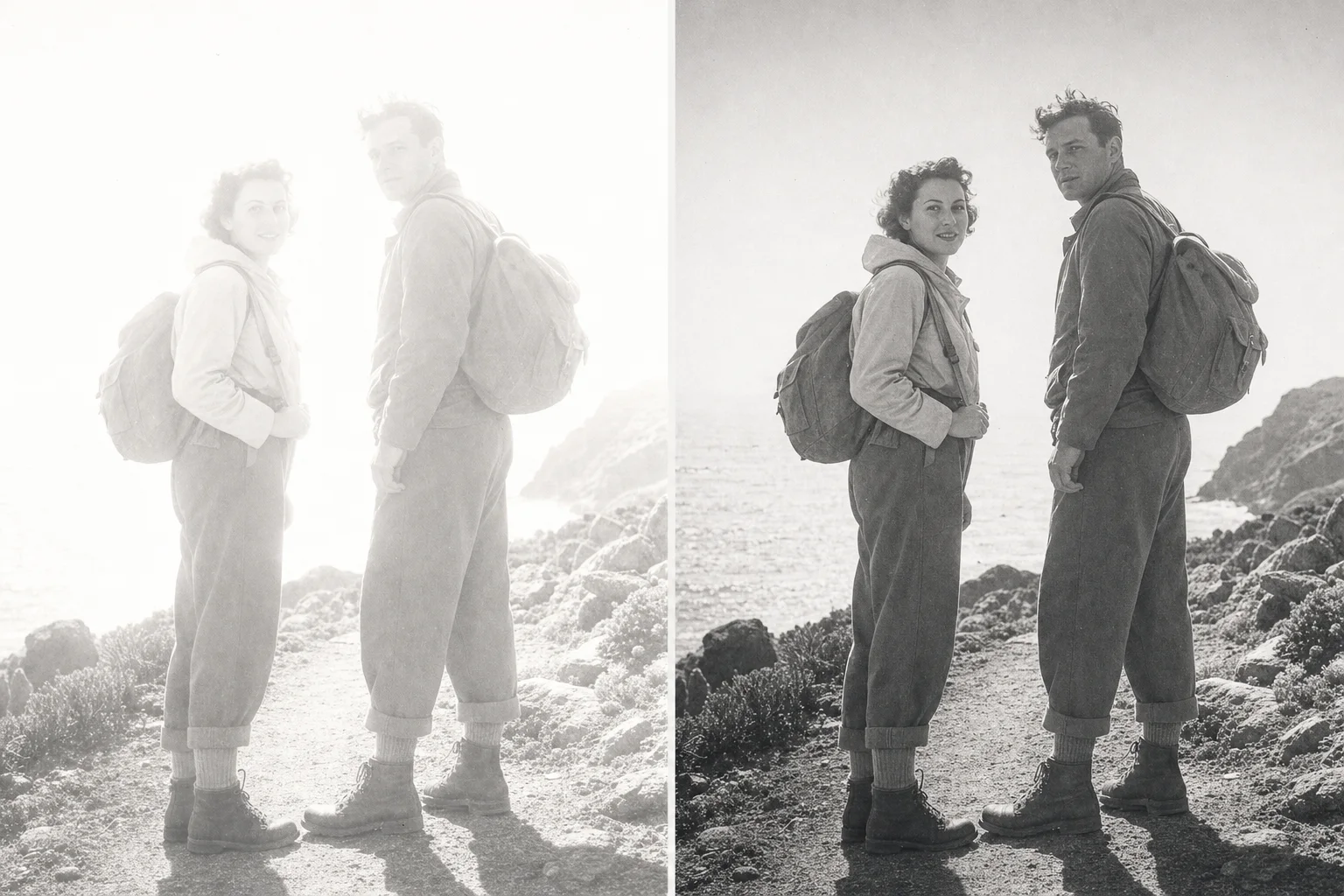
Recovered jackets, rocks, and horizon while the high-key haze and unsupported blank highlights remain believable.
Task: Create a side-by-side old photo restoration demonstration for an overexposed outdoor photograph. Subject: a fully fictional late-1940s snapshot of two adult hikers standing beside a rocky coastal path, wearing plain period-appropriate jackets and carrying an unbranded canvas pack, with no resemblance to real people. Context: an educational example showing highlight and contrast recovery without fabricating details lost to severe exposure. Style: photorealistic black-and-white outdoor snapshot with fine film grain and restrained archival restoration. Composition: show the exact same full-body pair twice in one 3:2 landscape frame, overexposed source on the left and corrected result on the right, equal panels with a slim neutral divider, identical faces, poses, clothing, pack, rocks, horizon, and crop. Lighting: preserve bright hazy daylight from behind the subjects, keeping a believable high-key atmosphere. Constraints: wash out sky and upper clothing highlights on the left while retaining faint structure; on the right recover only plausible tonal separation, keep truly blank highlights soft, and preserve identity, garment edges, landscape geometry, grain, and period character; no invented clouds, changed faces, extra people, dramatic relighting, colorization, text, labels, logos, or watermark. Output: one 1536×1024 faithful exposure-recovery before-and-after composite.
- Adjustable parameters
- Highlight clipping, contrast, haze, grain, black point
- Failure correction
- If clouds appear from nowhere, keep the sky softly blank and recover only structures already faintly visible in the source.
- Review focus
- faces, jacket edges, pack, rocks, horizon, and non-invented sky
- Tested model
- GPT Image 2
Underexposed Kitchen Gathering
For lifting blocked shadows while retaining the believable mood of a dim room.
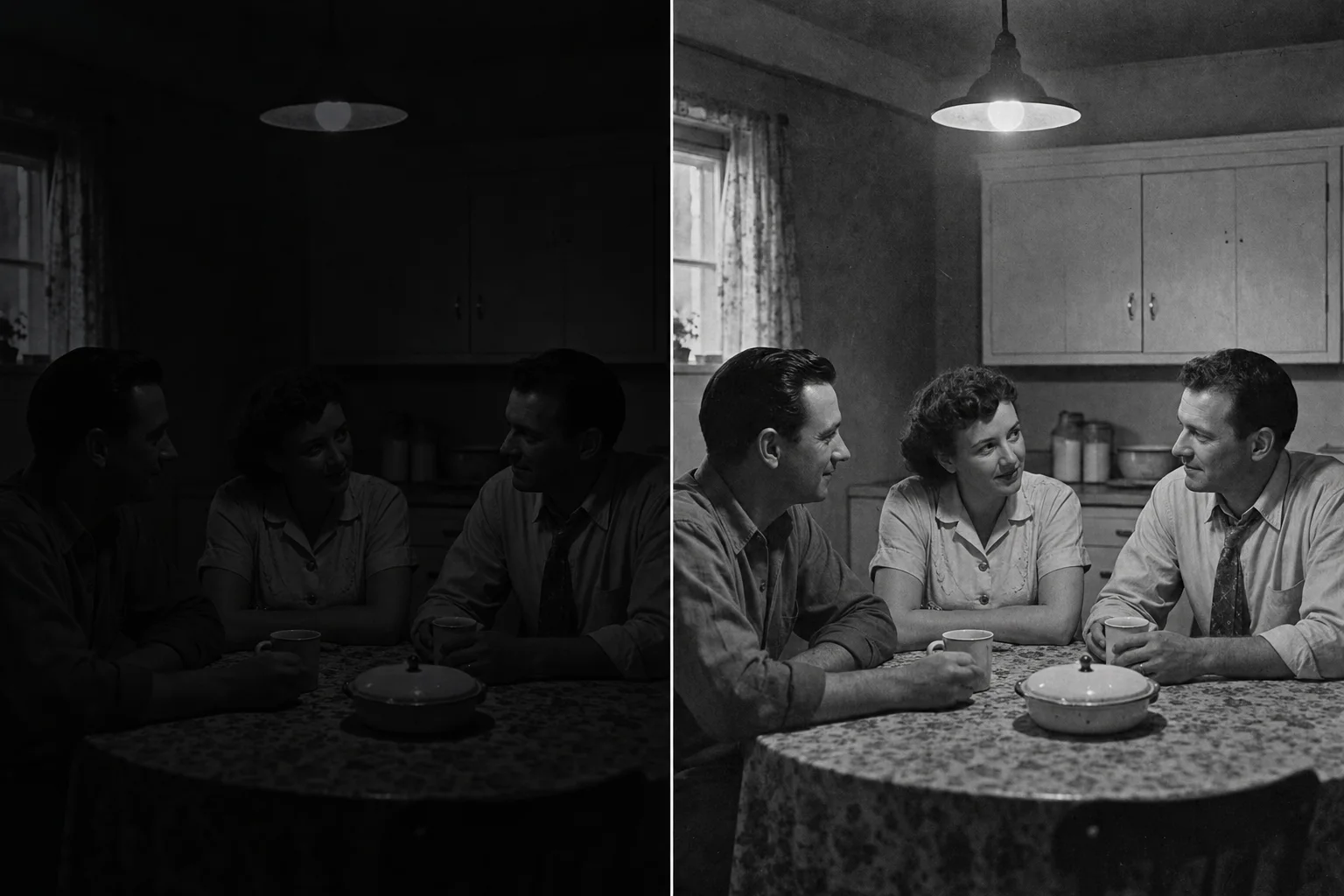
Readable faces and clothing in a room that still feels dim, with the same three people, table objects, lamp, and grain.
Task: Create a side-by-side old photo restoration demonstration for an underexposed indoor photograph. Subject: a fully fictional early-1950s kitchen gathering of three adults around a small table with plain cups and a covered dish, with no resemblance to real people and no branded objects. Context: an educational example showing shadow recovery while preserving the mood and evidence limits of a dark source frame. Style: photorealistic black-and-white candid photography with natural grain, soft period optics, and conservative tonal restoration. Composition: repeat the exact same three-person waist-up scene in equal left and right panels within one 3:2 landscape frame, dark source on the left and corrected result on the right, thin neutral divider, identical faces, poses, hands, table objects, cabinetry, and crop. Lighting: retain one dim ceiling lamp and a weak window fill; the repaired image should remain believable as a low-light room. Constraints: make the left panel heavily underexposed with blocked shadows but faint silhouettes; on the right lift midtones and recover supported facial and clothing detail without changing expressions, person count, hand positions, furniture, lamp, or grain; do not create daylight, smooth skin, invent objects, add text, labels, logos, colorization, or watermark. Output: one 1536×1024 conservative shadow-recovery before-and-after composite.
- Adjustable parameters
- Shadow lift, midtone contrast, grain, lamp intensity, black point
- Failure correction
- If the room turns into daylight, cap the shadow lift and require the original ceiling-lamp direction and dark ambient mood.
- Review focus
- three-person count, faces, hands, cups, covered dish, cabinetry, and lamp direction
- Tested model
- GPT Image 2
1970s Color-Cast Correction
For correcting faded dyes and a strong color cast without modernizing a period living room.
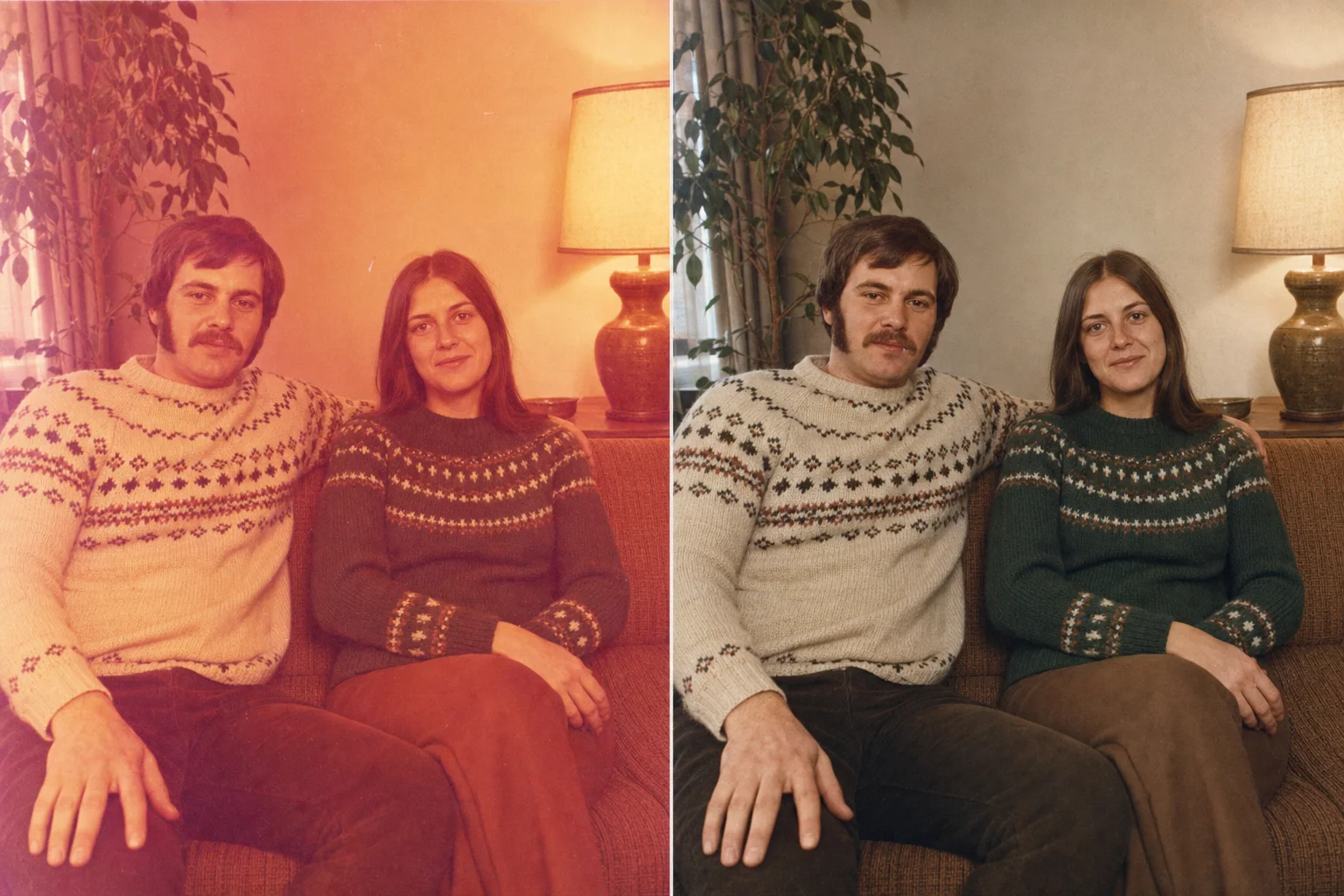
Neutralized skin and walls with restrained period color while the siblings, knit patterns, sofa, plant, and lamp stay fixed.
Task: Create a side-by-side old photo restoration demonstration for a 1970s color cast. Subject: a fully fictional 1974 living-room snapshot of two adult siblings seated on a low sofa, wearing plain patterned knitwear, with a houseplant and an unbranded ceramic lamp behind them, and no resemblance to real people. Context: an educational example showing dye-fade and color-balance correction without modernizing the scene. Style: photorealistic 1970s consumer color film with visible grain, modest sharpness, and period-accurate muted palette. Composition: duplicate the exact same waist-up scene in equal left and right panels inside one 3:2 landscape frame, color-shifted source on the left and corrected result on the right, thin neutral divider, identical faces, poses, clothing patterns, furniture, plant, lamp, and crop. Lighting: preserve warm household lamp light mixed with weak window light. Constraints: give the left panel a strong magenta-orange cast, faded shadows, and uneven dye density; on the right neutralize skin and wall tones, restore restrained greens and browns, and rebalance contrast while preserving identity, apparent ages, knit patterns, room geometry, grain, and 1970s character; no trendy recoloring, added decor, text, labels, logos, or watermark. Output: one 1536×1024 color-correction before-and-after composite.
- Adjustable parameters
- Cast hue, dye fade, skin balance, shadow density, saturation
- Failure correction
- If the result looks contemporary, restore muted greens and browns, keep visible grain, and prohibit teal-orange or high-gloss grading.
- Review focus
- faces, apparent ages, knit patterns, sofa, plant, lamp, and period palette
- Tested model
- GPT Image 2
Dust and Mold Cleanup
For removing scattered specks and mildew marks while retaining paper and film texture.
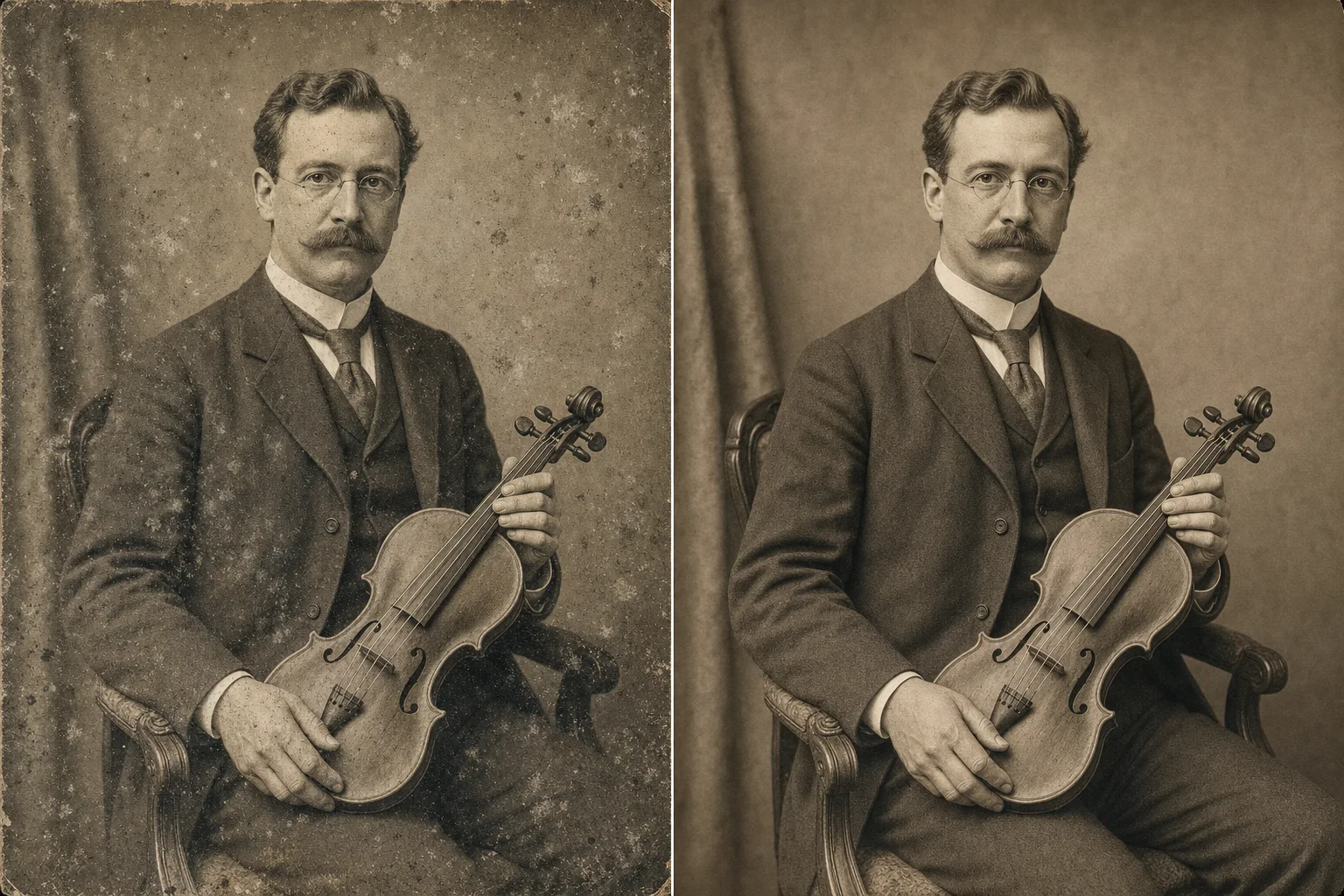
Surface contamination removed while the teacher, hands, violin construction, sepia tone, grain, and paper character remain natural.
Task: Create a side-by-side old photo restoration demonstration for dust and mold cleanup. Subject: a fully fictional 1910s studio portrait of an adult violin teacher seated with a plain unbranded violin across the lap, with no resemblance to any real person. Context: an educational archive example showing selective cleanup of surface contamination without erasing authentic grain or instrument detail. Style: photorealistic sepia-toned cabinet-card photography with fine emulsion grain, matte paper texture, and conservative restoration. Composition: duplicate the exact same three-quarter seated portrait in equal left and right panels within one 3:2 landscape frame, contaminated source on the left and cleaned result on the right, thin neutral divider, identical face, hands, clothing, violin, chair, crop, and backdrop. Lighting: preserve soft overhead-front studio light with gentle shadows under the hands and instrument. Constraints: scatter dust, pale mold blooms, dark mildew specks, and edge grime across the left panel without obscuring the whole subject; on the right remove contamination selectively while retaining pores, wrinkles, violin strings, wood grain, fabric texture, photographic grain, and paper character; no face change, instrument redesign, heavy sharpening, colorization, readable text, labels, logos, or watermark. Output: one 1536×1024 dust-and-mold before-and-after restoration composite.
- Adjustable parameters
- Dust density, mold color, cleanup strength, sepia tone, grain
- Failure correction
- If violin strings disappear, reduce cleanup strength and lock every surviving string, edge, hand, and wood-grain detail.
- Review focus
- face, hands, violin strings, wood grain, fabric texture, and selective speck removal
- Tested model
- GPT Image 2
Missing Corner Reconstruction
For filling a missing background corner while keeping people and readable evidence outside the repair mask.
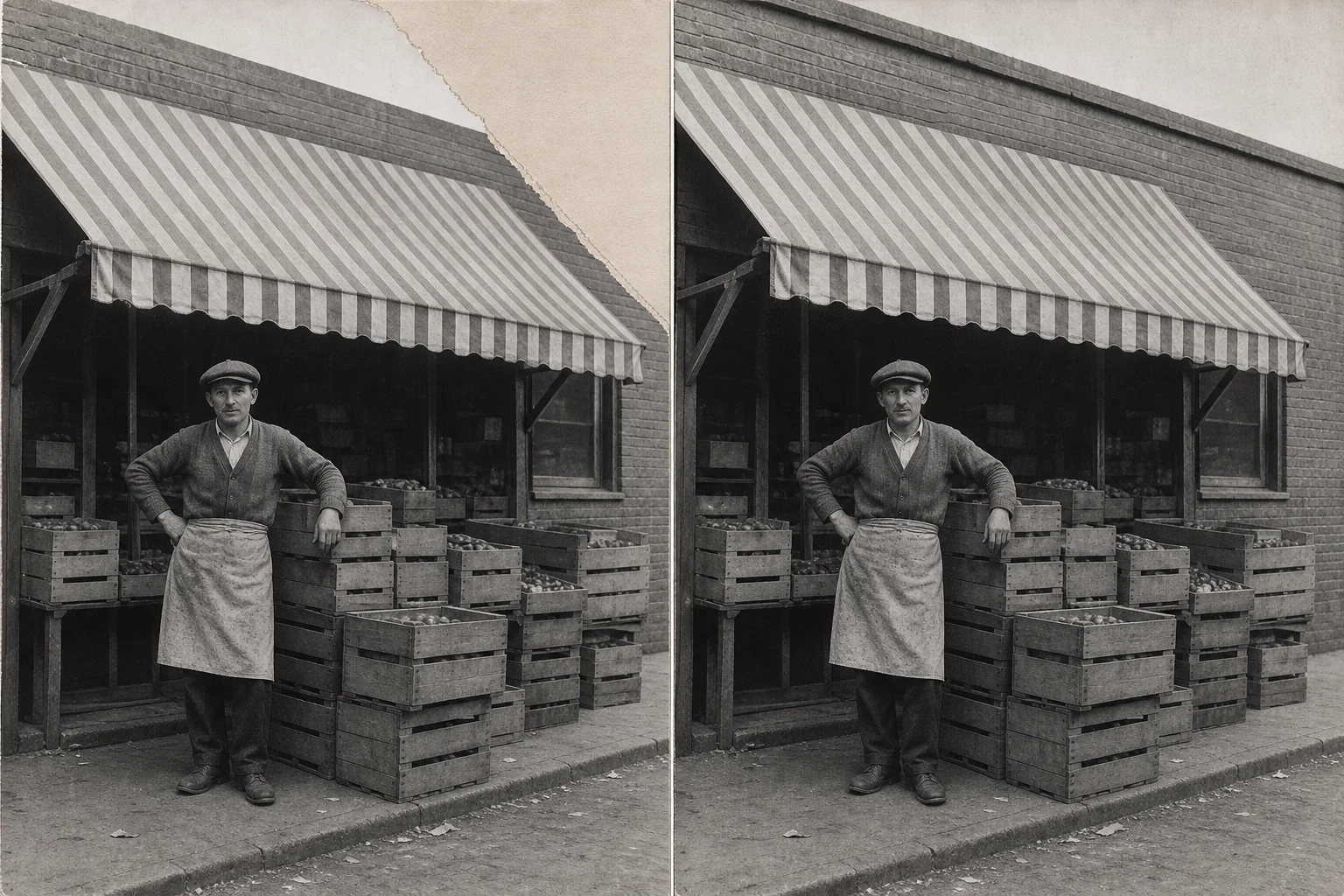
A repaired awning, brick wall, and sky corner with the vendor, crates, street, and all surviving evidence untouched.
Task: Create a side-by-side old photo restoration demonstration for a missing paper corner. Subject: a fully fictional early-1940s neighborhood market-stall scene with one adult vendor beside stacked plain wooden crates under a striped canvas awning, with no resemblance to a real person and no branded signs. Context: an educational example that separates conservative repair from speculative reconstruction by limiting the missing area to repeated background structure. Style: photorealistic black-and-white street photography with fine grain, modest contrast, and natural archival restoration. Composition: show the exact same scene twice in equal left and right panels inside one 3:2 landscape frame, source on the left and repaired result on the right, thin neutral divider, identical vendor, pose, clothing, crates, stall, awning, street, and crop. Lighting: preserve bright overcast daylight with soft shadows. Constraints: remove a large triangular upper-right paper corner on the left containing only part of the striped awning, brick wall, and blank sky; on the right reconstruct only those repeated lines and textures from surviving evidence, while leaving the vendor, crates, ground, all surviving edges, grain, and tonal character unchanged; no invented people, produce, signs, words, logos, colorization, labels, or watermark. Output: one 1536×1024 clearly bounded before-and-after corner-repair composite.
- Adjustable parameters
- Corner size, repair mask, awning stripe spacing, brick repeat, grain
- Failure correction
- If new objects appear, shrink the mask to the background corner and prohibit faces, signs, produce, or geometry not continued from surviving edges.
- Review focus
- vendor identity, crate count, awning stripes, brick pattern, mask boundary, and non-invention
- Tested model
- GPT Image 2
Faded Historic Street Scene
For restoring tonal separation across architecture, road, sky, and figures without inventing storefront detail.
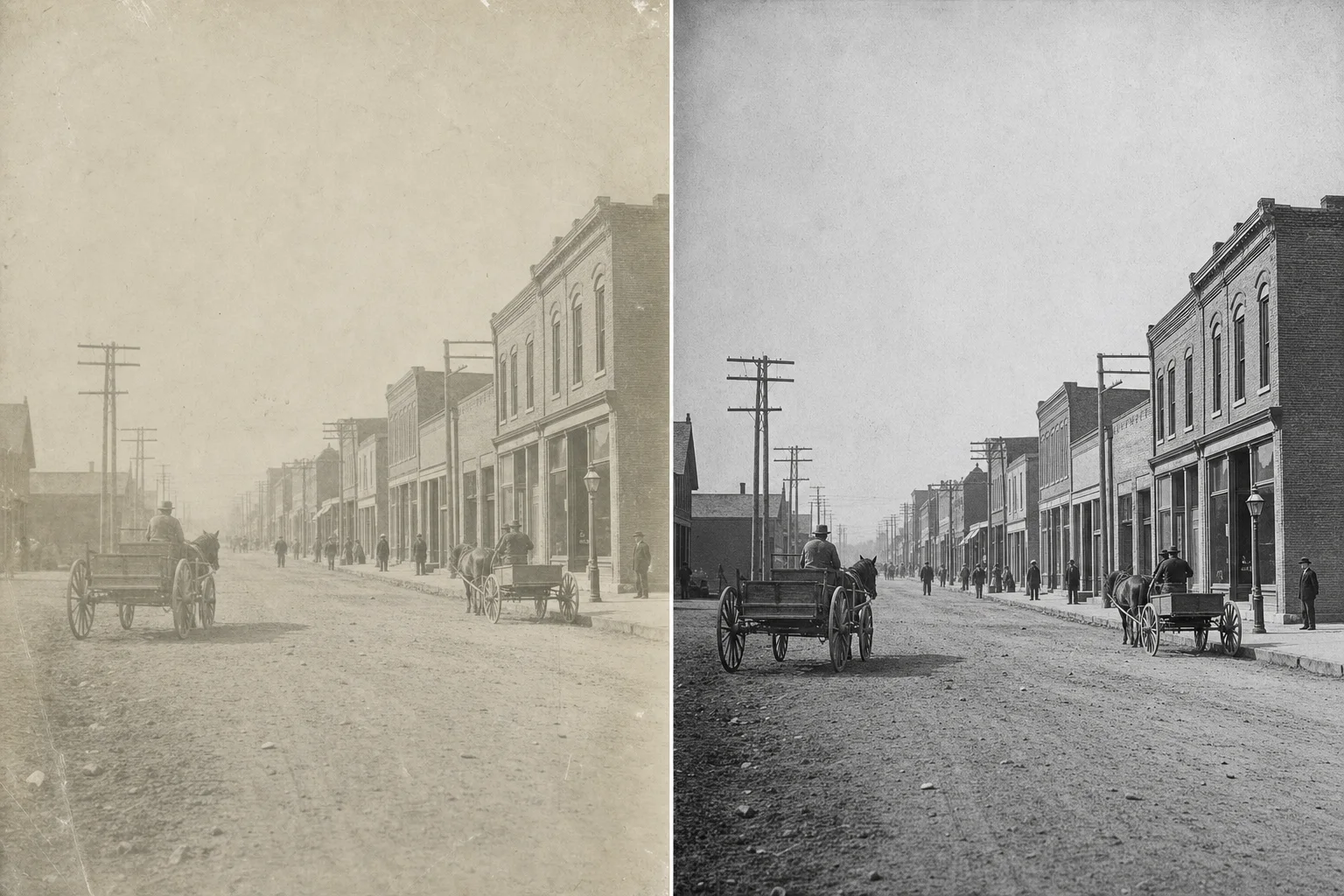
Recovered architecture and road tones while the carts, pedestrians, perspective, haze, and unlabeled storefronts remain documentary.
Task: Create a side-by-side old photo restoration demonstration for a severely faded street photograph. Subject: a fully fictional 1910s small-town main street with brick shopfronts, two horse-drawn carts, several distant pedestrians, utility poles, and no readable business signs or recognizable location. Context: an educational local-history example for recovering tone and surface detail without turning a documentary scene into modern concept art. Style: photorealistic early-twentieth-century black-and-white street photography with fine grain, slight lens softness, matte paper texture, and restrained archival restoration. Composition: duplicate the exact same wide street view in equal left and right panels within one 3:2 landscape frame, faded source on the left and restored result on the right, thin neutral divider, identical buildings, carts, pedestrians, poles, road, sky, perspective, and crop. Lighting: preserve hazy midday light with soft short shadows. Constraints: make the left panel pale, low-contrast, yellow-gray, and lightly scratched; on the right recover grayscale separation, architectural edges, road texture, and supported distant detail while retaining haze, grain, optical softness, person count, cart positions, and every building line; do not invent signs, vehicles, people, modern objects, dramatic clouds, color, labels, logos, or watermark. Output: one 1536×1024 historic-street before-and-after restoration composite.
- Adjustable parameters
- Fade strength, contrast, haze, scratch level, architectural clarity
- Failure correction
- If shop signs appear, prohibit readable text and require blank or indistinct signboards exactly where surviving shapes exist.
- Review focus
- building lines, cart count, pedestrian count, utility poles, road texture, and absence of invented signs
- Tested model
- GPT Image 2
Archival Landscape Restoration
For repairing a damaged landscape print while preserving natural geology, reflection, haze, and period optics.
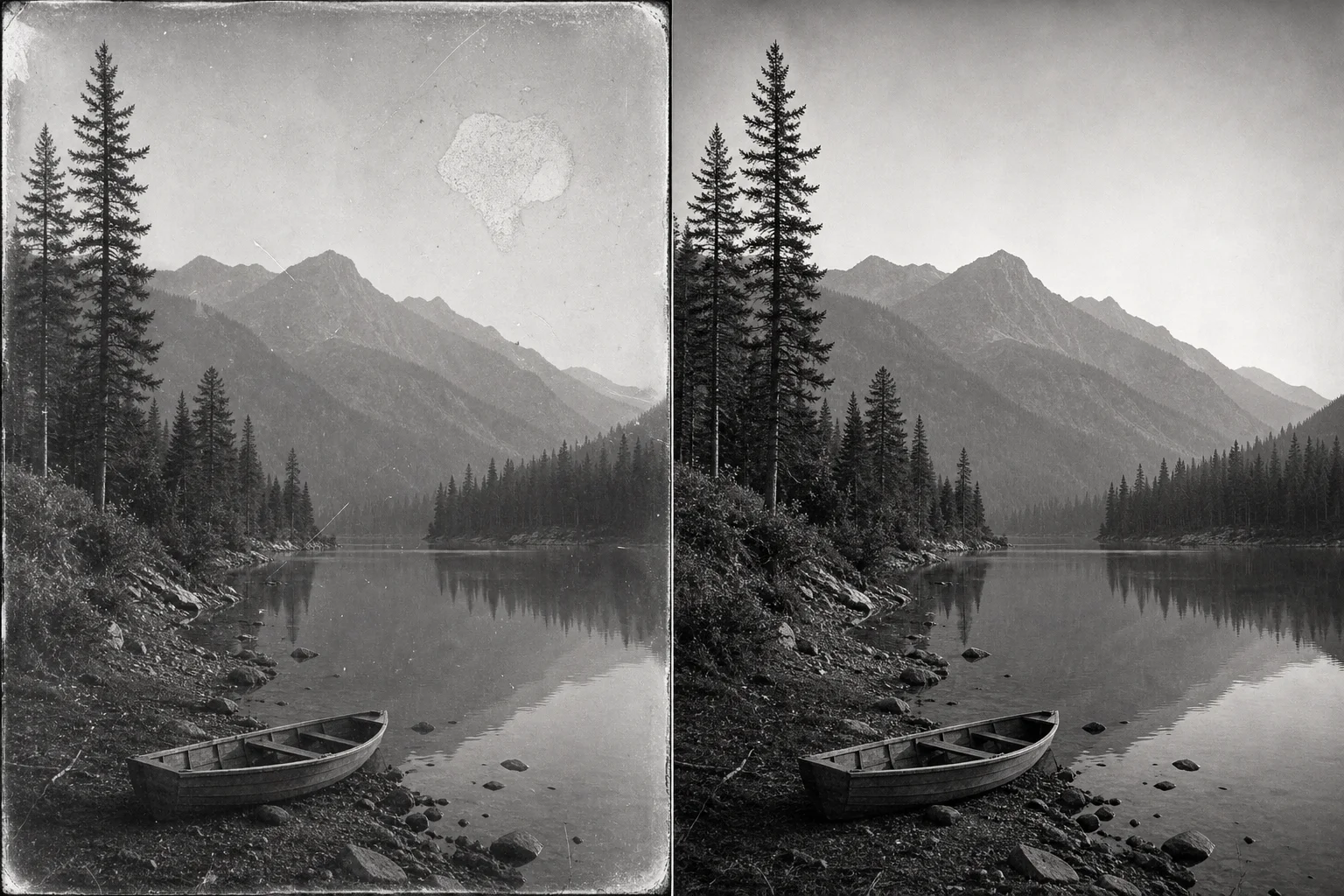
Cleaner sky, water, shoreline, and ridges with the rowboat, reflections, haze, grain, and natural geometry preserved.
Task: Create a side-by-side old photo restoration demonstration for an archival landscape print. Subject: a fully fictional circa-1900 mountain-lake panorama with a pine shoreline, layered ridges, still water, a small unbranded wooden rowboat pulled onto the near bank, and no people or recognizable landmark. Context: an educational conservation example for restoring environmental detail without inventing dramatic scenery. Style: photorealistic black-and-white glass-plate landscape photography with fine grain, subtle edge softness, matte print texture, and conservative restoration. Composition: show the exact same wide landscape twice in equal left and right panels inside one 3:2 frame, damaged source on the left and restored result on the right, thin neutral divider, identical shoreline, tree silhouettes, ridges, reflections, rowboat, horizon, and crop. Lighting: preserve quiet early-morning diffuse light with light atmospheric haze. Constraints: add fading, dust, several fine scratches, one pale chemical blotch in the sky, and mild edge silvering to the left panel; on the right remove those defects, restore tonal depth and supported texture, and retain natural haze, reflection geometry, tree count and placement, boat shape, grain, and optical softness; no new mountains, cabins, people, wildlife, dramatic clouds, colorization, text, labels, logos, or watermark. Output: one 1536×1024 archival landscape before-and-after restoration composite.
- Adjustable parameters
- Fade, scratches, blotch size, edge silvering, haze, tonal depth
- Failure correction
- If dramatic clouds or cabins appear, lock the blank hazy sky and every surviving shoreline edge, and prohibit any new object or landmark.
- Review focus
- shoreline, ridges, tree silhouettes, reflections, rowboat, haze, and non-invented scenery
- Tested model
- GPT Image 2
Old photo restoration FAQ
What should an old photo restoration prompt include?
Name the exact damage, describe the source and intended use, specify the photographic period and grain, lock identity and composition, preserve the original light, state what may be repaired, prohibit unsupported invention, and request a concrete output size. One focused defect per pass is easier to review than a vague request to modernize everything.
Can AI recover details that are completely missing?
No model can prove what was never captured or no longer survives. It can propose a visually plausible reconstruction from nearby texture and context, but that is an interpretation. Keep surviving evidence unchanged, restrict the fill area, avoid missing faces or text, and label speculative repairs when historical accuracy matters.
Is AI colorization historically accurate?
Colorization is reliable only when you have evidence such as notes, surviving objects, uniforms, paint references, or comparable material from the same period. Without that evidence, use restrained plausible colors and describe the result as an interpretation rather than the original color record.
What scan resolution works best for old photo restoration?
Use the highest clean optical scan your source and scanner support, commonly 600 dpi for small prints, and save a lossless untouched master. Higher input quality gives the model more real edges and texture to preserve, but it cannot turn absent information into verified detail.
Why do faces change during old photo enhancement?
Tiny, blurred, or damaged faces leave room for the model to substitute familiar facial patterns. Lock specific geometry, apparent age, expression, and head angle; ask for conservative detail recovery; compare at 100%; and reject any result that changes eye spacing, teeth, jawline, wrinkles, or person count.
Can I use these restoration prompts for commercial or archive work?
The examples on this page use fully synthetic people and scenes, but your own source rights still control real projects. Confirm ownership, license, privacy, institutional policy, model terms, and local law. Keep the original scan, document edits, and avoid presenting generated reconstruction as an authenticated historical record.