MBTI Pixel Art Prompts: 10 Original Avatar Cards
MBTI pixel art prompts turn a self-selected personality theme into a small, readable character illustration. Begin with a fictional adult, one expressive pose and two or three visible details that communicate the mood you choose. Then specify a restrained palette, a simple background, clear pixel-style edges and space for a type label you can add during layout. These ten complete prompts explore different portrait-card ideas, from a quiet library reader to a welcoming cafe host. Each uses its own original person and setting. They are creative starting points that can be adapted to any of the sixteen four-letter types; they are not a complete set of sixteen types. Choose a label for fun and self-expression. A face, outfit or illustrated hobby cannot establish someone’s personality or a psychological result.
By Nano Banana Studio · · 10 different fictional adults · Original pixel-style concepts
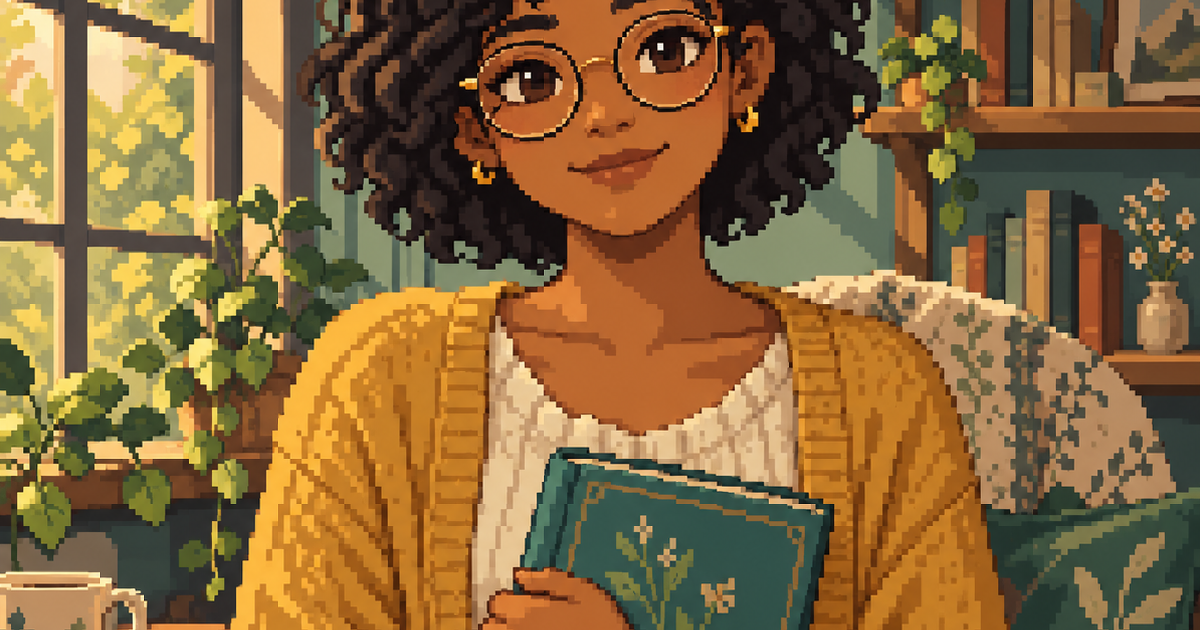
Choose a mood you can show. A thoughtful pause, an open greeting or a carefully arranged desk gives a portrait a readable idea. A four-letter label alone cannot tell the image tool how to draw the person.
Build an MBTI avatar around one visual decision
Start with the role you want the card to play: a profile picture, a personal mood board, a small character introduction or a gift illustration. Choose one pose that remains understandable at thumbnail size. A head turn and a single prop often communicate more clearly than a crowded desk full of personality symbols. A pixel personality card works best when the person remains the first thing you notice.
Keep the type separate from the design instructions. Select your own four-letter label, then describe the interests, expression and clothing you want to show. Quiet does not have to mean sad, organized does not have to mean rigid, and outgoing does not have to mean loud. Treat every theme as a flexible creative choice rather than a rule about real people. For a ChatGPT pixel art avatar, these visible directions give the image tool something specific to draw.
The ten examples are separate character concepts, with different faces, clothing and settings. They do not demonstrate the same person across multiple outputs. For a broader treatment of surfaces and color systems, explore the style-transfer prompt handbook; use the character sheet guide when you need a stable design across views.
Use a complete pixel portrait brief, then change one variable
- Pick an illustration idea. Choose the expression, posture and activity you want the card to communicate. Keep one main person and one focal prop. Choose your type label yourself; do not ask the tool to diagnose it from a photograph.
- Copy the full prompt. Retain Task, Subject, Context, Style, Composition, Lighting, Constraints and Output. These parts keep the person, pixel treatment and framing connected.
- Make one focused adjustment. Change the jacket color, hobby prop or background first. Keep the camera framing and light simple while checking whether that change helps the portrait read.
- Inspect at two sizes. View the result as a small avatar and at a larger zoom. Check the face and hand shapes, the outline of the prop, background separation and whether edges look crisp rather than blurred.
- Finish the card layout. Add your chosen four-letter label and other copy in a design editor if the image has no text. Check contrast, spelling, safe margins and the final crop. Export only after the person remains clear at the destination size.
The prompt text is free to copy and adapt. Image generation availability and limits depend on your tool. The examples were created with GPT’s built-in image tool; the exact model version was not supplied.
MBTI pixel avatar prompts: choose framing and detail
Use the subject’s silhouette and the final display size to set the amount of detail. Ratios in the prompts are composition requests. Verify the actual delivered dimensions before exporting.
| Card purpose | Starting composition | Useful detail | Palette and light | Priority check |
|---|---|---|---|---|
| Small profile avatar | One head-and-shoulders portrait | Distinct hair shape and collar | Few separated colors; simple light | Face remains readable in a small circular crop |
| Personality-themed portrait card | One waist-up person with one prop | Gesture plus a hobby cue | One dominant hue and a quiet accent | Prop does not obscure the face or merge into hands |
| Quiet reflective mood | Comfortable pose with a clear gaze | Book, map or other single chosen object | Soft tonal steps; modest contrast | Expression feels intentional rather than vacant |
| Energetic social mood | Open posture with generous headroom | One visible greeting or presentation gesture | Brighter accent against a restrained background | Hands are distinct and the pose fits the frame |
| Creative character introduction | One adult in a small setting | A readable tool or work surface | Consistent pixel scale and directional light | Background supports the person instead of becoming the subject |
| Finished label-ready card | Simple image with a planned text area | User-chosen four-letter label added in layout | High text contrast and consistent margins | Spelling, crop and pixel edges survive the final export |
10 pixel portrait prompts for an original avatar card
Choose a complete brief and adapt the visible traits to your own creative theme. A prompt’s occupation, hobby or expression does not belong to one fixed personality type. The ten images illustrate ten different fictional adults, so you can explore the designs without assuming cross-image identity consistency.
- 01 · Quiet library portrait
- 02 · Observatory night avatar
- 03 · Pocket garden field notes
- 04 · Workshop maker portrait
- 05 · Mountain route explorer
- 06 · Music rehearsal avatar
- 07 · Seaside cafe welcome portrait
- 08 · Creative studio planner
- 09 · Greenhouse caretaker portrait
- 10 · Retro arcade quest avatar
Quiet library portrait
Readers choosing a calm profile illustration.
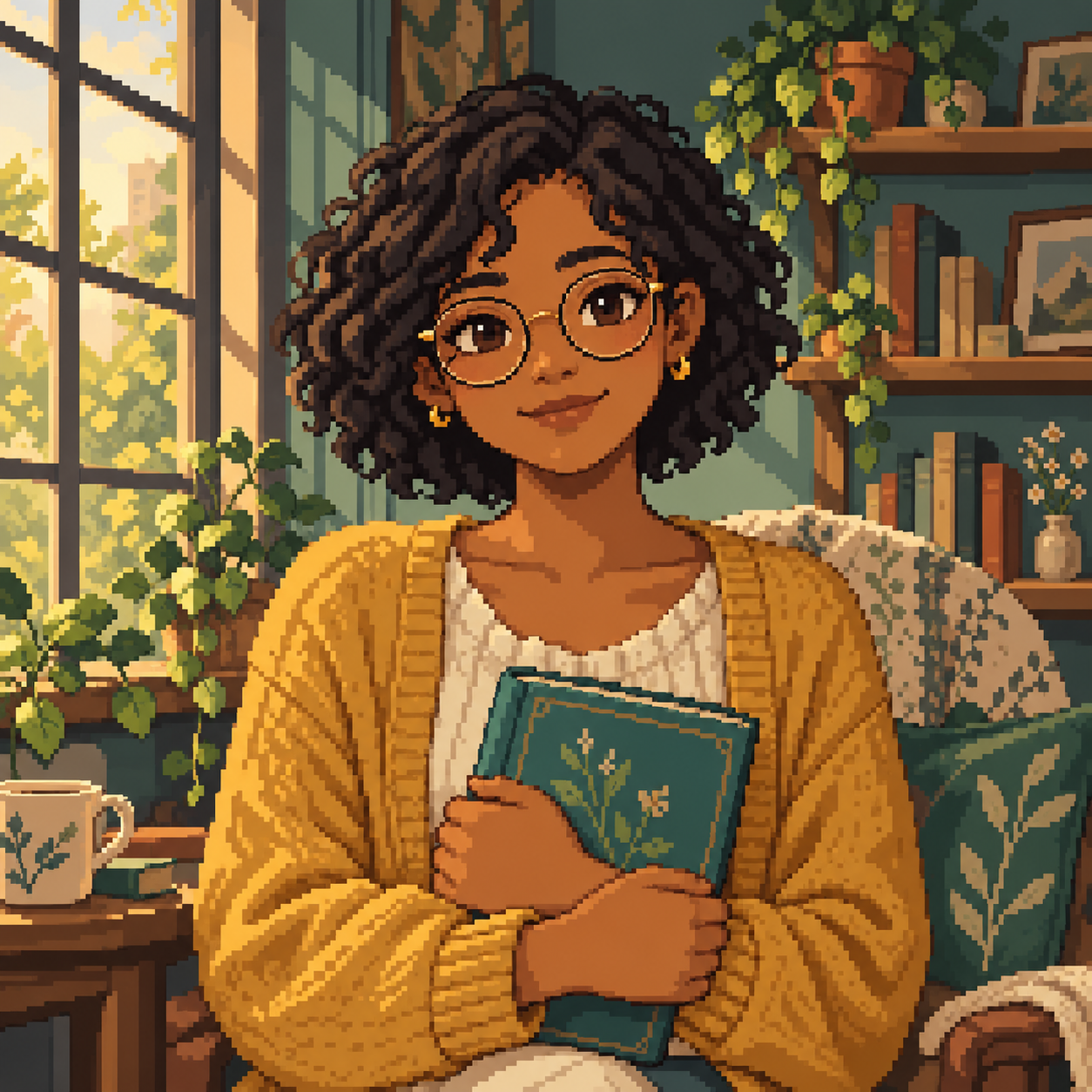
A closed book and a simple library corner give this portrait a quiet focus. Keep the face brighter than the shelving so the image still reads as an avatar.
Optional type example: INFP. Replace it with any self-chosen label; the type is added outside the image.
Task: Create one original MBTI-themed pixel-art portrait avatar for a playful self-expression card.
Subject: A fictional adult with short curly black hair, warm brown skin, round spectacles and a mustard cardigan, holding one closed teal book against the chest. The optional self-selected theme is INFP; treat it only as a creative label, never as a personality assessment.
Context: A small reading alcove with two simple shelves and a tall window, no other people. A personal profile illustration based on explicitly chosen appearance and interests, with a completely fictional adult.
Style: Carefully drawn retro pixel art with clearly visible square pixel clusters, crisp stepped contours, a restrained color palette and simple two-to-three-tone shading. No smooth painting, 3D rendering, blur or anti-aliased illustration finish.
Composition: Waist-up front-facing portrait, centered head and shoulders well clear of every edge; the closed book and both resting hands fully visible. One person in one continuous scene.
Lighting: Soft afternoon window light from the left, warm amber face planes and a quiet muted teal background. Render light and shadow as deliberate solid-color pixel clusters.
Constraints: Exactly one fictional adult with a coherent face and body. Keep the chosen hairstyle, clothing and setting readable. No text, letters, MBTI code, numbers, logos, trademarked game characters, watermarks, extra people, duplicated limbs, borders, panels, icon grid, collage or interface. Do not invent biographical facts from the type label.
Output: One finished square 1:1 pixel-art avatar at the closest supported native size. A single full-frame illustration with clean margins; no contact sheet. The type label will be added outside the image later.
- Check one coherent fictional adult, crisp pixel clusters, a readable face and the named single setting/prop. A book, glasses and a thoughtful pose are chosen interests, not evidence of a personality type.
- A book, glasses and a thoughtful pose are chosen interests, not evidence of a personality type.
Adjustable parameters
- Palette
- Mustard and muted teal; change one accent at a time
- Prop
- One closed book; keep its cover free of lettering
- Framing
- Square waist-up portrait with space around the head
- Ratio
- 1:1; check delivered dimensions
Expected result
One fictional reader with an unobstructed face, a single closed book and a clear silhouette.
Failure correction
If the shelves overwhelm the avatar, replace them with two broad dark rectangles and keep the face the largest light shape.
Image tool
GPT built-in image tool. Exact model version unknown.
Observatory night avatar
Stargazing enthusiasts making a night-themed card.
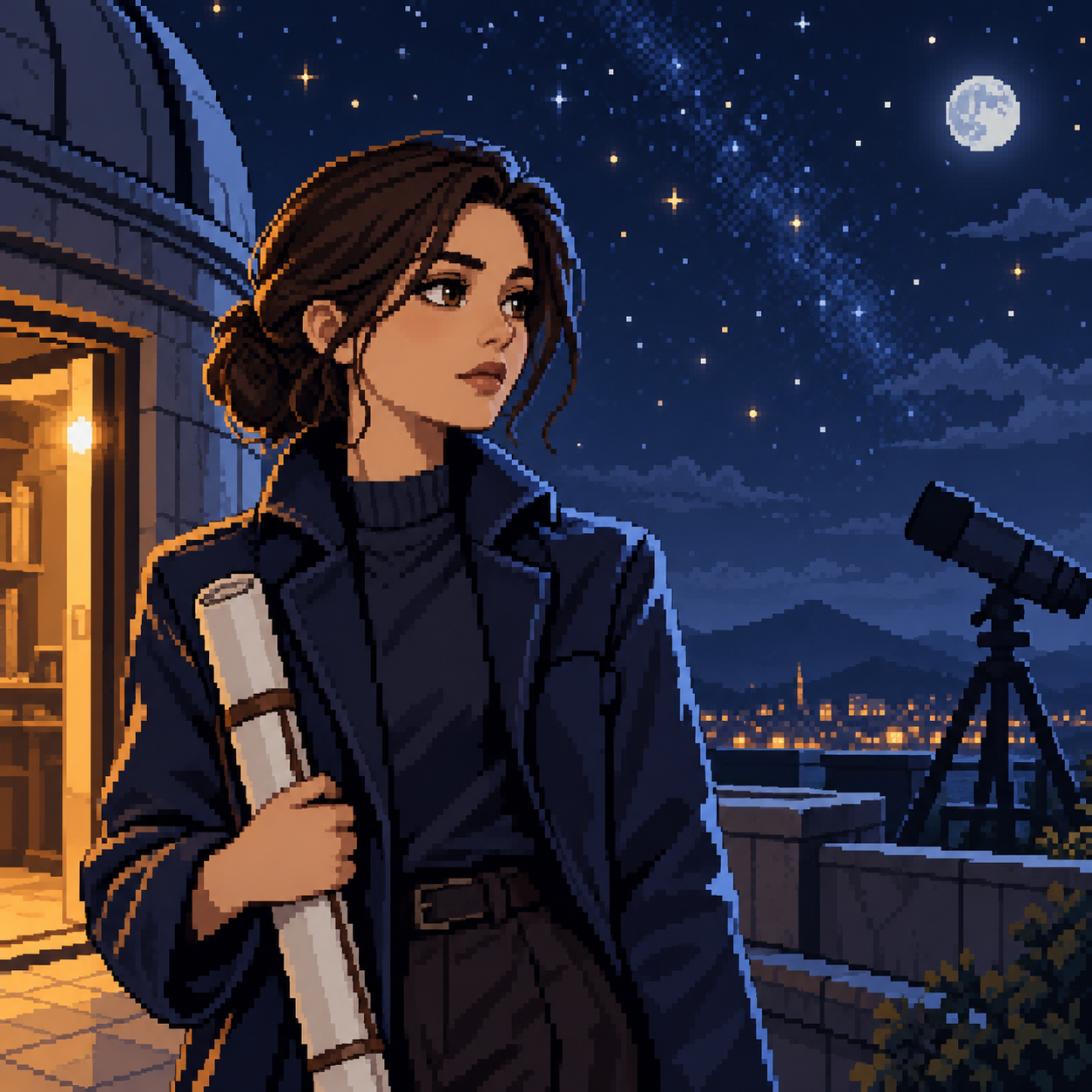
Use the contrast between cool moonlight and a small warm doorway accent. The rolled chart is a visual interest, while the distant telescope sets the place.
Optional type example: INTJ. Replace it with any self-chosen label; the type is added outside the image.
Task: Create one original MBTI-themed pixel-art portrait avatar for a playful self-expression card.
Subject: A fictional adult with straight dark-brown hair in a low bun, light olive skin and a navy jacket, holding a plain rolled star chart vertically at their side. The optional self-selected theme is INTJ; treat it only as a creative label, never as a personality assessment.
Context: A small rooftop observatory with one distant telescope silhouette and a sparse starry sky. A personal profile illustration based on explicitly chosen appearance and interests, with a completely fictional adult.
Style: Carefully drawn retro pixel art with clearly visible square pixel clusters, crisp stepped contours, a restrained color palette and simple two-to-three-tone shading. No smooth painting, 3D rendering, blur or anti-aliased illustration finish.
Composition: Three-quarter waist-up view, figure on the left two-thirds and one simple telescope silhouette on the far right, all subject edges inside the frame. One person in one continuous scene.
Lighting: Cool blue moonlight with a narrow warm amber light from a doorway at lower left; clear readable eyes. Render light and shadow as deliberate solid-color pixel clusters.
Constraints: Exactly one fictional adult with a coherent face and body. Keep the chosen hairstyle, clothing and setting readable. No text, letters, MBTI code, numbers, logos, trademarked game characters, watermarks, extra people, duplicated limbs, borders, panels, icon grid, collage or interface. Do not invent biographical facts from the type label.
Output: One finished square 1:1 pixel-art avatar at the closest supported native size. A single full-frame illustration with clean margins; no contact sheet. The type label will be added outside the image later.
- Check one coherent fictional adult, crisp pixel clusters, a readable face and the named single setting/prop. The observatory is a self-chosen setting; it does not establish intelligence or analytical ability.
- The observatory is a self-chosen setting; it does not establish intelligence or analytical ability.
Adjustable parameters
- Palette
- Deep blue with a small amber accent
- Prop
- One plain rolled chart
- Background
- Sparse stars and one distant telescope
- Ratio
- 1:1; check delivered dimensions
Expected result
A readable night portrait with one restrained background silhouette and separated light sources.
Failure correction
If stars become visual noise, ask for a dark plain sky with only a few separated square star clusters.
Image tool
GPT built-in image tool. Exact model version unknown.
Pocket garden field notes
Nature observers who want a field-notes avatar.
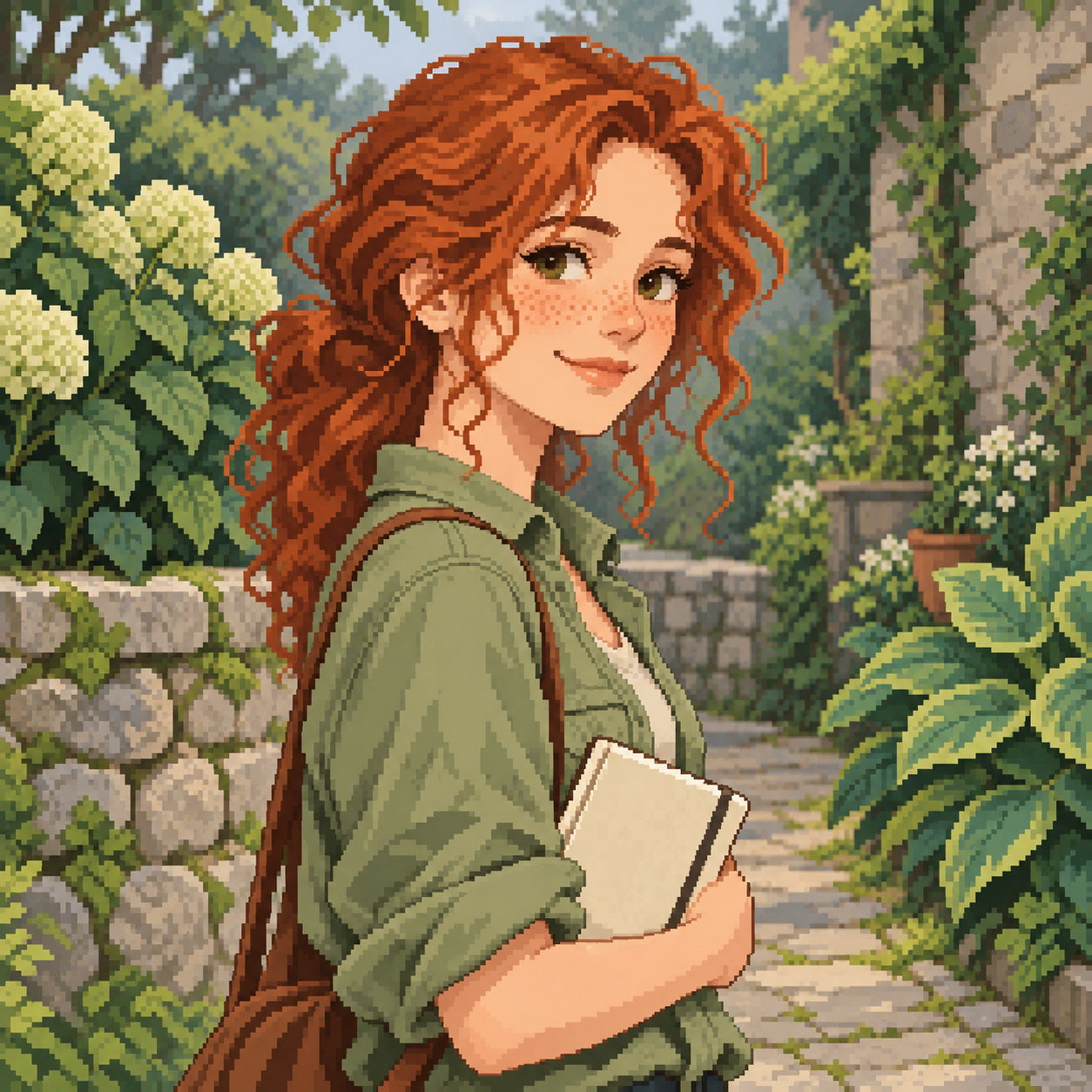
A closed notebook and two broad plants give this outdoor portrait a simple observation theme. Keep the notebook tucked under the arm so it stays separate from the torso.
Optional type example: ISFP. Replace it with any self-chosen label; the type is added outside the image.
Task: Create one original MBTI-themed pixel-art portrait avatar for a playful self-expression card.
Subject: A fictional adult with copper-red wavy hair, pale freckled skin and a sage-green work shirt, one small closed cream notebook tucked under the left arm. The optional self-selected theme is ISFP; treat it only as a creative label, never as a personality assessment.
Context: A quiet garden path with two broad leafy plants and a low stone wall. A personal profile illustration based on explicitly chosen appearance and interests, with a completely fictional adult.
Style: Carefully drawn retro pixel art with clearly visible square pixel clusters, crisp stepped contours, a restrained color palette and simple two-to-three-tone shading. No smooth painting, 3D rendering, blur or anti-aliased illustration finish.
Composition: Three-quarter torso portrait facing right with the face turned gently toward the viewer; both shoulders and the notebook fit within a calm square crop. One person in one continuous scene.
Lighting: Soft overcast daylight, restrained green shadows and a warm peach face palette. Render light and shadow as deliberate solid-color pixel clusters.
Constraints: Exactly one fictional adult with a coherent face and body. Keep the chosen hairstyle, clothing and setting readable. No text, letters, MBTI code, numbers, logos, trademarked game characters, watermarks, extra people, duplicated limbs, borders, panels, icon grid, collage or interface. Do not invent biographical facts from the type label.
Output: One finished square 1:1 pixel-art avatar at the closest supported native size. A single full-frame illustration with clean margins; no contact sheet. The type label will be added outside the image later.
- Check one coherent fictional adult, crisp pixel clusters, a readable face and the named single setting/prop. The garden and notebook express selected interests rather than a fixed rule about ISFP people.
- The garden and notebook express selected interests rather than a fixed rule about ISFP people.
Adjustable parameters
- Palette
- Muted greens with one clothing accent
- Interest
- One small closed notebook with no lettering
- Background
- Broad garden shapes, simplified at thumbnail size
- Ratio
- 1:1; check delivered dimensions
Expected result
One adult in a readable outdoor portrait, with a simple nature-study cue.
Failure correction
If leaves merge into the hair, lower the plants below the shoulder line and add a contrasting plain wall behind the head.
Image tool
GPT built-in image tool. Exact model version unknown.
Workshop maker portrait
Makers planning an approachable workshop portrait.

A blue apron and an orange toolbox behind the person establish a maker’s setting. The hands stay empty and relaxed, leaving the face and silhouette easy to read.
Optional type example: ISTP. Replace it with any self-chosen label; the type is added outside the image.
Task: Create one original MBTI-themed pixel-art portrait avatar for a playful self-expression card.
Subject: A fictional adult with short silver hair, medium brown skin and a plain blue work apron over a cream shirt, standing with relaxed empty hands. The optional self-selected theme is ISTP; treat it only as a creative label, never as a personality assessment.
Context: A tidy miniature repair bench behind the subject with one orange toolbox and two broad pegboard shapes. A personal profile illustration based on explicitly chosen appearance and interests, with a completely fictional adult.
Style: Carefully drawn retro pixel art with clearly visible square pixel clusters, crisp stepped contours, a restrained color palette and simple two-to-three-tone shading. No smooth painting, 3D rendering, blur or anti-aliased illustration finish.
Composition: Front-facing waist-up portrait, hands resting separately on the near bench edge, face centered in the upper third and all fingers simplified into coherent pixel clusters. One person in one continuous scene.
Lighting: Broad warm overhead work light with cool blue fill, crisp shape separation. Render light and shadow as deliberate solid-color pixel clusters.
Constraints: Exactly one fictional adult with a coherent face and body. Keep the chosen hairstyle, clothing and setting readable. No text, letters, MBTI code, numbers, logos, trademarked game characters, watermarks, extra people, duplicated limbs, borders, panels, icon grid, collage or interface. Do not invent biographical facts from the type label.
Output: One finished square 1:1 pixel-art avatar at the closest supported native size. A single full-frame illustration with clean margins; no contact sheet. The type label will be added outside the image later.
- Check one coherent fictional adult, crisp pixel clusters, a readable face and the named single setting/prop. The workshop is an elective hobby setting, not a claim about a type having particular skills.
- The workshop is an elective hobby setting, not a claim about a type having particular skills.
Adjustable parameters
- Palette
- Warm workshop neutrals with one accent
- Detail
- One background toolbox and broad pegboard shapes
- Framing
- Keep the face and focal object inside the crop
- Ratio
- 1:1; check delivered dimensions
Expected result
One fictional maker with relaxed empty hands and a tidy simplified repair bench.
Failure correction
If tools multiply or fingers distort, remove all handheld objects and request two simple relaxed hands on a clean empty bench edge.
Image tool
GPT built-in image tool. Exact model version unknown.
Mountain route explorer
Outdoor hobbyists creating an explorer card.
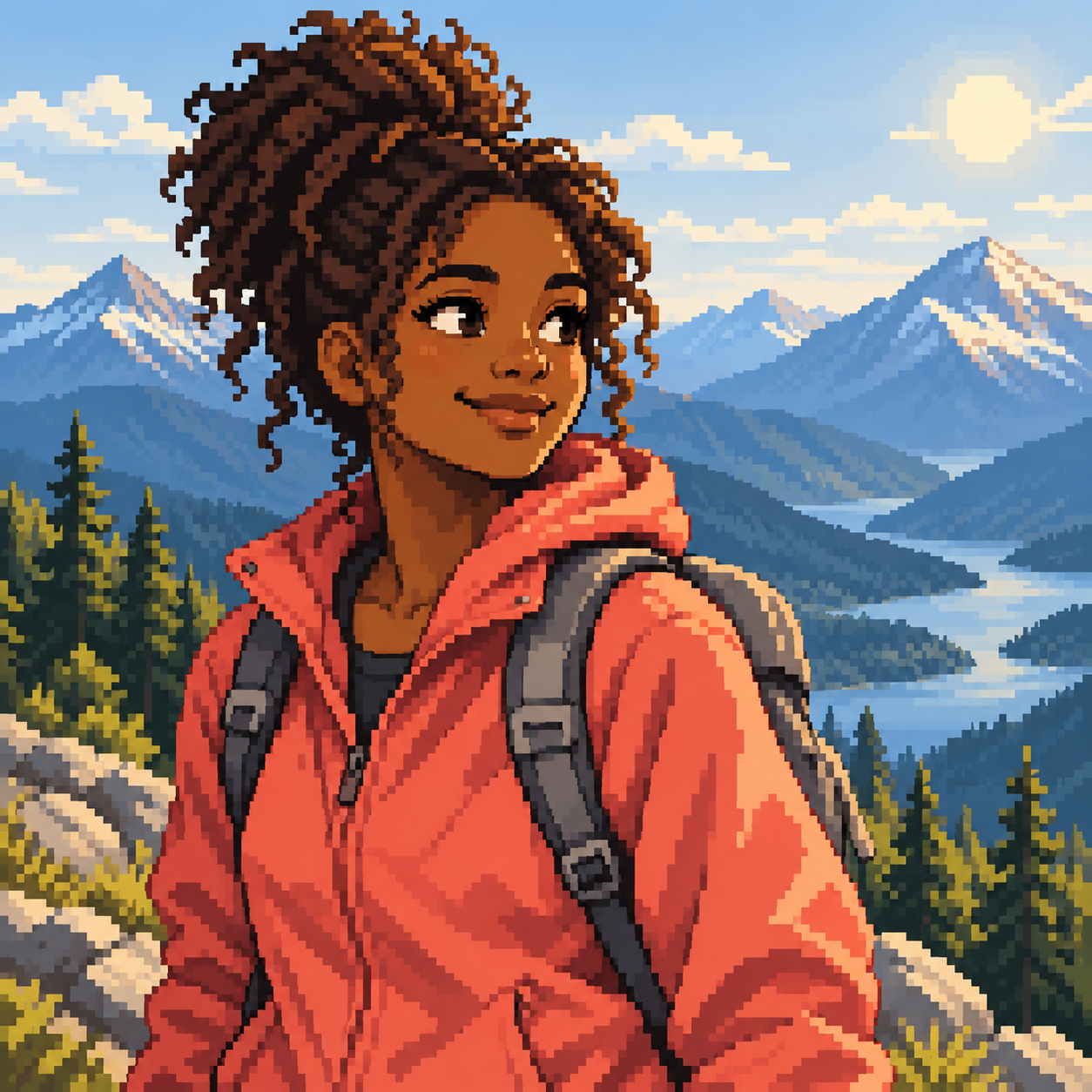
Let the background establish the route while the character stays dominant. The chosen hiking details are personal art direction, not a claim about a type’s courage or habits.
Optional type example: ENFP. Replace it with any self-chosen label; the type is added outside the image.
Task: Create one original MBTI-themed pixel-art portrait avatar for a playful self-expression card.
Subject: A fictional adult with dark curly hair tied high, deep brown skin, a coral windbreaker and one small plain grey backpack with two visible shoulder straps. The optional self-selected theme is ENFP; treat it only as a creative label, never as a personality assessment.
Context: A wide mountain overlook with three large distant ridge shapes and a simple pale sky. A personal profile illustration based on explicitly chosen appearance and interests, with a completely fictional adult.
Style: Carefully drawn retro pixel art with clearly visible square pixel clusters, crisp stepped contours, a restrained color palette and simple two-to-three-tone shading. No smooth painting, 3D rendering, blur or anti-aliased illustration finish.
Composition: Waist-up outdoor avatar facing three-quarter left, backpack straps readable, face dominant with clear space above the hair and no cropped shoulders. One person in one continuous scene.
Lighting: Fresh morning light from upper right, warm highlights and muted blue mountain shadows. Render light and shadow as deliberate solid-color pixel clusters.
Constraints: Exactly one fictional adult with a coherent face and body. Keep the chosen hairstyle, clothing and setting readable. No text, letters, MBTI code, numbers, logos, trademarked game characters, watermarks, extra people, duplicated limbs, borders, panels, icon grid, collage or interface. Do not invent biographical facts from the type label.
Output: One finished square 1:1 pixel-art avatar at the closest supported native size. A single full-frame illustration with clean margins; no contact sheet. The type label will be added outside the image later.
- Check one coherent fictional adult, crisp pixel clusters, a readable face and the named single setting/prop. The trip is a chosen story, not proof of extraversion or adventurousness.
- The trip is a chosen story, not proof of extraversion or adventurousness.
Adjustable parameters
- Palette
- Cool landscape planes and a warmer clothing accent
- Setting
- A few broad mountain layers
- Crop
- Retain headroom and both backpack shoulder straps
- Ratio
- 1:1; check delivered dimensions
Expected result
A clear explorer silhouette against a simplified mountain setting.
Failure correction
If the scenery makes the face too small, keep a waist-up crop and reduce the mountain range to three flat silhouettes.
Image tool
GPT built-in image tool. Exact model version unknown.
Music rehearsal avatar
Music lovers choosing a rehearsal-themed avatar.
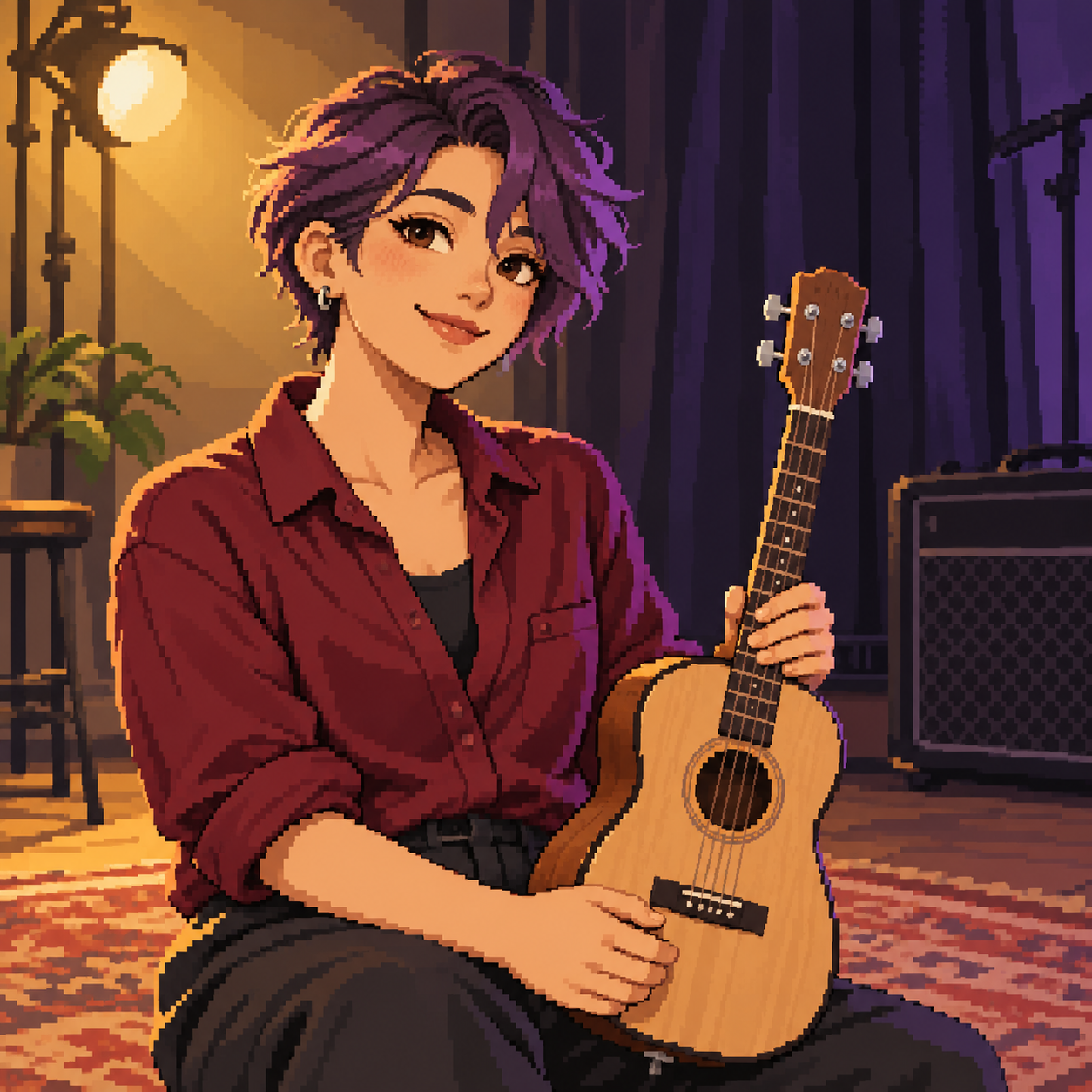
Keep the person on the left and the small upright guitar on the right, with clear space around the face, shoulders and instrument. The resting hands should remain distinct from the guitar body.
Optional type example: ESFP. Replace it with any self-chosen label; the type is added outside the image.
Task: Create one original MBTI-themed pixel-art portrait avatar for a playful self-expression card.
Subject: A fictional adult with a short violet-tinted haircut, warm beige skin and a burgundy shirt, holding one small travel-size acoustic guitar upright beside the lower torso. The optional self-selected theme is ESFP; treat it only as a creative label, never as a personality assessment.
Context: A small rehearsal room with one dark curtain and an unlit plain amplifier behind the figure. A personal profile illustration based on explicitly chosen appearance and interests, with a completely fictional adult.
Style: Carefully drawn retro pixel art with clearly visible square pixel clusters, crisp stepped contours, a restrained color palette and simple two-to-three-tone shading. No smooth painting, 3D rendering, blur or anti-aliased illustration finish.
Composition: Front three-quarter waist-up portrait with a wider crop. Show the complete face, both shoulders and the entire small upright guitar including body, neck and headstock with a clear margin from every image edge. The person occupies the left half; the small guitar is on the right half. Hands rest on its body rather than playing. One person in one continuous scene.
Lighting: One broad warm stage-rehearsal lamp from the left and soft dim purple fill from the right. Render light and shadow as deliberate solid-color pixel clusters.
Constraints: Exactly one fictional adult with a coherent face and body. Keep the chosen hairstyle, clothing and setting readable. No text, letters, MBTI code, numbers, logos, trademarked game characters, watermarks, extra people, duplicated limbs, borders, panels, icon grid, collage or interface. Do not invent biographical facts from the type label.
Output: One finished square 1:1 pixel-art avatar at the closest supported native size. A single full-frame illustration with clean margins; no contact sheet. The type label will be added outside the image later.
- Check one coherent fictional adult, crisp pixel clusters, a readable face and the named single setting/prop. The musical prop is a selected activity and does not predict talent or social behavior.
- The musical prop is a selected activity and does not predict talent or social behavior.
Adjustable parameters
- Palette
- A restrained studio base with one expressive accent
- Interest
- One small plain acoustic guitar held upright on the right
- Lighting
- Directional studio light rendered in solid pixel clusters
- Framing
- Wider waist-up crop with margins around both shoulders and the complete guitar
- Ratio
- 1:1; check delivered dimensions
Expected result
One fictional adult with both shoulders visible and one complete upright travel guitar, including its body, neck and headstock.
Failure correction
If the guitar gains duplicate necks, request one compact guitar silhouette with a single neck and two stationary resting hands.
Image tool
GPT built-in image tool. Exact model version unknown.
Seaside cafe welcome portrait
Cafe enthusiasts making a welcoming profile card.
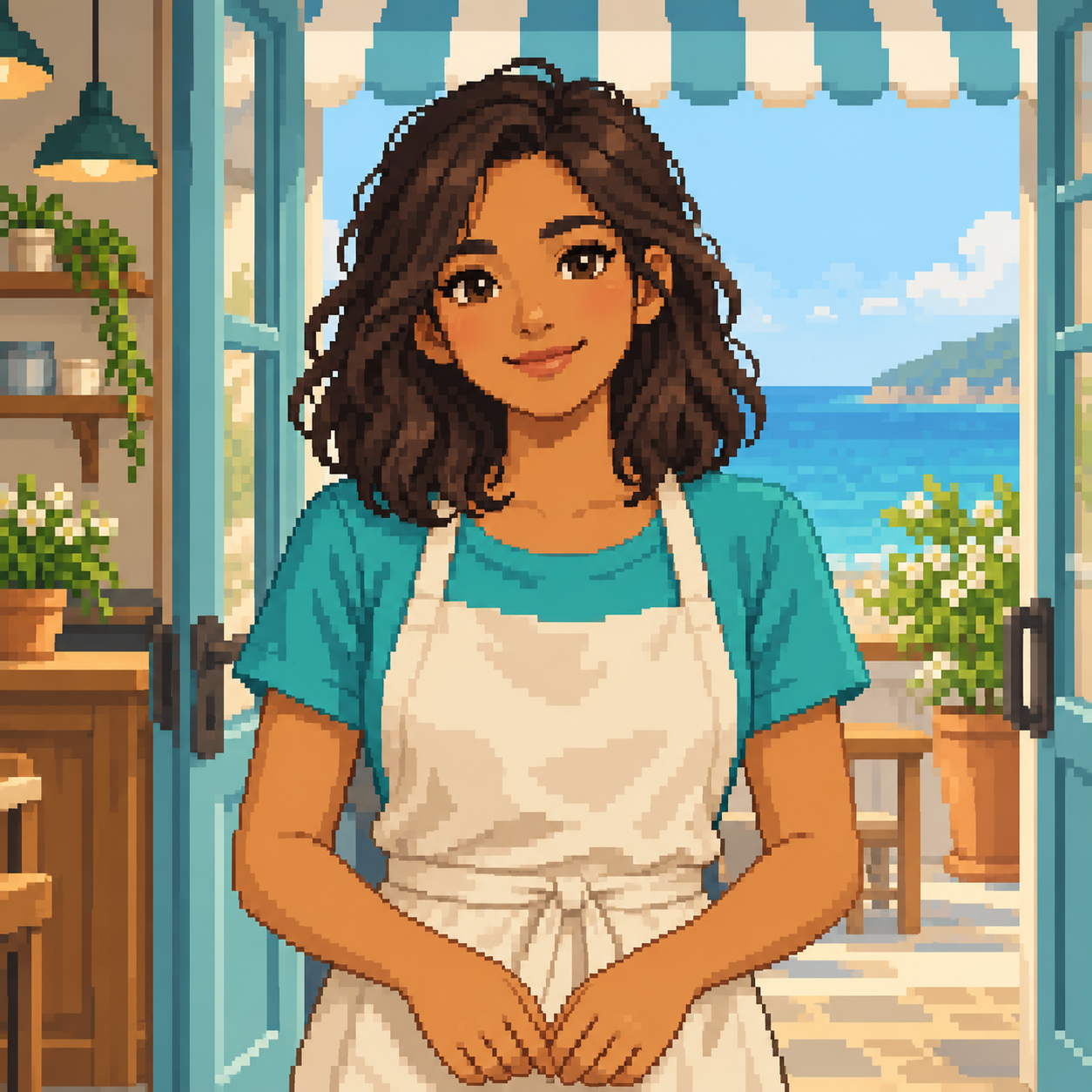
An open doorway, a striped awning and a distant blue sea rectangle can establish a welcoming cafe without signs or customers. Keep the hands relaxed and empty.
Optional type example: ESFJ. Replace it with any self-chosen label; the type is added outside the image.
Task: Create one original MBTI-themed pixel-art portrait avatar for a playful self-expression card.
Subject: A fictional adult with shoulder-length dark hair, golden-brown skin and a plain turquoise shirt under a cream apron, hands empty and relaxed at the waist. The optional self-selected theme is ESFJ; treat it only as a creative label, never as a personality assessment.
Context: An open cafe doorway with one distant sea-blue rectangle and a simple striped awning above, no signs or customers. A personal profile illustration based on explicitly chosen appearance and interests, with a completely fictional adult.
Style: Carefully drawn retro pixel art with clearly visible square pixel clusters, crisp stepped contours, a restrained color palette and simple two-to-three-tone shading. No smooth painting, 3D rendering, blur or anti-aliased illustration finish.
Composition: Centered waist-up avatar with a friendly subtle smile, complete hair silhouette and both forearms visible, uncluttered space around the head. One person in one continuous scene.
Lighting: Bright diffused coastal daylight, turquoise and warm cream shapes with gentle facial shading. Render light and shadow as deliberate solid-color pixel clusters.
Constraints: Exactly one fictional adult with a coherent face and body. Keep the chosen hairstyle, clothing and setting readable. No text, letters, MBTI code, numbers, logos, trademarked game characters, watermarks, extra people, duplicated limbs, borders, panels, icon grid, collage or interface. Do not invent biographical facts from the type label.
Output: One finished square 1:1 pixel-art avatar at the closest supported native size. A single full-frame illustration with clean margins; no contact sheet. The type label will be added outside the image later.
- Check one coherent fictional adult, crisp pixel clusters, a readable face and the named single setting/prop. The welcoming scene is an optional visual story, not a requirement for ESFJ people.
- The welcoming scene is an optional visual story, not a requirement for ESFJ people.
Adjustable parameters
- Palette
- Warm cafe accents with a quiet coastal background
- Mood
- A self-chosen friendly expression
- Setting
- Keep the cafe cues broad and uncluttered
- Ratio
- 1:1; check delivered dimensions
Expected result
A welcoming fictional adult with a clear pose in a compact seaside-cafe setting.
Failure correction
If signs or letters appear, remove the menu and signage entirely and describe a blank doorway and unmarked awning.
Image tool
GPT built-in image tool. Exact model version unknown.
Creative studio planner
Visual creators planning a studio-themed introduction.
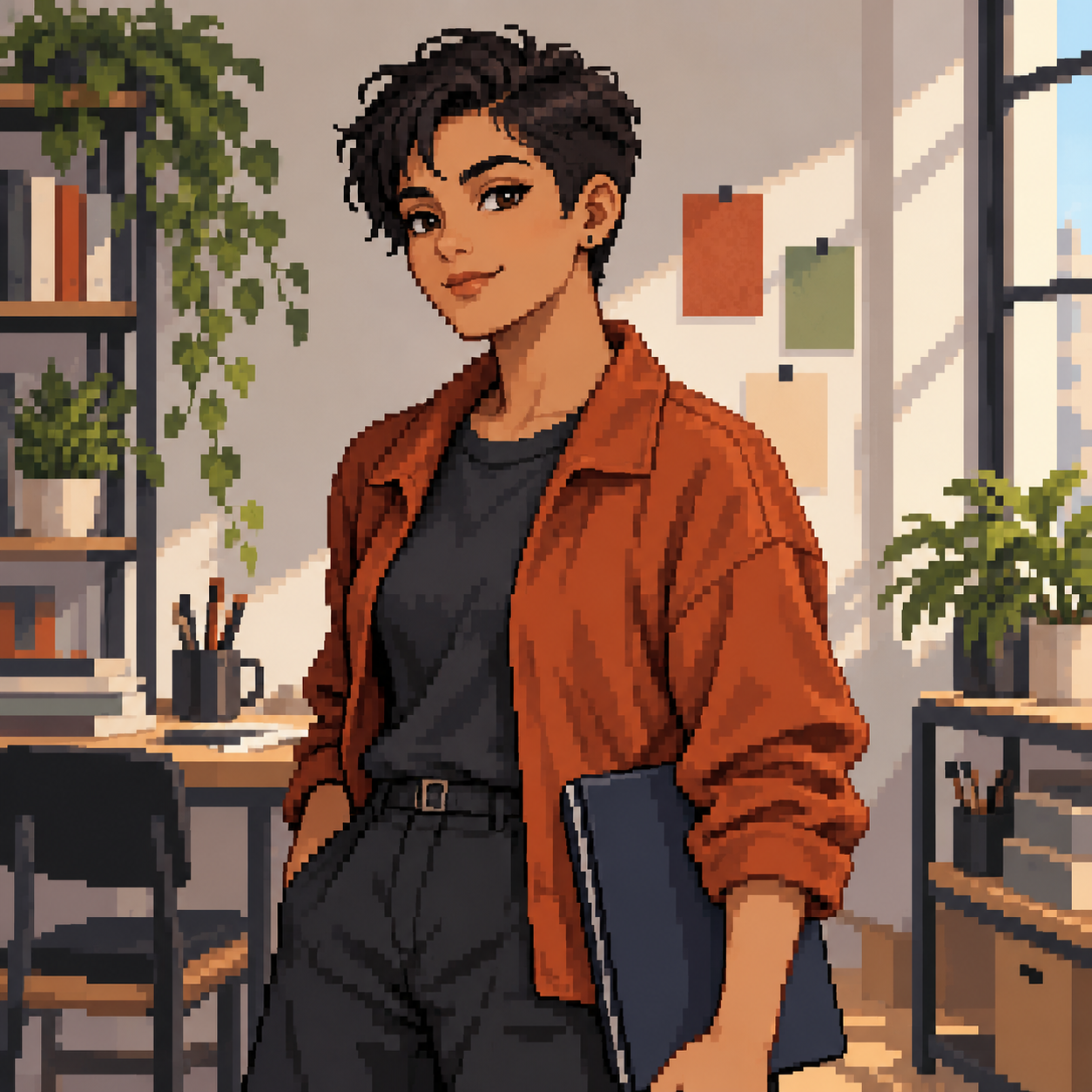
A closed indigo portfolio and three unmarked colored papers give this portrait a visual-design theme. Keep those surfaces simple so the face remains the main subject.
Optional type example: ENTJ. Replace it with any self-chosen label; the type is added outside the image.
Task: Create one original MBTI-themed pixel-art portrait avatar for a playful self-expression card.
Subject: A fictional adult with cropped dark hair, light brown skin and a rust-orange jacket over a charcoal shirt, one closed indigo portfolio held at the side. The optional self-selected theme is ENTJ; treat it only as a creative label, never as a personality assessment.
Context: A quiet design studio with three unmarked colored paper rectangles pinned to a pale wall. A personal profile illustration based on explicitly chosen appearance and interests, with a completely fictional adult.
Style: Carefully drawn retro pixel art with clearly visible square pixel clusters, crisp stepped contours, a restrained color palette and simple two-to-three-tone shading. No smooth painting, 3D rendering, blur or anti-aliased illustration finish.
Composition: Three-quarter torso portrait facing slightly left, relaxed upright posture and direct gaze, portfolio partly beside the hip with all main subject edges inside the square. One person in one continuous scene.
Lighting: Large soft window key from the right, warm rust accents and cool charcoal shadow clusters. Render light and shadow as deliberate solid-color pixel clusters.
Constraints: Exactly one fictional adult with a coherent face and body. Keep the chosen hairstyle, clothing and setting readable. No text, letters, MBTI code, numbers, logos, trademarked game characters, watermarks, extra people, duplicated limbs, borders, panels, icon grid, collage or interface. Do not invent biographical facts from the type label.
Output: One finished square 1:1 pixel-art avatar at the closest supported native size. A single full-frame illustration with clean margins; no contact sheet. The type label will be added outside the image later.
- Check one coherent fictional adult, crisp pixel clusters, a readable face and the named single setting/prop. A studio and portfolio are chosen interests; this illustration does not assess leadership or workplace suitability.
- A studio and portfolio are chosen interests; this illustration does not assess leadership or workplace suitability.
Adjustable parameters
- Palette
- Neutral studio planes with one bright accent
- Detail
- One closed portfolio and three unmarked paper rectangles
- Crop
- Keep the person larger than the wall decorations
- Ratio
- 1:1; check delivered dimensions
Expected result
One fictional creative adult with a clear face, a closed portfolio and three simple studio color shapes.
Failure correction
If the wall becomes a text-heavy strategy board, replace it with exactly three large blank colored paper rectangles.
Image tool
GPT built-in image tool. Exact model version unknown.
Greenhouse caretaker portrait
Plant lovers choosing a gentle greenhouse portrait.
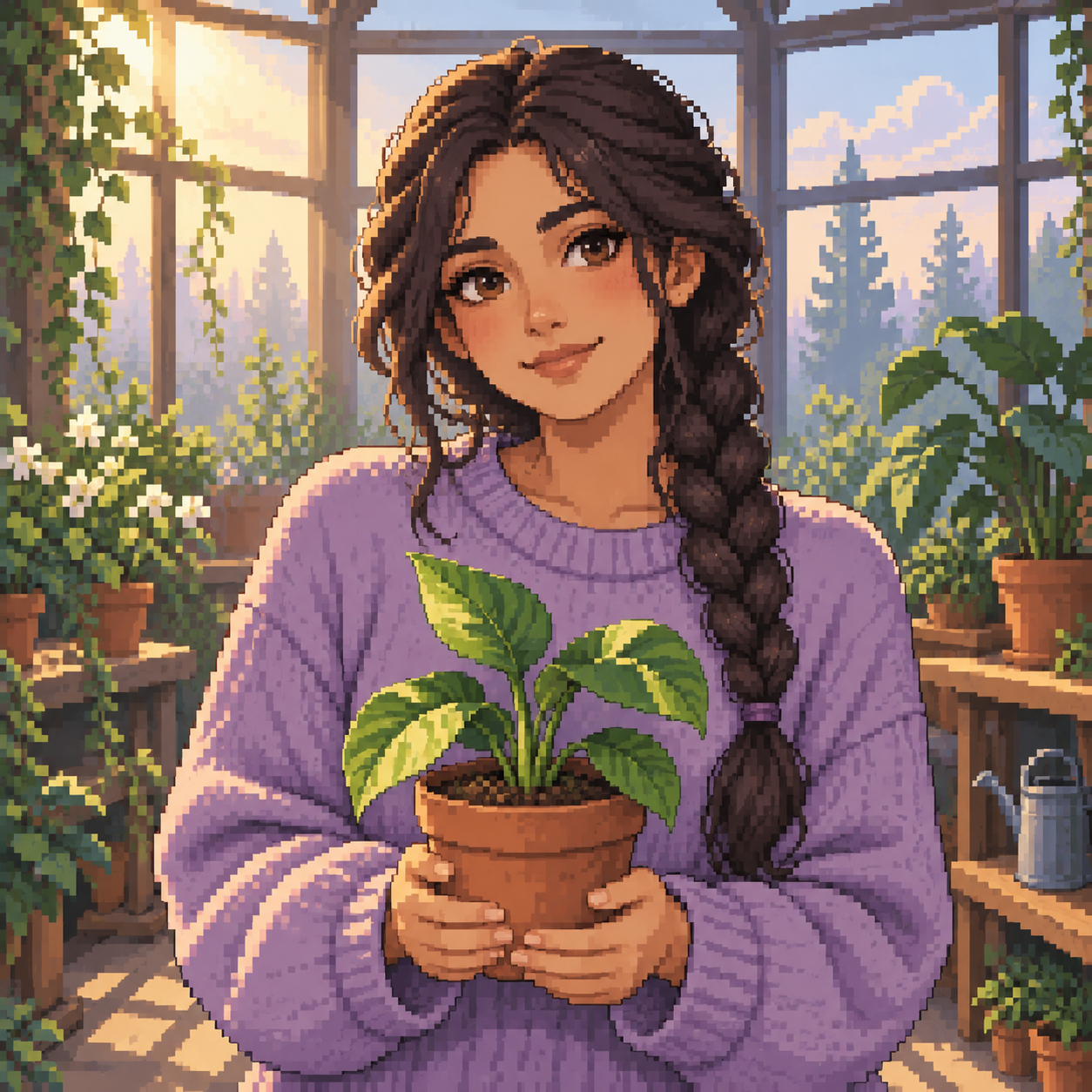
Broad plant shapes make an effective frame if they do not cover the face. The caretaker role is a chosen story detail, with no fixed relationship to a personality type.
Optional type example: INFJ. Replace it with any self-chosen label; the type is added outside the image.
Task: Create one original MBTI-themed pixel-art portrait avatar for a playful self-expression card.
Subject: A fictional adult with long dark hair in a braid, medium olive skin and a lavender sweater, gently holding one small terracotta pot containing one broad-leaf seedling. The optional self-selected theme is INFJ; treat it only as a creative label, never as a personality assessment.
Context: A simple greenhouse corner with three broad window panes and two distant plant silhouettes. A personal profile illustration based on explicitly chosen appearance and interests, with a completely fictional adult.
Style: Carefully drawn retro pixel art with clearly visible square pixel clusters, crisp stepped contours, a restrained color palette and simple two-to-three-tone shading. No smooth painting, 3D rendering, blur or anti-aliased illustration finish.
Composition: Waist-up portrait angled toward the viewer, pot centered below the chest, both supporting hands and the single plant fully within the frame. One person in one continuous scene.
Lighting: Soft early-morning light through the upper-left panes, muted lavender and terracotta tones with clean leaf edges. Render light and shadow as deliberate solid-color pixel clusters.
Constraints: Exactly one fictional adult with a coherent face and body. Keep the chosen hairstyle, clothing and setting readable. No text, letters, MBTI code, numbers, logos, trademarked game characters, watermarks, extra people, duplicated limbs, borders, panels, icon grid, collage or interface. Do not invent biographical facts from the type label.
Output: One finished square 1:1 pixel-art avatar at the closest supported native size. A single full-frame illustration with clean margins; no contact sheet. The type label will be added outside the image later.
- Check one coherent fictional adult, crisp pixel clusters, a readable face and the named single setting/prop. Care for a plant is a selected narrative motif, not a conclusion about empathy or personality.
- Care for a plant is a selected narrative motif, not a conclusion about empathy or personality.
Adjustable parameters
- Palette
- Layered greens and a contrasting clothing color
- Background
- Broad window panes and two distant plant silhouettes
- Lighting
- Soft directional greenhouse light with stepped shading
- Prop
- One small pot with one broad-leaf seedling
- Ratio
- 1:1; check delivered dimensions
Expected result
A clear adult portrait with a simple greenhouse cue and separated foliage.
Failure correction
If the seedling merges with the face, keep the pot below chest height and leave a clear background gap between leaves and hair.
Image tool
GPT built-in image tool. Exact model version unknown.
Retro arcade quest avatar
Retro-game fans making an original arcade avatar.
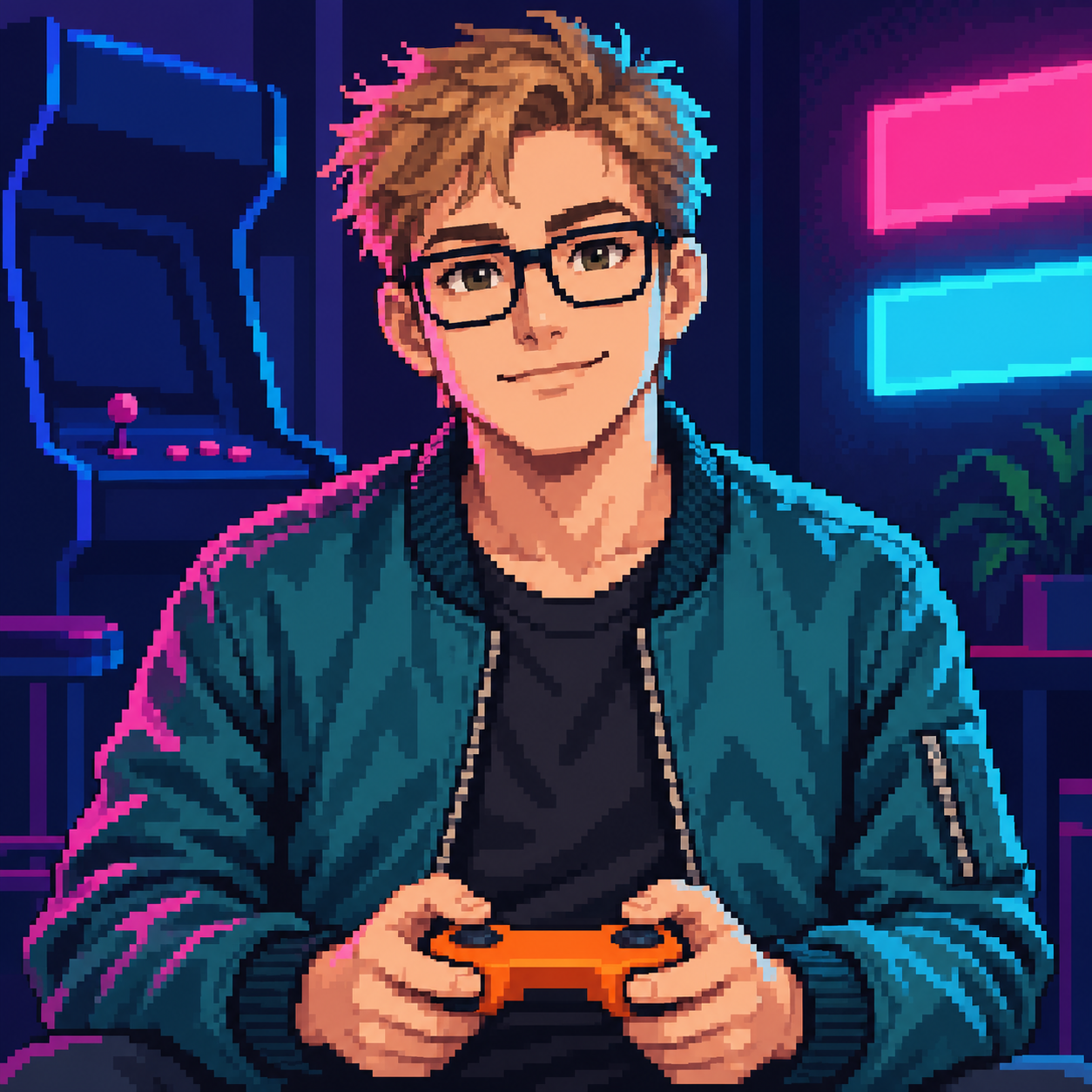
Use an invented arcade setting and an original person. Large dark cabinet shapes and a few light accents can establish the mood without recognizable game characters or interface text.
Optional type example: ENTP. Replace it with any self-chosen label; the type is added outside the image.
Task: Create one original MBTI-themed pixel-art portrait avatar for a playful self-expression card.
Subject: A fictional adult with short sandy hair, dark-framed glasses, fair skin and a teal bomber jacket, holding one small plain orange game controller at waist level. The optional self-selected theme is ENTP; treat it only as a creative label, never as a personality assessment.
Context: A simplified retro arcade corner with one dark blue cabinet silhouette and two broad neon-colored rectangles, no game characters or logos. A personal profile illustration based on explicitly chosen appearance and interests, with a completely fictional adult.
Style: Carefully drawn retro pixel art with clearly visible square pixel clusters, crisp stepped contours, a restrained color palette and simple two-to-three-tone shading. No smooth painting, 3D rendering, blur or anti-aliased illustration finish.
Composition: Front-facing waist-up portrait, head centered and dominant, both hands supporting one controller, all face and hair edges safely inside the square. One person in one continuous scene.
Lighting: Soft cyan light from the right and a narrow magenta rim from the left, readable natural face planes rather than glow covering the eyes. Render light and shadow as deliberate solid-color pixel clusters.
Constraints: Exactly one fictional adult with a coherent face and body. Keep the chosen hairstyle, clothing and setting readable. No text, letters, MBTI code, numbers, logos, trademarked game characters, watermarks, extra people, duplicated limbs, borders, panels, icon grid, collage or interface. Do not invent biographical facts from the type label.
Output: One finished square 1:1 pixel-art avatar at the closest supported native size. A single full-frame illustration with clean margins; no contact sheet. The type label will be added outside the image later.
- Check one coherent fictional adult, crisp pixel clusters, a readable face and the named single setting/prop. The arcade is an elective setting; it does not establish ingenuity, competitiveness or any cognitive trait.
- The arcade is an elective setting; it does not establish ingenuity, competitiveness or any cognitive trait.
Adjustable parameters
- Palette
- Dark base and a limited neon accent
- Setting
- Generic cabinet shapes with no game artwork
- Detail
- No text, score displays or familiar franchise symbols
- Prop
- One small plain orange controller at waist level
- Ratio
- 1:1; check delivered dimensions
Expected result
One fictional adult in a readable arcade portrait with original visual elements.
Failure correction
If neon hides the facial features, reduce it to two background rectangles and ask for a neutral softly lit face.
Image tool
GPT built-in image tool. Exact model version unknown.
Repair blurred pixels, crowded props and weak expressions
Edges look like a blurred photo filter
Reduce competing texture instructions. Ask for deliberate block-shaped clusters, stepped contours and a limited palette. Regenerate and inspect the eyes, hair outline and prop. A generated pixel-style image may still need manual cleanup before it becomes an exact-grid game sprite.
The type label is misspelled
Remove text from the image request and reserve a quiet area for it. Add the four-letter label in a design editor, then review the complete card at its actual display size. Keep the original portrait free of accidental lettering.
A prop merges into the hands
Use one simple object and describe how it is held. Ask for a visible gap between the object and the torso, with both hands clearly separated where they appear. Recheck fingers, wrists and object boundaries.
The mood becomes a stereotype
Replace an abstract type name with observable expression and posture. Ask for a relaxed gaze, a small smile or an attentive stance without assigning intelligence, emotional health or social ability to a face.
The small avatar loses its face
Increase the face’s share of the composition and simplify background shapes. Keep a clear light-dark boundary around the head. Check the final crop instead of relying on the large preview.
The image has too many competing details
Remove extra objects and decorative icons. Keep one main person, one gesture and one focal prop. A quiet background gives the portrait room to read and makes the pixel pattern easier to inspect.
MBTI pixel art portrait questions
How do I write MBTI pixel art prompts?
Describe the portrait you want to see: a fictional adult, a visible expression, a simple pose, a restrained palette and a clear pixel-style treatment. Add one chosen activity or prop. Select the four-letter type yourself as a creative theme; do not expect the image to infer personality from appearance.
Do these ten prompts cover all sixteen MBTI types?
The page provides ten design setups, not one portrait for every type. You can adapt each setup to any self-selected four-letter label and to your own interests. A hobby, outfit or expression is a design choice rather than a fixed characteristic of one type.
Can I turn my selfie into an MBTI pixel art avatar?
These examples show independently generated fictional adults. They do not verify photo-to-pixel conversion or likeness preservation. If you edit a real portrait, use a photograph you are authorized to use and inspect the face, hair and expression against that reference before sharing the result.
Should the four-letter type be generated inside the image?
You can keep the portrait free of lettering and add the type in a design editor. This gives direct control over spelling, type size, contrast and spacing. If you ask the image tool for text, inspect every character and the final small-size rendering.
How do I make pixel art edges look crisp?
Ask for deliberate block-shaped color clusters, stepped outlines, a restrained palette and no soft blur. Check the enlarged result and the final avatar crop. If the project needs an exact logical pixel grid or a production sprite sheet, perform a separate grid and export review.
Can a portrait image identify someone’s personality type?
No. Facial appearance, clothing, hobbies and illustrated gestures cannot establish an MBTI result or diagnose personality. Use a type selected by the person as a playful design theme, and avoid presenting a generated character as psychological evidence.