Then and Now Photo Prompts: 15 Matched Past-and-Present Ideas

Then and now photo prompts tell an image model to place two matched moments in one comparison: the past on the left and the present on the right. The strongest prompts define a shared subject, fixed camera position, continuity anchors, elapsed time, era cues, lighting direction, and a strict two-panel output. For people or pets, describe stable facial features, markings, pose, and eye line while allowing natural aging. For streets, rooms, vehicles, and buildings, lock the viewpoint and surviving structural details before changing materials, use, or surroundings. These 15 copy-ready templates are designed for GPT Image 2 and use fictional, rights-safe subjects. Review every result for identity drift, mixed eras, invented logos, extra panels, false historical detail, and mismatched perspective before publishing it as a then-and-now comparison.

Use these matched past-and-present prompts to lock identity, viewpoint, lighting, and structural anchors while showing one clear change across time.

15 prompts · 15 matched GPT Image 2 results · Updated 2026-07-17

Six steps for a reliable then-and-now comparison

  1. Confirm rights and truth boundaryUse synthetic subjects or source images you own or are licensed to edit, and treat generated reconstruction as interpretation rather than historical proof.
  2. Choose continuity anchorsName at least three features that must remain stable across both panels, such as eye spacing, a window grid, a tree, or a vehicle grille.
  3. Define one time changeSpecify the elapsed period and the exact variable that changes: age, renovation, restoration, season, career stage, or construction.
  4. Lock the shotState the camera position, lens feel, horizon, crop, panel order, divider, and lighting direction.
  5. Generate and inspectReject extra panels, identity drift, mixed eras, unreadable text, invented brands, warped anatomy, moved architecture, or mismatched perspective.
  6. Document the resultKeep the exact visible prompt, output file, model, prompt hash, image hash, and review status together in evidence.

Then and now photo parameter guide

GoalSource conditionAdjustPreserveAvoid
Time gapOne subject at two momentsSeason, decade, life stage, or 20–40-year intervalCore identity and scene anchorsA change too small to read
ContinuityPeople, pets, vehicles, rooms, or placesThree to five named facial, material, or structural featuresAnchor positions and geometryMoved, missing, or substituted anchors
Camera matchMatched comparison panels24–50 mm lens, eye level, horizon, and cropVanishing point and subject scalePerspective or viewpoint drift
Era treatmentHistoric left panel and present right panelMonochrome, faded color, slide film, or clean digital finishReadable subject detailFake damage that hides the scene
Two-panel outputOne result image per promptLeft-right 3:2 or top-bottom 4:5 layoutTwo equal panels and one thin dividerA grid, contact sheet, labels, or third panel

Failure corrections before you rerun

The person or pet changes identity

Why it happens: The prompt describes age or growth without locking invariant geometry and markings.

Prompt correction: Add: preserve the same invariant facial geometry and named marks; change only age-related features.

The two views do not align

Why it happens: Camera position, lens, horizon, or anchor coordinates were left open.

Prompt correction: Add: use one locked tripod position, identical lens, horizon, crop, and vanishing point in both panels.

Past and present details leak across panels

Why it happens: The era-specific changes are listed without assigning them to one side.

Prompt correction: Add: past-only objects stay exclusively in the left panel; present-only objects stay exclusively in the right panel.

The model creates a grid or extra panel

Why it happens: The comparison format is described loosely as a collage.

Prompt correction: Add: exactly two equal panels, one past and one present, separated by one thin divider; no collage and no contact sheet.

Garbled signs, dates, or logos appear

Why it happens: Storefront, school, landmark, or vehicle context invites unsupported text and branding.

Prompt correction: Add: no readable words, dates, trademarks, badges, watermarks, or signage in the image.

The historic panel looks overprocessed

Why it happens: Heavy grain, damage, or color grading replaces plausible photographic character.

Prompt correction: Add: use restrained archival texture; keep faces, masonry, wood, metal, and film grain physically plausible.

15 copy-ready then and now photo prompts

Then and now · GPT Image 2 · Prompt 01

Childhood and Adulthood at the Same Gate

For family-memory concepts or a fictional childhood-to-adulthood comparison.

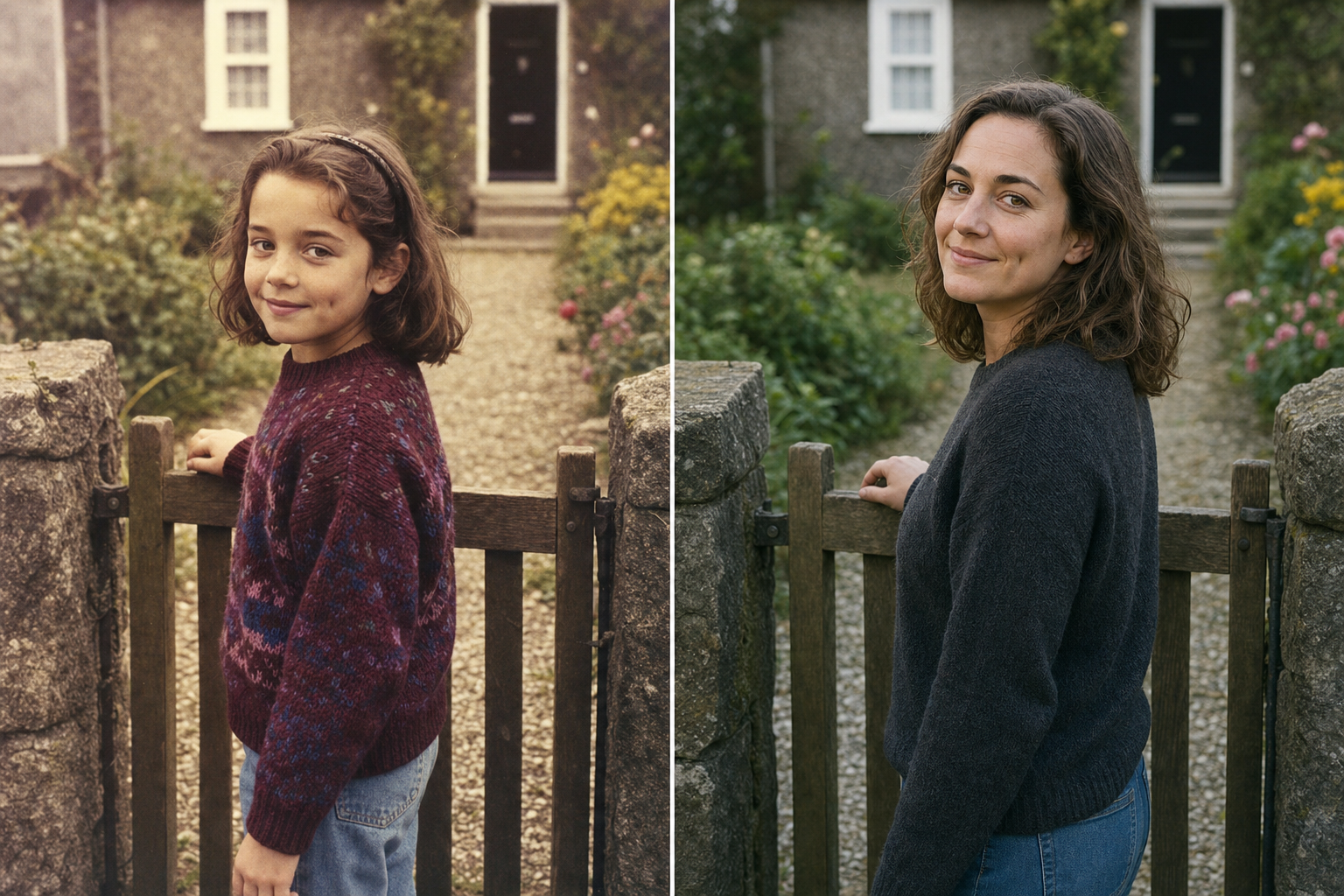
Childhood and adulthood then and now photo at the same garden gate
Childhood and Adulthood at the Same Gate | Best for: For family-memory concepts or a fictional childhood-to-adulthood comparison. | Prompt TN-P01 | Check: exactly two panels, natural age progression, matching facial anchors, aligned gate and eye line, intact hands, and no text or logos | If it fails: If identity drifts, add: Treat the right subject as the naturally aged version of the left subject; preserve exact eye spacing, nose shape, dimple position, and smile asymmetry.
Expected result

One recognizable fictional person shown at two believable ages, with the gate and pose creating immediate visual continuity.

Copy-ready tested prompt
Create a documentary-style then-and-now photo composite showing the same fictional person at age eight on the left and age thirty-eight on the right, standing at the same modest garden gate for a family-memory project. Preserve shared facial anchors: hazel eyes, rounded brows, a small left-cheek dimple, and the same relaxed half-smile; age the face and body naturally and use age-appropriate, unbranded clothing. Give the past panel a warm early-1990s consumer-film look with restrained grain and mild fading, and the present panel clean contemporary editorial photography. Use two equal side-by-side panels separated by one thin neutral divider; align head height, body angle, eye line, gate posts, and camera distance. Use soft overcast morning light from the same direction in both panels. No printed labels, no famous likeness, no beauty retouching, no adult proportions on the child, no duplicated limbs, and no extra panels. Output one horizontal 3:2 composite at 1536×1024 with sharp faces and a coherent background.
Adjustable parameters
Age gap=20/30/40 years | anchor=gate/porch/tree | era=1980s/1990s/2000s | layout=left-right/top-bottom
Failure correction
If identity drifts, add: Treat the right subject as the naturally aged version of the left subject; preserve exact eye spacing, nose shape, dimple position, and smile asymmetry.
Review focus
exactly two panels, natural age progression, matching facial anchors, aligned gate and eye line, intact hands, and no text or logos
Tested model
GPT Image 2
Then and now · GPT Image 2 · Prompt 02

Old Street and Modern Streetscape

For local-history storytelling without depicting a real named street.

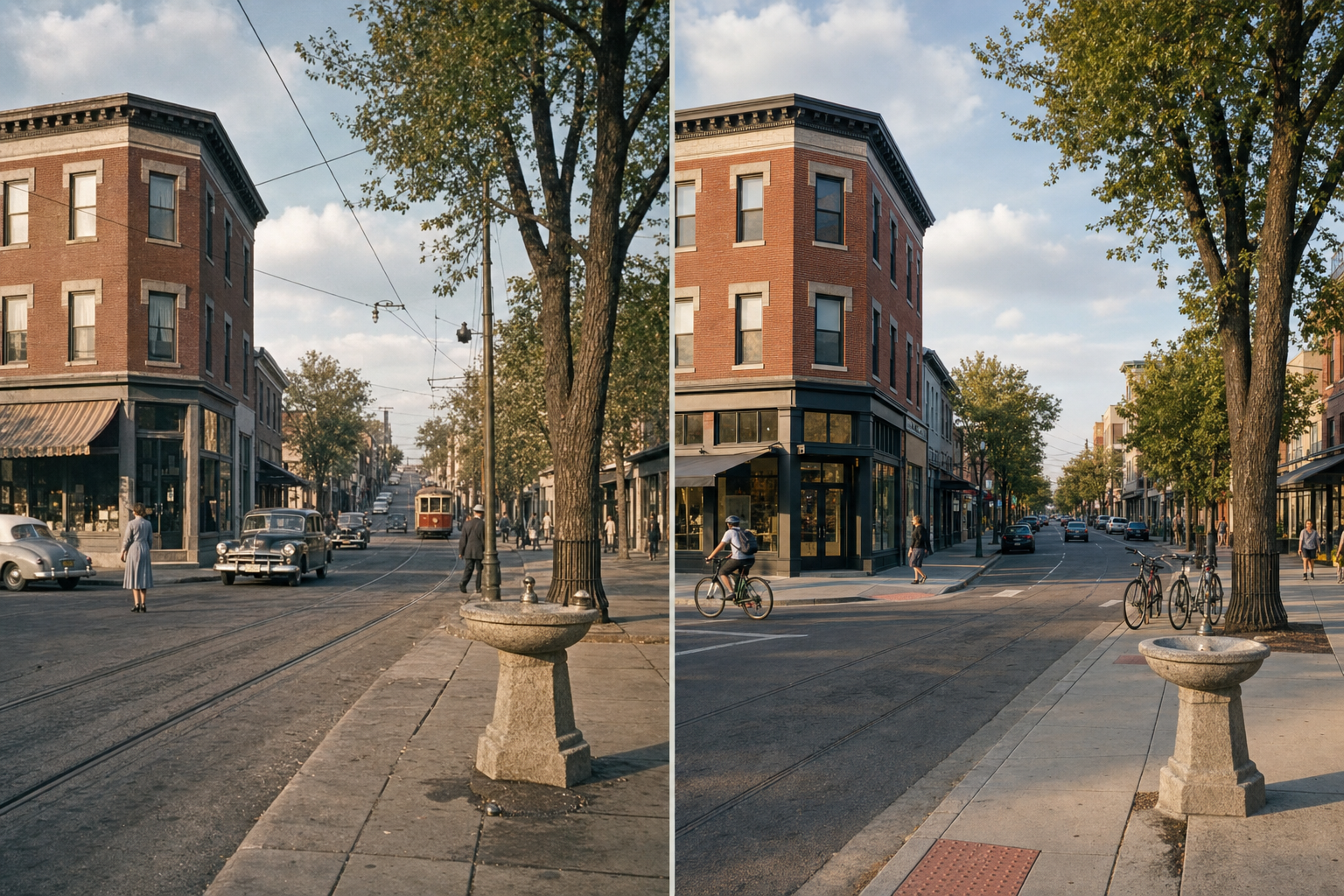
Old street and modern streetscape then and now comparison
Old Street and Modern Streetscape | Best for: For local-history storytelling without depicting a real named street. | Prompt TN-P02 | Check: same viewpoint and corner building, clean era separation, period-appropriate generic vehicles, and no real signs, logos, or impossible geometry | If it fails: If the views do not align, add: Lock the corner building outline, fountain position, curb line, horizon, and vanishing point identically across both panels.
Expected result

A clearly matched street view whose surviving anchors make the passage of time credible.

Copy-ready tested prompt
Create a then-and-now architectural photo composite of the same fictional neighborhood intersection, shown in 1958 on the left and in the present day on the right, for a local-history feature. The subject is a narrow main street anchored by a three-story brick corner building, a stone drinking fountain, two mature street-tree positions, and tram tracks that remain faintly visible after the route closes. Render the past as restrained colorized archival street photography with fine grain and period-appropriate generic vehicles; render the present as crisp documentary photography with bicycles, accessible sidewalks, and updated but plausible storefronts. Use the exact same eye-level camera position, 35 mm field of view, horizon, vanishing point, and building scale in two equal panels. Match late-afternoon sunlight from camera left and similar cloud cover. No readable business names, trademarks, famous buildings, fantasy towers, duplicated pedestrians, false dates, or extra panels. Output one horizontal 3:2 composite at 1536×1024 with a thin neutral divider and no embedded words.
Adjustable parameters
Past year=1930/1958/1985 | modernization=light/moderate/major | weather=clear/overcast | traffic=quiet/busy
Failure correction
If the views do not align, add: Lock the corner building outline, fountain position, curb line, horizon, and vanishing point identically across both panels.
Review focus
same viewpoint and corner building, clean era separation, period-appropriate generic vehicles, and no real signs, logos, or impossible geometry
Tested model
GPT Image 2
Then and now · GPT Image 2 · Prompt 03

Old House and Renovated Interior

For renovation planning or a fictional heritage-home transformation.

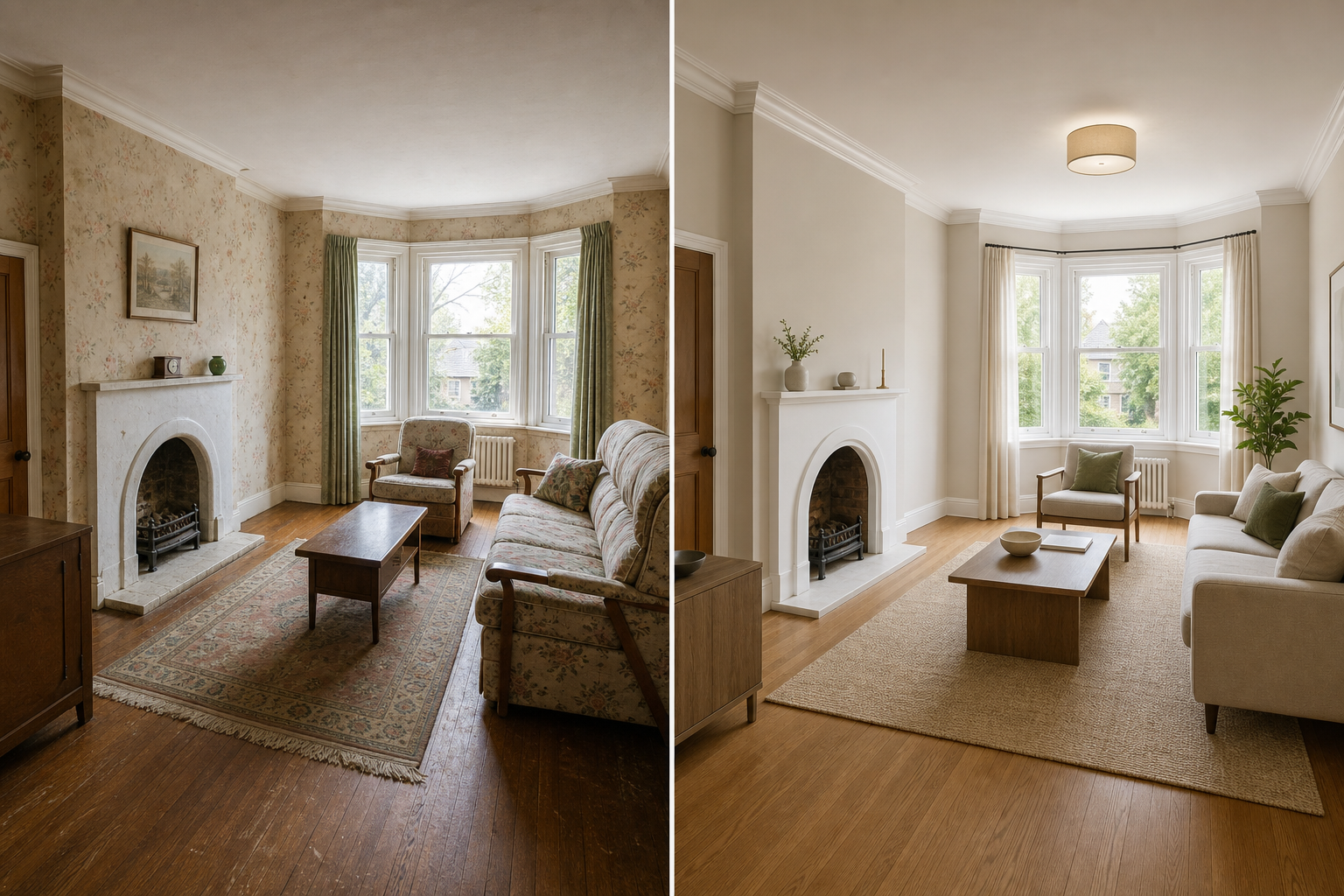
Old house interior and renovated room then and now photo
Old House and Renovated Interior | Best for: For renovation planning or a fictional heritage-home transformation. | Prompt TN-P03 | Check: matching shell geometry, plausible renovation, aligned light direction, realistic materials, and no room expansion, branding, text, or third view | If it fails: If the room geometry changes, add: Do not alter the room shell: keep every opening, wall length, fireplace edge, floorboard direction, and lens perspective fixed.
Expected result

A believable renovation in which the room’s structure remains fixed and only finishes, furnishings, and condition change.

Copy-ready tested prompt
Create a photorealistic then-and-now interior composite of the same fictional 1940s living room before renovation on the left and after a sensitive modern renovation on the right, for a residential design case study. Preserve the original arched fireplace, three-pane bay window, ceiling height, oak floor direction, door position, and camera location. In the past panel show worn floral wallpaper, a faded rug, simple timber furniture, and gentle signs of age; in the present panel show repaired plaster, warm neutral paint, restored flooring, efficient concealed lighting, and contemporary unbranded furniture while retaining the room’s historic character. Use architectural editorial photography, two equal side-by-side panels, identical 24 mm lens perspective, matching crop, and aligned verticals. Let midday window light enter from the same angle with comparable exposure. No widened room, moved windows, impossible openings, logos, readable artwork text, excessive luxury, people, or extra panels. Output one horizontal 3:2 composite at 1536×1024 with a slim divider and realistic material texture.
Adjustable parameters
Room=living room/kitchen/bedroom | renovation=heritage/minimal/accessible | palette=warm/cool/earthy
Failure correction
If the room geometry changes, add: Do not alter the room shell: keep every opening, wall length, fireplace edge, floorboard direction, and lens perspective fixed.
Review focus
matching shell geometry, plausible renovation, aligned light direction, realistic materials, and no room expansion, branding, text, or third view
Tested model
GPT Image 2
Then and now · GPT Image 2 · Prompt 04

Two Generations Re-create a Family Pose

For a rights-safe concept for a generational family portrait.

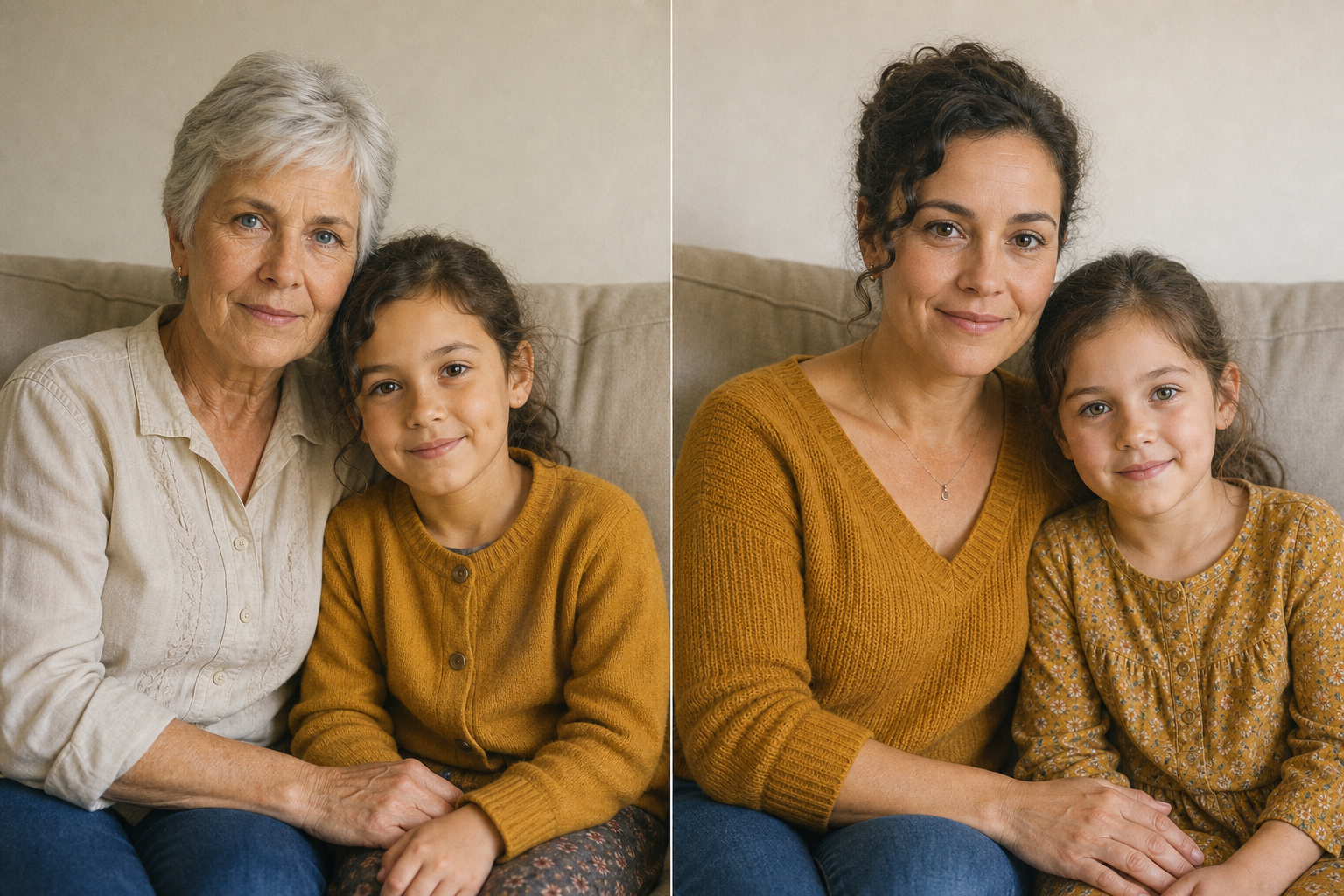
Two generations re-create the same family portrait pose
Two Generations Re-create a Family Pose | Best for: For a rights-safe concept for a generational family portrait. | Prompt TN-P04 | Check: consistent middle identity, distinct new child, aligned pose and sofa, age-appropriate children, and intact hands | If it fails: If faces are cloned or identity is lost, add: The adult on the right is the naturally aged child from the left; the younger child on the right is a distinct relative, not a duplicate face.
Expected result

A readable generational echo rather than three cloned faces.

Copy-ready tested prompt
Create a warm generational then-and-now family portrait composite using entirely fictional people. LEFT PANEL, 1992: a fifty-five-year-old grandmother with short silver hair, blue eyes, and an angular face sits beside her eight-year-old granddaughter, who has almond-shaped brown eyes, a softly squared jaw, a narrow nose bridge, a small left-cheek dimple, and one curl over her right temple; the child wears a mustard cardigan. RIGHT PANEL, present day: show that exact granddaughter naturally aged to forty-two, preserving her brown eyes, squared jaw, narrow nose, dimple, and right-temple curl, seated beside her own distinct eight-year-old daughter, who has green eyes and a rounder face. The silver-haired grandmother from the left must not appear on the right. The adult on the right must be the aged version of the child on the left, not the adult on the left; echo the mustard color in her present-day clothing to reinforce continuity. Style the past as modest 1990s household film photography and the present as natural contemporary family editorial photography. Use the same plain apartment sofa, two equal side-by-side panels, matched waist-up framing, sofa seams, hand placement, head spacing, and eye level. Match soft window light from camera right. Use age-appropriate unbranded clothing. No famous likenesses, copied faces, glamour retouching, adult styling on children, extra fingers, merged bodies, text, or extra panels. Output one horizontal 3:2 composite at 1536×1024.
Adjustable parameters
Relationship=mother-daughter/father-son/grandparent-grandchild | era gap=25/30/40 years | setting=sofa/porch/garden
Failure correction
If faces are cloned or identity is lost, add: The adult on the right is the naturally aged child from the left; the younger child on the right is a distinct relative, not a duplicate face.
Review focus
consistent middle identity, distinct new child, aligned pose and sofa, age-appropriate children, and intact hands
Tested model
GPT Image 2
Then and now · GPT Image 2 · Prompt 05

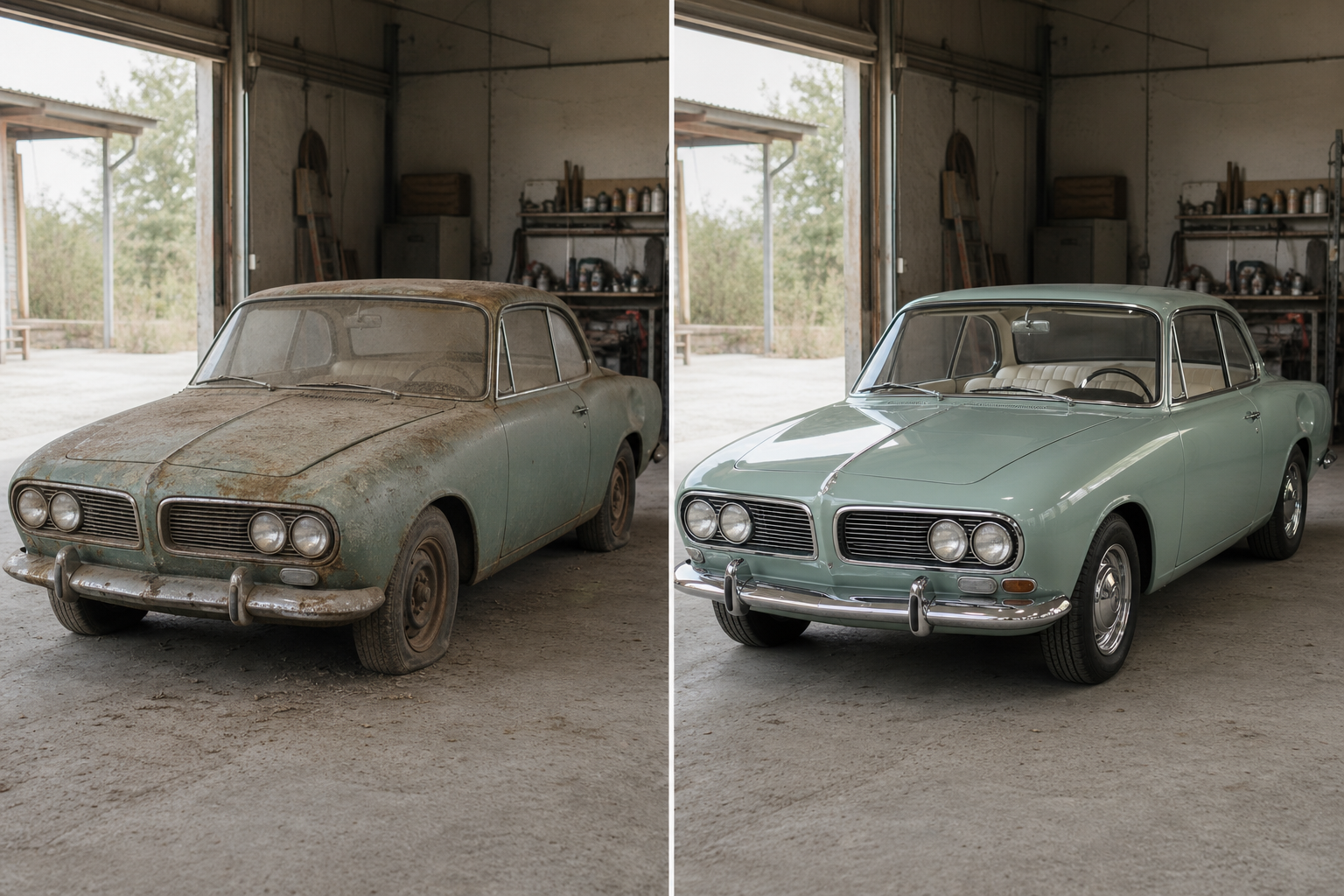
Vintage Car Before and After Restoration

For restoration-shop concepts, collector presentations, or automotive storytelling.

Vintage car before and after restoration then and now photo
Vintage Car Before and After Restoration | Best for: For restoration-shop concepts, collector presentations, or automotive storytelling. | Prompt TN-P05 | Check: matching body geometry, plausible restoration, coherent wheels and reflections, and no badges, plate text, or model substitution | If it fails: If the vehicle design changes, add: Use one invariant vehicle mesh across both panels; preserve grille, headlights, roofline, wheelbase, dent location, and camera angle exactly.
Expected result

The exact same fictional car progresses from neglected to restored without changing design.

Copy-ready tested prompt
Create an automotive then-and-now composite of the same fictional 1960s two-door touring coupe before restoration on the left and after restoration on the right. Give the car distinctive but unbranded anchors: sea-green bodywork, round paired headlights, a narrow split chrome grille, one shallow dent above the rear wheel, and cream interior piping. In the past panel place it in a dusty open garage with oxidized paint, flat tires, cloudy glass, and surface rust; in the present panel show a careful roadworthy restoration with polished paint, repaired trim, clean tires, and the same body geometry. Use premium but realistic automotive editorial photography. Compose two equal three-quarter front views at identical camera height, 50 mm perspective, wheel angle, and crop. Match broad softbox-like daylight from upper left and neutral reflections. No manufacturer badge, license text, impossible wheel count, altered model shape, showroom fantasy, people, embedded labels, or extra panels. Output one horizontal 3:2 composite at 1536×1024 with a narrow divider and crisp mechanical detail.
Adjustable parameters
Vehicle=coupe/pickup/roadster | damage=light/moderate/heavy | restored finish=original/patina/custom
Failure correction
If the vehicle design changes, add: Use one invariant vehicle mesh across both panels; preserve grille, headlights, roofline, wheelbase, dent location, and camera angle exactly.
Review focus
matching body geometry, plausible restoration, coherent wheels and reflections, and no badges, plate text, or model substitution
Tested model
GPT Image 2
Then and now · GPT Image 2 · Prompt 06

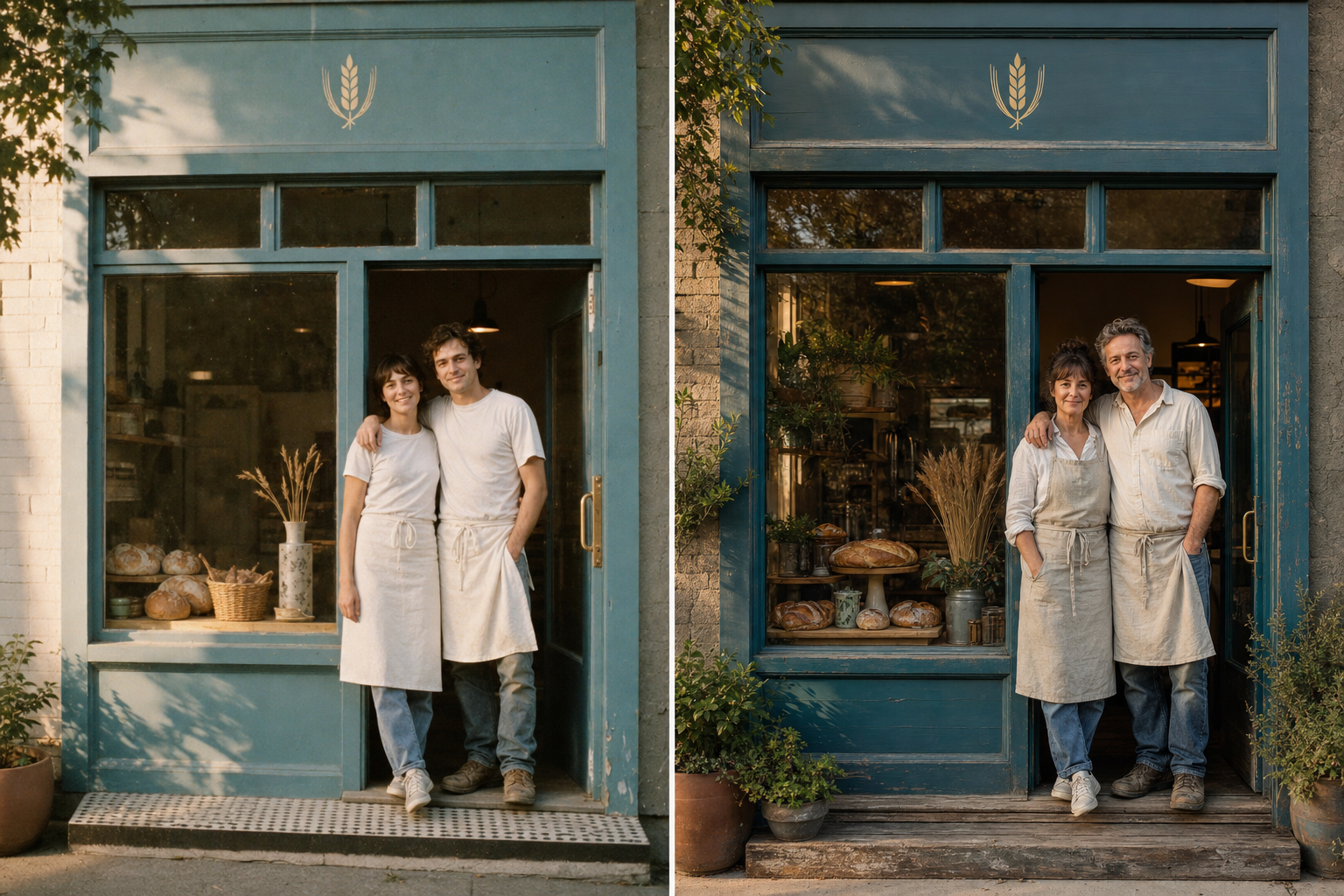
Shop Opening Day and Decades Later

For fictional small-business anniversary visuals.

Shop opening day and thirty years later then and now photo
Shop Opening Day and Decades Later | Best for: For fictional small-business anniversary visuals. | Prompt TN-P06 | Check: aligned storefront structure, natural founder aging, wordless emblem, coherent displays, and no real branding or malformed lettering | If it fails: If the storefront or founders drift, add: Keep the facade grid, transom count, emblem shape, door hardware, founder identities, and camera coordinates unchanged.
Expected result

The same fictional shop and founders visibly mature without losing their defining anchors.

Copy-ready tested prompt
Create a narrative then-and-now composite of the same fictional corner bakery on opening day in 1996 on the left and thirty years later on the right. Anchor both panels with the same narrow blue-green storefront, three upper transom panes, tiled doorstep, brass door handle, and simple wheat-shaped emblem with no words. Show the same fictional founder couple standing in the doorway: young adults in the past and naturally aged adults in the present, with consistent facial geometry and posture. The past should feel like candid consumer-film photography with modest displays and fresh paint; the present should feel like polished documentary editorial photography with a mature storefront, weathered threshold, plants, and a fuller window display. Use identical eye-level framing, 35 mm field of view, doorway alignment, and two equal panels. Match gentle golden-hour light from camera left. No readable signs, real brand, famous likeness, duplicated customers, luxury redesign, false lettering, or extra panels. Output one horizontal 3:2 composite at 1536×1024 with a clean divider.
Adjustable parameters
Business=bakery/florist/bookshop | interval=10/20/30 years | people=owners/no people | season=spring/autumn
Failure correction
If the storefront or founders drift, add: Keep the facade grid, transom count, emblem shape, door hardware, founder identities, and camera coordinates unchanged.
Review focus
aligned storefront structure, natural founder aging, wordless emblem, coherent displays, and no real branding or malformed lettering
Tested model
GPT Image 2
Then and now · GPT Image 2 · Prompt 07

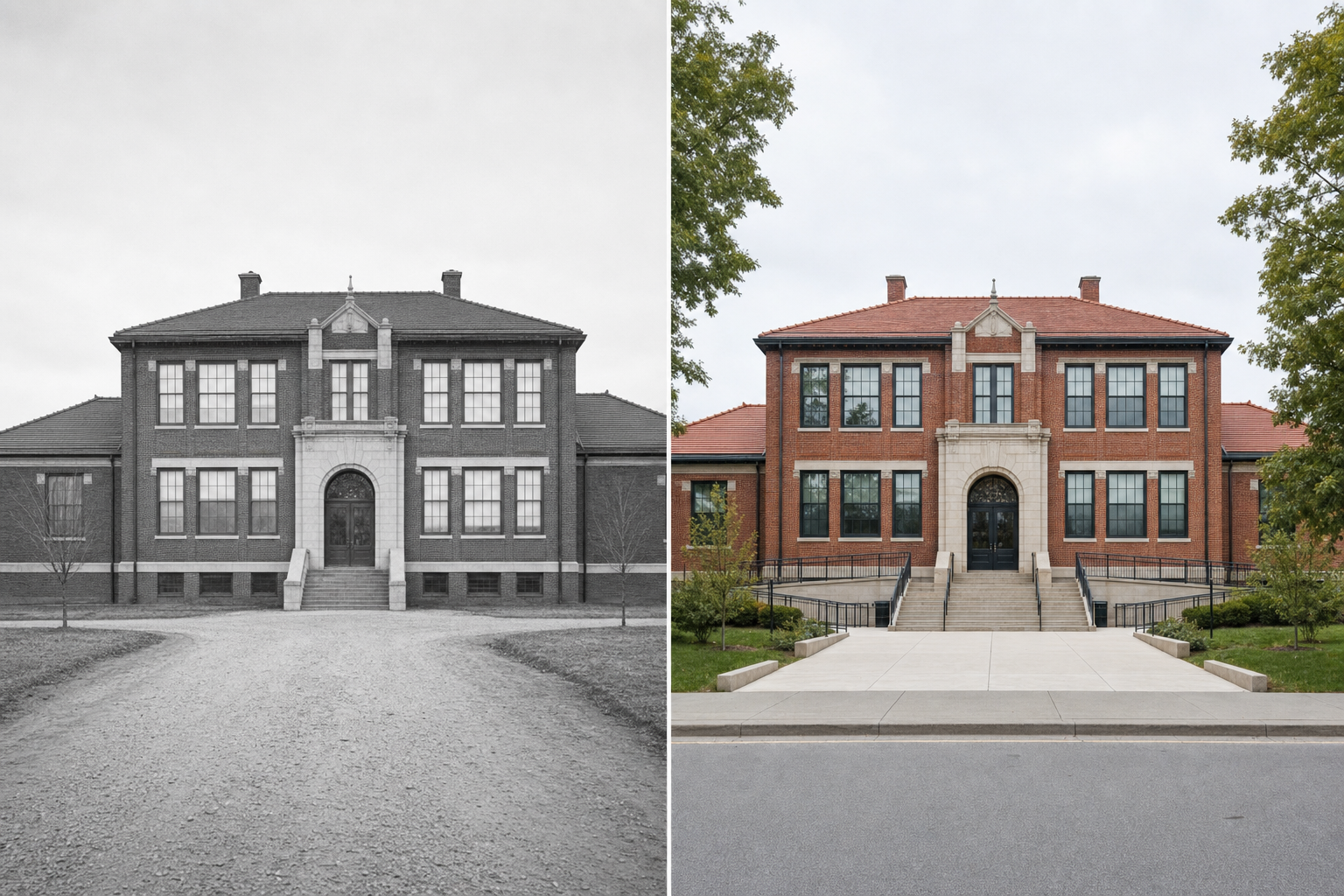
School Building Past and Present

For fictional school-history or adaptive-renovation storytelling.

School building past and present architectural comparison
School Building Past and Present | Best for: For fictional school-history or adaptive-renovation storytelling. | Prompt TN-P07 | Check: matching twelve-window rhythm and central arch, plausible ramps, fixed viewpoint, and no readable plaque, extra floor, or perspective shift | If it fails: If the facade changes, add: Trace the same facade silhouette and window grid into both panels before adding any period-specific changes.
Expected result

A historically legible school comparison with accessibility updates that do not rewrite the original architecture.

Copy-ready tested prompt
Create an architectural then-and-now composite of the same fictional neighborhood school in 1935 on the left and after a careful present-day update on the right. The subject is a symmetrical red-brick building with a central stone arch, twelve tall windows, two short wings, and a broad front staircase. Render the past as clean monochrome archival photography with sparse landscaping and a gravel approach; render the present as natural color documentary photography with restored masonry, accessible side ramps, mature trees, and a safe paved forecourt. Use the exact same centered street-level viewpoint, 35 mm lens, horizon, facade scale, and vertical alignment in two equal side-by-side panels. Match bright overcast daylight so shadows do not hide the architecture. Preserve the main massing and window rhythm. No real school name, readable plaque, logo, flag emphasis, famous campus, invented extra floor, crowds, warped bricks, embedded labels, or extra panels. Output one horizontal 3:2 composite at 1536×1024 with a thin divider and clear facade detail.
Adjustable parameters
Past year=1910/1935/1970 | update=restoration/extension/accessibility | season=leafless/full foliage
Failure correction
If the facade changes, add: Trace the same facade silhouette and window grid into both panels before adding any period-specific changes.
Review focus
matching twelve-window rhythm and central arch, plausible ramps, fixed viewpoint, and no readable plaque, extra floor, or perspective shift
Tested model
GPT Image 2
Then and now · GPT Image 2 · Prompt 08

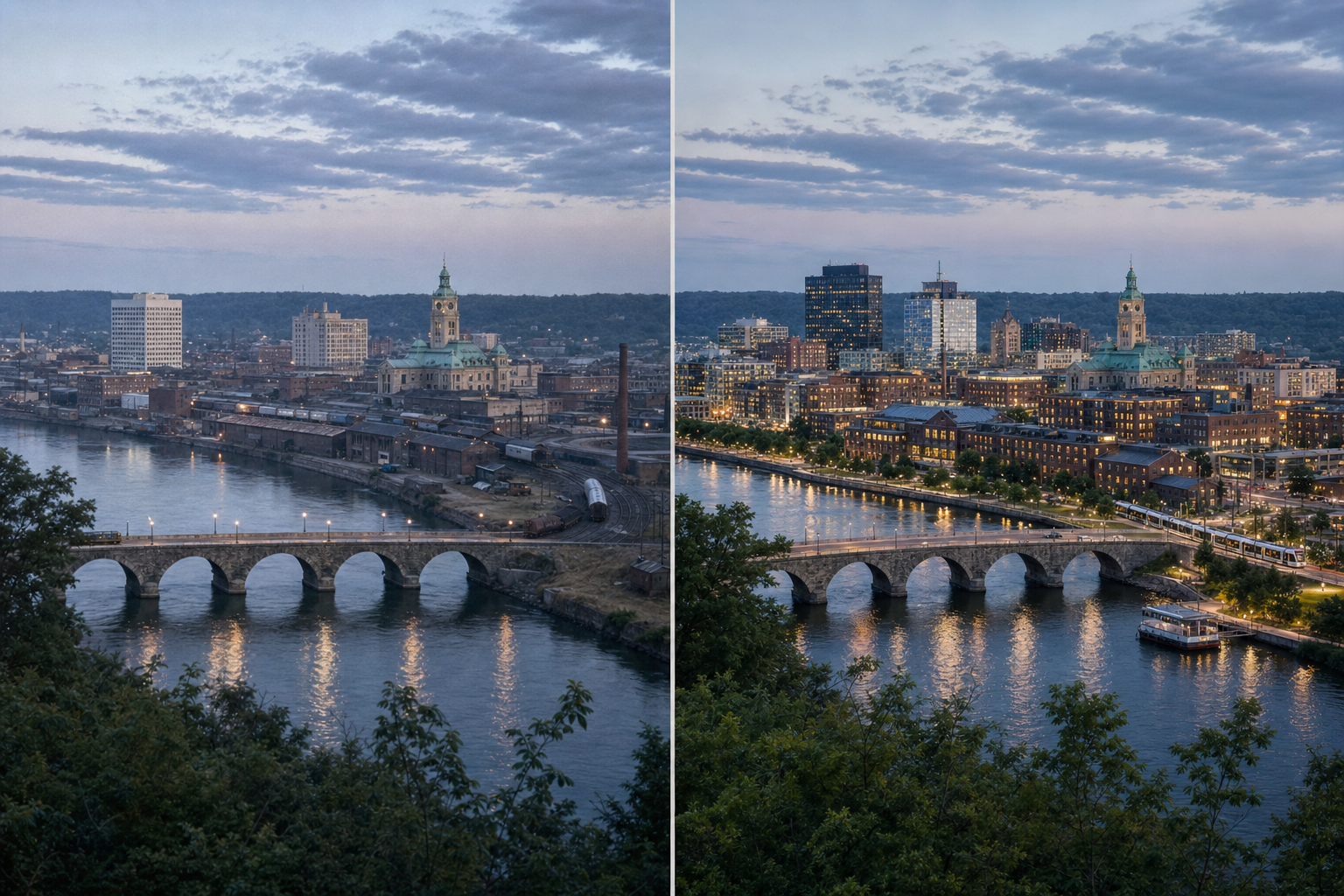
City Skyline Across Five Decades

For urban-change concepts without reproducing a real protected skyline.

Fictional city skyline then and now across five decades
City Skyline Across Five Decades | Best for: For urban-change concepts without reproducing a real protected skyline. | Prompt TN-P08 | Check: aligned bridge, tower, river, and ridge, original modern architecture, coherent reflections, and no recognizable skyline, text, or third panel | If it fails: If the skyline no longer matches, add: Preserve the bridge arches, river curve, civic tower coordinates, ridge contour, horizon, and lens compression exactly.
Expected result

A believable fictional skyline evolution grounded by the bridge, civic tower, river, and ridge.

Copy-ready tested prompt
Create a cinematic documentary then-and-now composite of the same fictional river city skyline in 1974 on the left and in the present day on the right. Use stable anchors including a low stone bridge with five arches, a copper-roofed civic tower, the river bend, and a wooded ridge. In the past panel show warehouses, rail sheds, modest mid-rise blocks, and restrained faded slide-film color; in the present panel show a plausible mix of converted warehouses, transit, parks, and original contemporary high-rises that do not copy any famous building. Compose both views from the same elevated riverside overlook with identical 50 mm perspective, horizon, bridge placement, and two equal panels. Use matching blue-hour light, the same cloud pattern direction, and coherent reflections on the water. No named city, trademark architecture, readable signs, fantasy megatowers, erased historic anchors, impossible bridge geometry, dramatic disaster, labels, or extra panels. Output one horizontal 3:2 composite at 1536×1024 with a narrow neutral divider.
Adjustable parameters
Interval=25/50/75 years | city growth=low/moderate/high | viewpoint=riverbank/hill/bridge
Failure correction
If the skyline no longer matches, add: Preserve the bridge arches, river curve, civic tower coordinates, ridge contour, horizon, and lens compression exactly.
Review focus
aligned bridge, tower, river, and ridge, original modern architecture, coherent reflections, and no recognizable skyline, text, or third panel
Tested model
GPT Image 2
Then and now · GPT Image 2 · Prompt 09

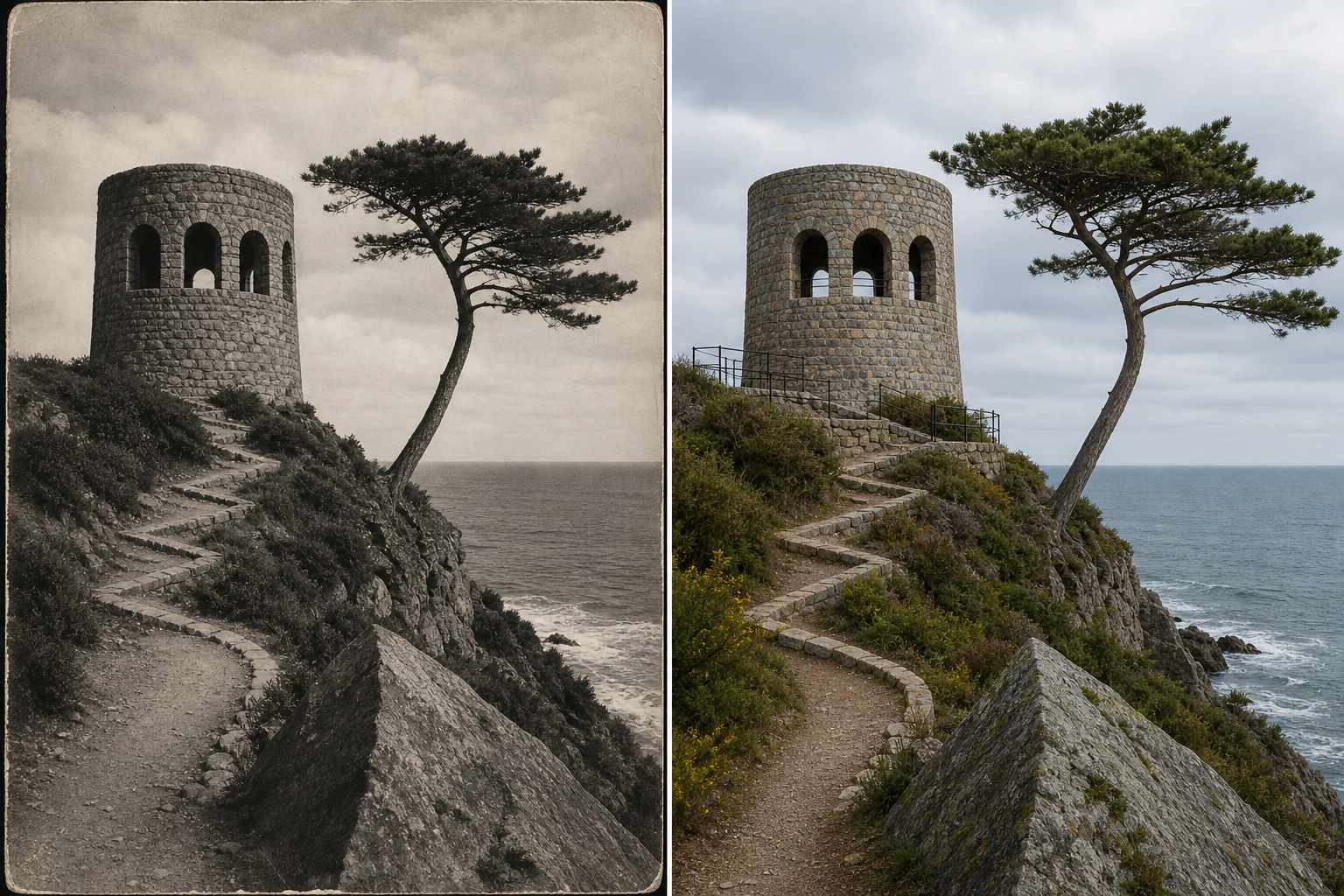
Travel Landmark Old Photo Re-created

For a travel rephotography guide using an invented landmark.

Travel landmark old photo re-created from the same viewpoint
Travel Landmark Old Photo Re-created | Best for: For a travel rephotography guide using an invented landmark. | Prompt TN-P09 | Check: matching viewpoint and five anchors, subtle safety update, accurate tonal separation, and no real landmark, plaque text, or fantasy additions | If it fails: If the rephotography viewpoint drifts, add: Overlay the tower openings, foreground rock, pine trunk, path bends, and horizon at the same pixel positions in both panels.
Expected result

A convincing rephotography pair whose camera match is obvious without relying on labels.

Copy-ready tested prompt
Create a travel-editorial then-and-now composite of the same fictional cliffside stone observation tower, photographed in 1932 on the left and rephotographed from the identical spot today on the right. Anchor the scene with the tower’s three arched openings, a zigzag footpath, one leaning coastal pine, the horizon line, and a triangular foreground rock. Treat the past as a carefully preserved monochrome travel snapshot with fine grain, slight edge wear, and accurate tonal range; treat the present as crisp natural-color photography showing repaired stonework, a discreet safety rail, and mature vegetation. Use two equal side-by-side panels with identical eye-level camera coordinates, 40 mm field of view, horizon height, and landmark scale. Match soft maritime overcast light and wind direction. No real landmark, place name, tourism logo, readable plaque, invented ruins, people blocking anchors, false text, dramatic fantasy scenery, or extra panels. Output one horizontal 3:2 composite at 1536×1024 with a slim divider.
Adjustable parameters
Landmark=tower/bridge/pavilion | interval=50/90/120 years | condition=preserved/restored/weathered
Failure correction
If the rephotography viewpoint drifts, add: Overlay the tower openings, foreground rock, pine trunk, path bends, and horizon at the same pixel positions in both panels.
Review focus
matching viewpoint and five anchors, subtle safety update, accurate tonal separation, and no real landmark, plaque text, or fantasy additions
Tested model
GPT Image 2
Then and now · GPT Image 2 · Prompt 10

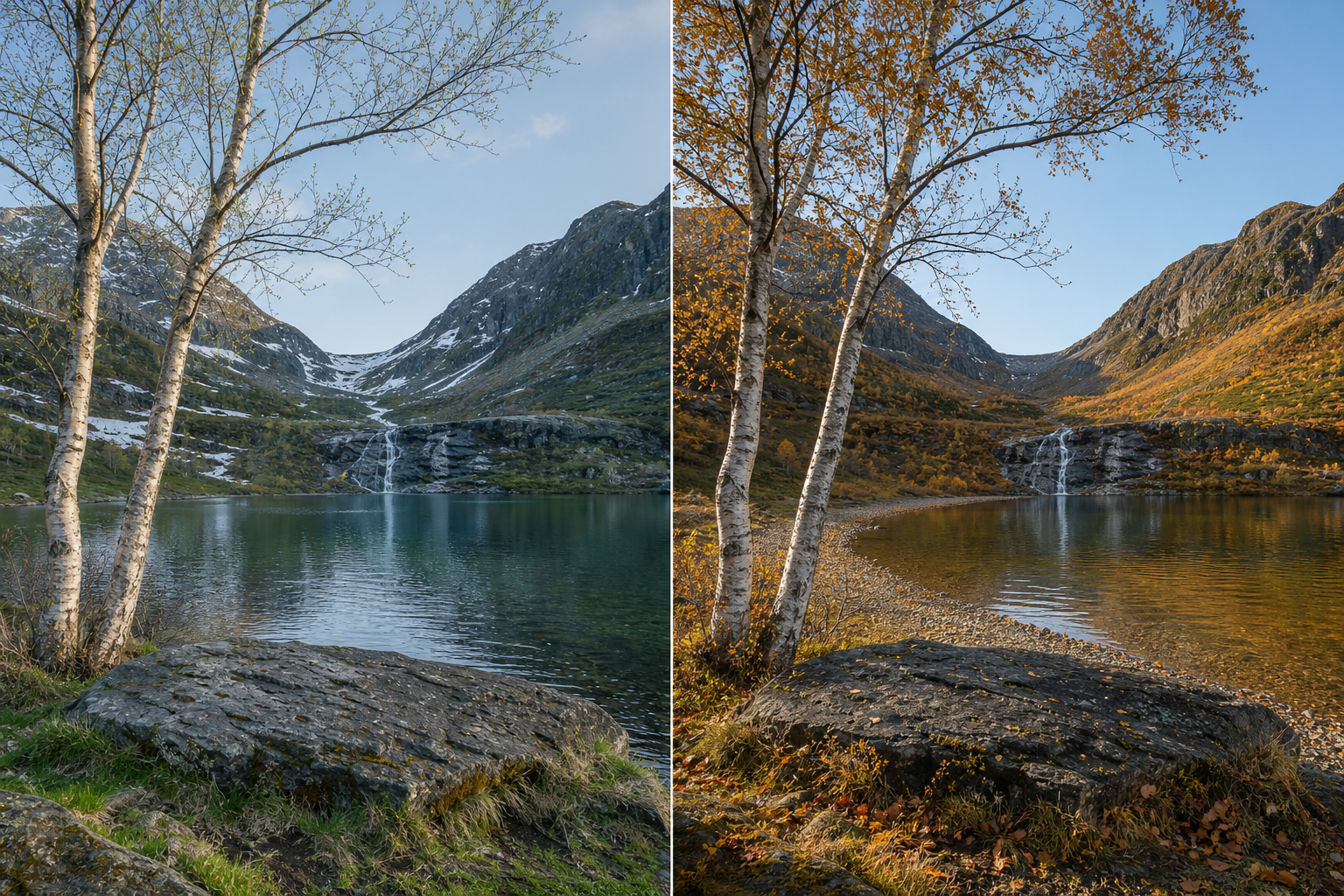
One Natural Place in Two Seasons

For seasonal storytelling, destination planning, or environmental mood studies.

Same mountain lake in spring and autumn then and now photo
One Natural Place in Two Seasons | Best for: For seasonal storytelling, destination planning, or environmental mood studies. | Prompt TN-P10 | Check: aligned tree, boulder, waterfall, mountain, and shore, stable geology, distinct restrained seasons, and no exaggerated environmental change | If it fails: If geology changes, add: Freeze all geology and camera geometry; change only vegetation phase, snow cover, water level, and seasonal color.
Expected result

A stable landscape whose seasonal differences are visually rich but geographically plausible.

Copy-ready tested prompt
Create a naturalistic then-and-now seasonal composite of the same fictional mountain lake in early spring on the left and late autumn on the right. Lock the place with a forked silver-bark tree at frame left, a flat dark boulder in the foreground, a narrow waterfall across the lake, the mountain saddle, and the exact shoreline curve. In spring show thin snow remnants, pale new grass, high water, and cool blue-green tones; in autumn show amber foliage, lower water revealing a narrow pebble band, and crisp copper-green color. Use high-end landscape documentary photography rather than fantasy art. Compose two equal side-by-side panels from the same tripod position, 28 mm lens, camera height, horizon, and crop. Match low morning sunlight from camera right and similar calm weather so the seasonal change remains the main variable. No buildings, people, text, impossible tree growth, changed mountain shape, mirrored waterfall, extreme climate disaster, oversaturation, or extra panels. Output one horizontal 3:2 composite at 1536×1024 with realistic vegetation and a thin divider.
Adjustable parameters
Seasons=spring-autumn/summer-winter/wet-dry | water level=stable/moderate change | weather=clear/mist
Failure correction
If geology changes, add: Freeze all geology and camera geometry; change only vegetation phase, snow cover, water level, and seasonal color.
Review focus
aligned tree, boulder, waterfall, mountain, and shore, stable geology, distinct restrained seasons, and no exaggerated environmental change
Tested model
GPT Image 2
Then and now · GPT Image 2 · Prompt 11

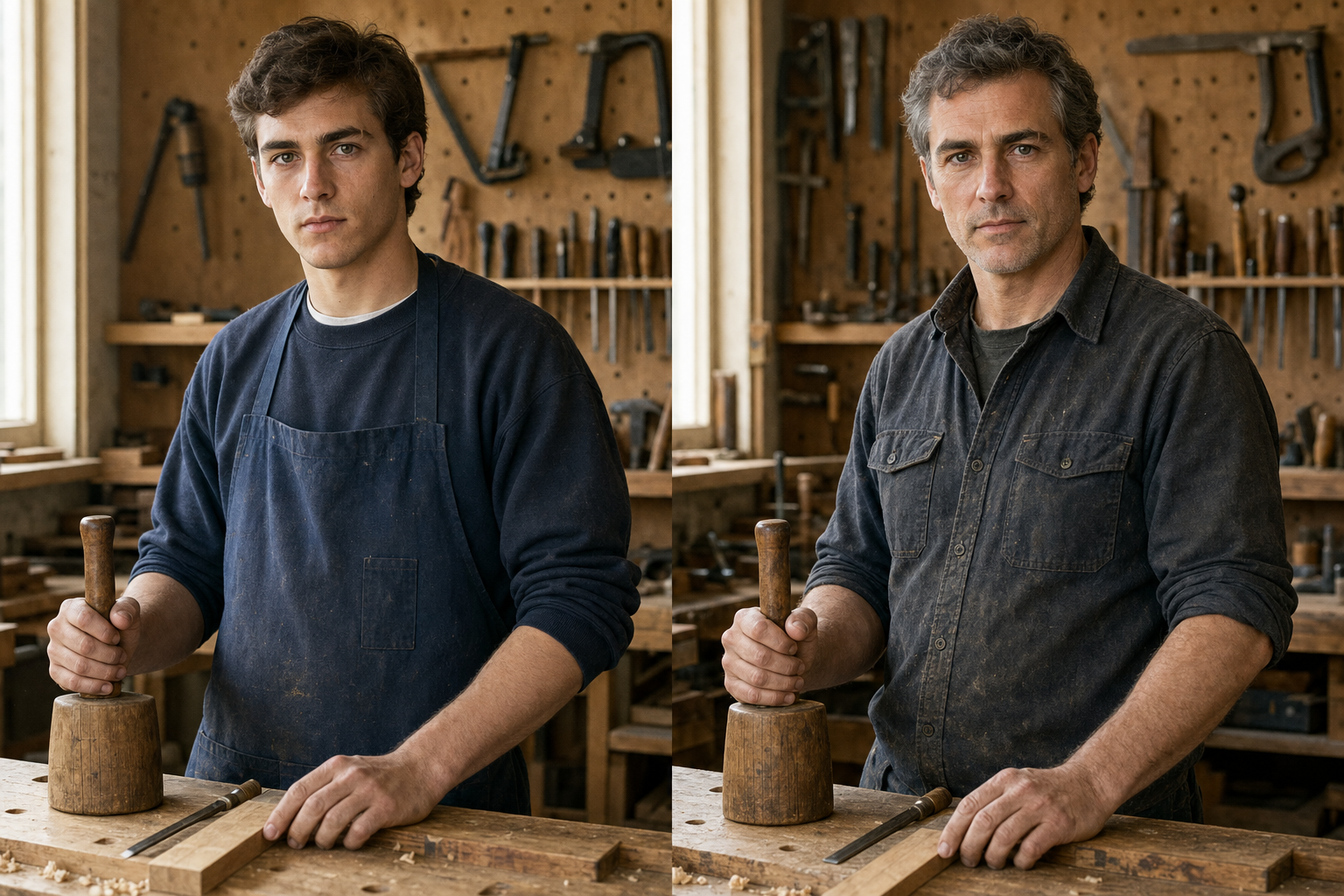
Career First Day and Present Day

For professional milestone or retirement-story concepts with a fictional subject.

Career first day and present day furniture maker portrait
Career First Day and Present Day | Best for: For professional milestone or retirement-story concepts with a fictional subject. | Prompt TN-P11 | Check: natural identity aging, matching pose and bench, safe tool use, intact hands, and no logo, readable plan, or face substitution | If it fails: If identity or pose changes, add: Preserve the eyebrow notch, eye spacing, cheekbone width, pose, hand location, workbench scars, and peg pattern across both panels.
Expected result

A grounded career progression with the same person and workbench connecting both eras.

Copy-ready tested prompt
Create an editorial then-and-now portrait composite of the same fictional furniture maker at the beginning of an apprenticeship in 1999 on the left and as an experienced workshop owner in the present day on the right. Preserve recognizable anchors: deep-set gray eyes, straight brows, a small notch in the left eyebrow, broad cheekbones, and a calm focused expression; age the person naturally. Use the same heavy maple workbench, wall peg pattern, wooden mallet, and three-quarter standing pose. The past panel should have restrained late-1990s color-film character, simpler tools, and clean apprentice clothing; the present panel should use contemporary documentary photography, well-used unbranded tools, subtle gray hair, and practical workwear. Compose two equal waist-up panels at identical 50 mm perspective, eye level, hand placement, and crop. Match warm north-window light from camera left. No real company, logo, readable plans, famous likeness, age reversal, unsafe tool use, extra fingers, glamour retouching, text, or extra panels. Output one horizontal 3:2 composite at 1536×1024.
Adjustable parameters
Career=maker/chef/gardener/scientist | interval=10/20/30 years | anchor=bench/desk/studio
Failure correction
If identity or pose changes, add: Preserve the eyebrow notch, eye spacing, cheekbone width, pose, hand location, workbench scars, and peg pattern across both panels.
Review focus
natural identity aging, matching pose and bench, safe tool use, intact hands, and no logo, readable plan, or face substitution
Tested model
GPT Image 2
Then and now · GPT Image 2 · Prompt 12

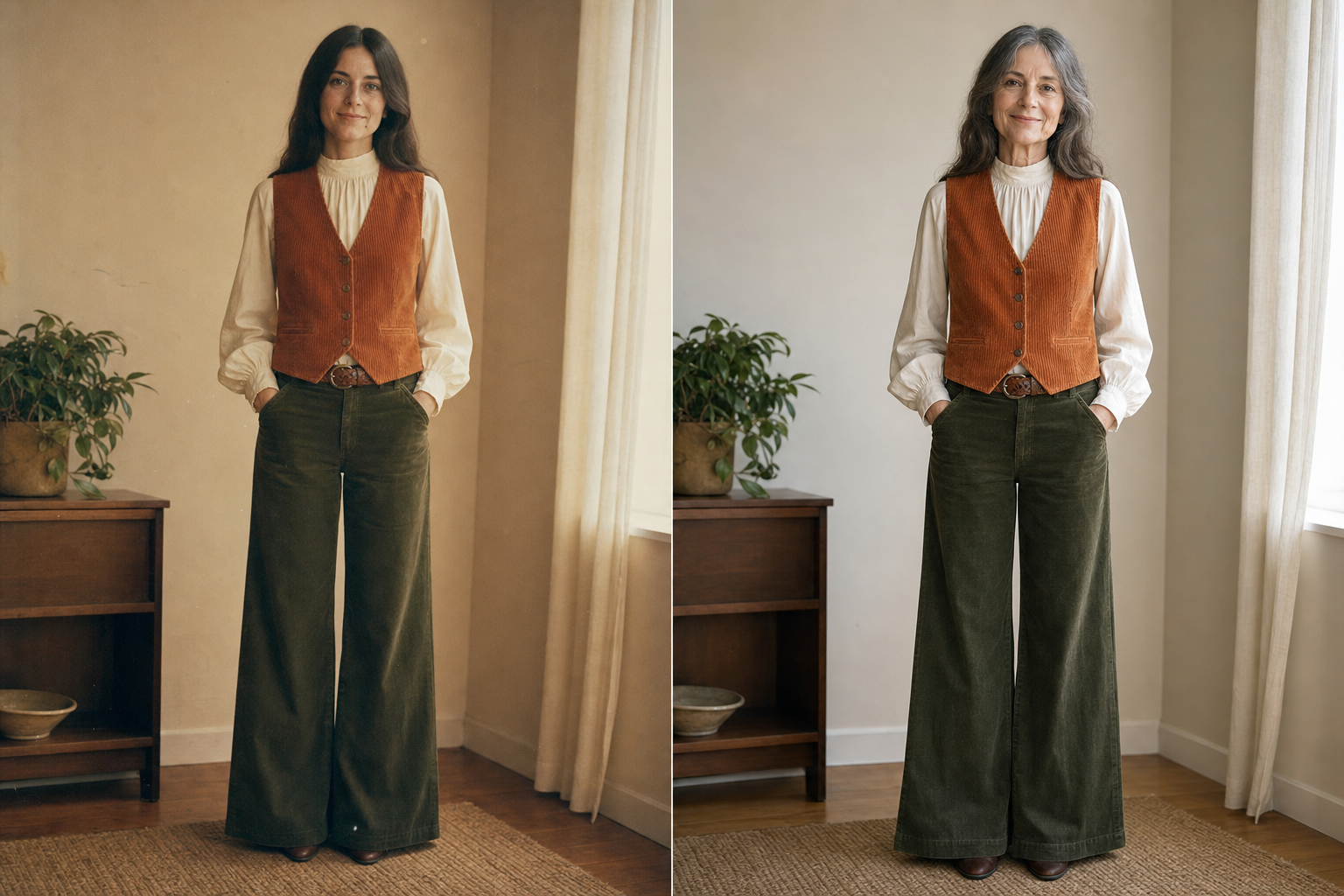
Re-creating an Old Photo Outfit

For fashion-memory content using a wholly invented garment and subject.

Old photo outfit faithfully re-created in a modern portrait
Re-creating an Old Photo Outfit | Best for: For fashion-memory content using a wholly invented garment and subject. | Prompt TN-P12 | Check: truthful aging, matching garment construction, stable pose and crop, and no designer cues, body reshaping, text, or third view | If it fails: If age or clothing drifts, add: Age the face and body truthfully while reproducing the vest seams, blouse collar, trouser width, belt, pose, and crop exactly.
Expected result

An older person naturally re-creates their fictional youthful outfit without becoming de-aged.

Copy-ready tested prompt
Create a fashion-history then-and-now composite of the same fictional person wearing an original handmade outfit in 1977 on the left and a faithful re-creation of that outfit in the present day on the right. Show the person at age twenty-two in the past and age seventy-one now, preserving dark green eyes, a long oval face, a slightly asymmetric smile, and a small beauty mark below the left jaw. The outfit is an unbranded rust-orange corduroy vest over a cream high-neck blouse with dark olive wide-leg trousers and a woven brown belt; reproduce its cut, seams, colors, and proportions without copying a known designer. Style the past as warm household film and the present as clean editorial portraiture. Use the same plain living-room corner, standing pose, hand position, 50 mm framing, and two equal panels. Match soft window light from camera right. No designer logo, celebrity likeness, age erasure, body reshaping, altered garment pattern, false text, extra limbs, or extra panels. Output one horizontal 3:2 composite at 1536×1024.
Adjustable parameters
Decade=1950s/1970s/1990s | garment=dress/suit/casual set | re-creation=exact/modernized
Failure correction
If age or clothing drifts, add: Age the face and body truthfully while reproducing the vest seams, blouse collar, trouser width, belt, pose, and crop exactly.
Review focus
truthful aging, matching garment construction, stable pose and crop, and no designer cues, body reshaping, text, or third view
Tested model
GPT Image 2
Then and now · GPT Image 2 · Prompt 13

Historic Room with a New Purpose

For adaptive-reuse concepts for architecture and community planning.

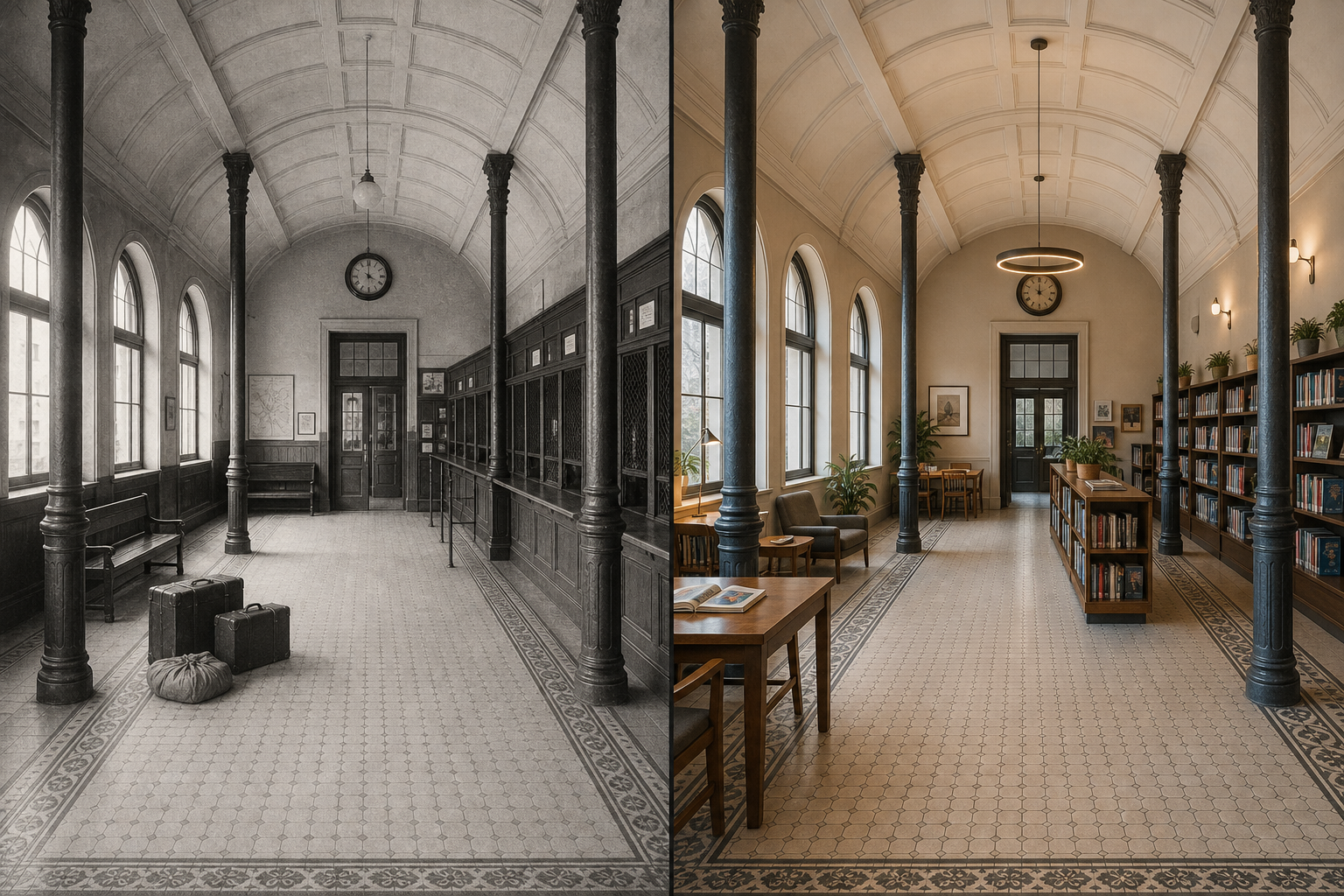
Historic ticket hall and modern community reading room
Historic Room with a New Purpose | Best for: For adaptive-reuse concepts for architecture and community planning. | Prompt TN-P13 | Check: aligned historic shell, plausible freestanding new use, accessible circulation, and no moved columns, text, logo, or real station resemblance | If it fails: If the historic shell changes, add: Keep the ceiling curve, column grid, window openings, tile boundary, clock coordinates, and lens position invariant.
Expected result

A credible adaptive-reuse comparison where the historic envelope remains readable.

Copy-ready tested prompt
Create an architectural then-and-now composite of the same fictional railway ticket hall in 1912 on the left and its present-day reuse as a community reading room on the right. Preserve the barrel-vaulted ceiling, four iron columns, three arched windows, patterned tile border, central clock position, and camera viewpoint. In the past panel show a functional ticket hall with timber counters, simple benches, generic luggage, and restrained monochrome archival detail; in the present panel show restored surfaces, freestanding bookshelves, reading tables, accessible circulation, and warm contemporary materials that do not damage the historic shell. Use two equal wide-angle panels at the exact same 24 mm lens position, camera height, vertical alignment, and crop. Match daylight entering through the arched windows from camera left, supplemented by subtle warm fixtures on the right. No real station identity, readable timetable, logo, famous interior, moved columns, widened room, false lettering, crowds, or extra panels. Output one horizontal 3:2 composite at 1536×1024 with a slim divider.
Adjustable parameters
Former use=station/factory/post office | new use=library/gallery/community hall | intervention=minimal/moderate
Failure correction
If the historic shell changes, add: Keep the ceiling curve, column grid, window openings, tile boundary, clock coordinates, and lens position invariant.
Review focus
aligned historic shell, plausible freestanding new use, accessible circulation, and no moved columns, text, logo, or real station resemblance
Tested model
GPT Image 2
Then and now · GPT Image 2 · Prompt 14

Puppy and Adult Dog in the Same Place

For pet-growth announcements or fictional animal-memory visuals.

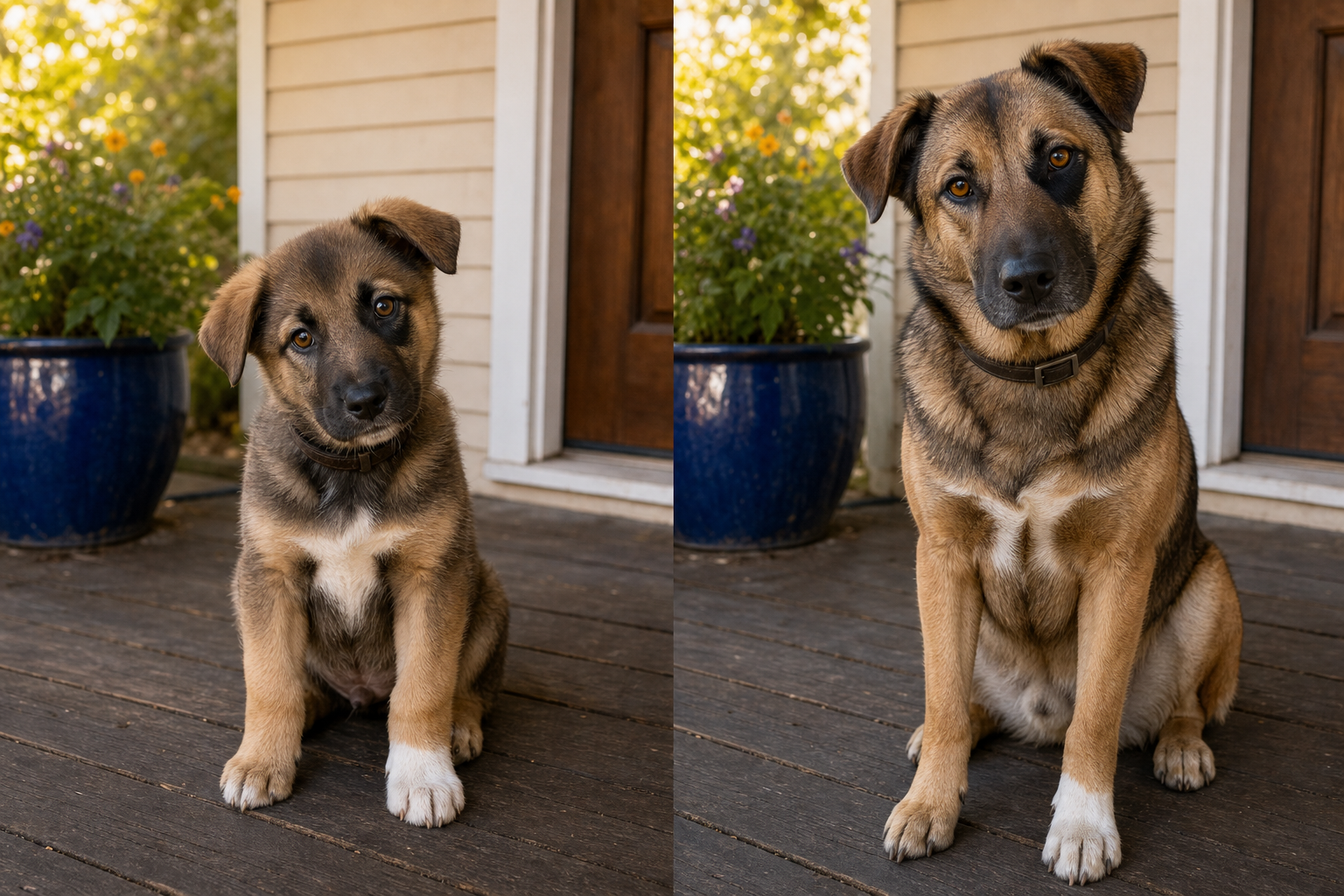
Puppy and adult dog then and now photo on the same porch
Puppy and Adult Dog in the Same Place | Best for: For pet-growth announcements or fictional animal-memory visuals. | Prompt TN-P14 | Check: all five markings, natural anatomy and growth, aligned porch anchors, and no extra legs, costume, tag text, or breed change | If it fails: If markings or breed drift, add: Map the right-eye patch, chest crescent, white paw, amber eyes, and tipped ear to the identical locations on the adult animal.
Expected result

A believable puppy-to-adult progression defined by five consistent markings and the same porch.

Copy-ready tested prompt
Create a joyful then-and-now pet photo composite showing the same fictional mixed-breed dog at ten weeks old on the left and five years old on the right, sitting on the same covered porch. Preserve distinctive markings: one white front paw, a crescent-shaped cream patch on the chest, a dark patch around the right eye, amber eyes, and one ear that tips forward. Let body size, muzzle length, coat density, and posture mature naturally while keeping the animal clearly recognizable. Use warm lifestyle pet photography with realistic fur and a candid, gentle mood. Compose two equal side-by-side panels from the same low camera height and 50 mm perspective; align the dog’s eye line, porch boards, blue ceramic pot, and doorway edge. Match soft late-afternoon shade with a warm reflection from camera left. Use a plain collar with no tag text. No human-like expression, cloned paws, extra legs, changed markings, breed substitution, costume, logo, embedded labels, or extra panels. Output one horizontal 3:2 composite at 1536×1024.
Adjustable parameters
Pet=dog/cat/rabbit | interval=1/3/5 years | location=porch/blanket/garden
Failure correction
If markings or breed drift, add: Map the right-eye patch, chest crescent, white paw, amber eyes, and tipped ear to the identical locations on the adult animal.
Review focus
all five markings, natural anatomy and growth, aligned porch anchors, and no extra legs, costume, tag text, or breed change
Tested model
GPT Image 2
Then and now · GPT Image 2 · Prompt 15

Construction Site and Completed Building

For architecture presentations, project milestones, or community-development concepts.

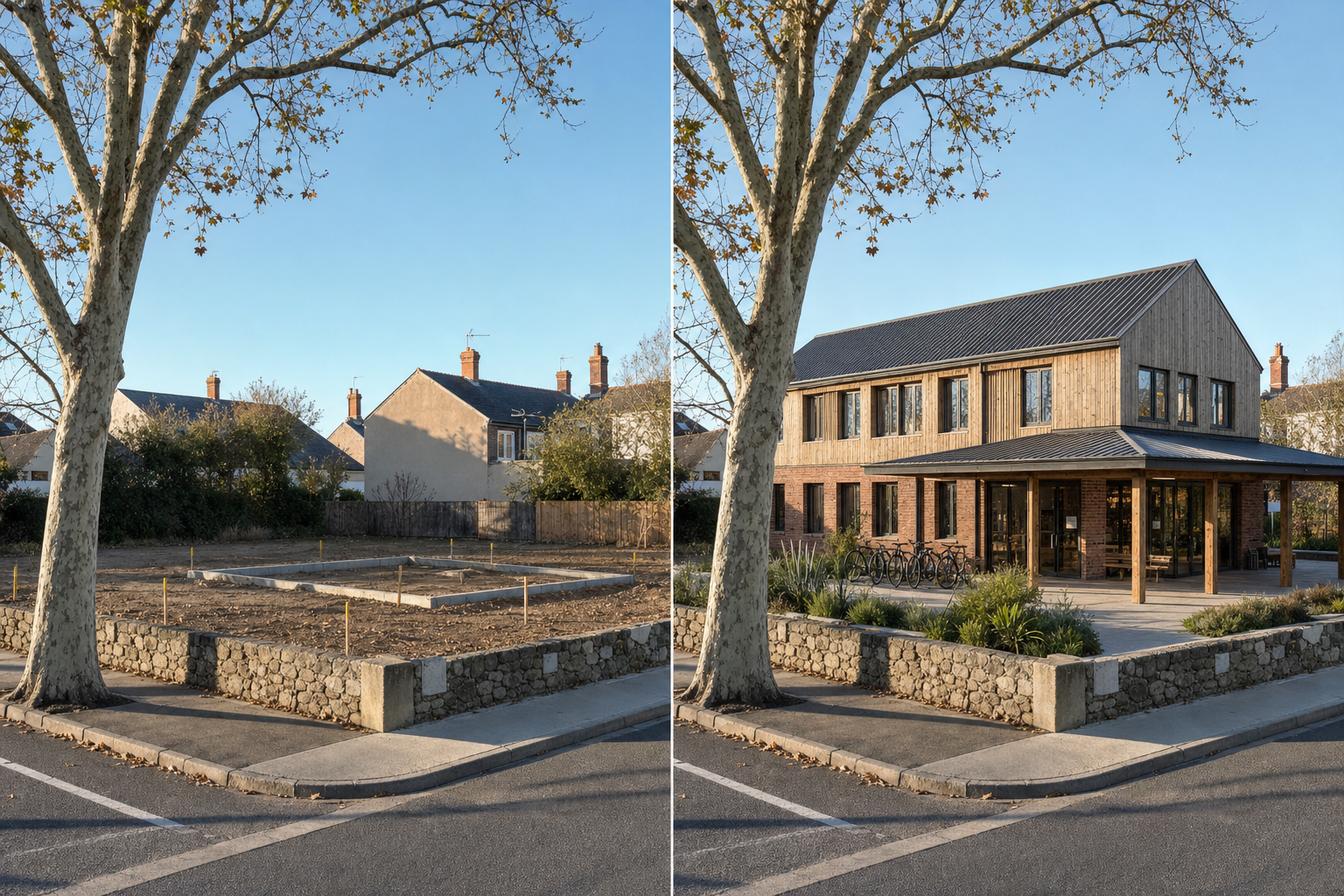
Construction site and completed community building comparison
Construction Site and Completed Building | Best for: For architecture presentations, project milestones, or community-development concepts. | Prompt TN-P15 | Check: aligned site anchors, finished footprint following the foundation, buildable structure, and no logo, sign text, famous design, or third panel | If it fails: If the site or footprint changes, add: Lock the lot boundary, curb, tree trunk, wall, neighboring roofs, camera coordinates, and foundation footprint before rendering the completed building.
Expected result

A structurally plausible before-and-after construction record tied together by the lot, tree, wall, curb, and neighbors.

Copy-ready tested prompt
Create an architectural then-and-now composite of the same fictional community arts center site before construction on the left and after completion on the right. In the past panel show a cleared urban infill lot with survey stakes, one retained mature plane tree, a low stone boundary wall, and the first rectangular foundation outline; in the present panel show an original two-story timber-and-brick arts center whose footprint follows that outline, with a sheltered entrance, workshop windows, bicycle parking, and modest native planting. Use professional construction-progress photography with realistic materials and no resemblance to a famous building. Compose two equal side-by-side panels from an identical fixed street-corner camera at 28 mm, matching horizon, curb, tree trunk, boundary wall, and neighboring rooflines. Use clear morning light from camera right with the same shadow direction and season. No real architect or contractor branding, readable safety signs, impossible cantilevers, changed neighboring buildings, missing retained tree, crowds, false text, or extra panels. Output one horizontal 3:2 composite at 1536×1024 with straight verticals and a thin divider.
Adjustable parameters
Building=arts center/clinic/library | stage=empty lot/foundation/frame | material=brick/timber/stone
Failure correction
If the site or footprint changes, add: Lock the lot boundary, curb, tree trunk, wall, neighboring roofs, camera coordinates, and foundation footprint before rendering the completed building.
Review focus
aligned site anchors, finished footprint following the foundation, buildable structure, and no logo, sign text, famous design, or third panel
Tested model
GPT Image 2

Then and now photo prompt FAQ

What should a then and now photo prompt include?

A strong prompt names the subject, the two moments, elapsed time, shared continuity anchors, fixed viewpoint, style for each era, lighting direction, prohibited changes, and final two-panel format. The anchors matter most because they prove that both panels show the same person, place, object, or animal.

How do I keep the same person recognizable at two ages?

Describe stable geometry rather than only hair or clothing. Lock eye spacing, brow shape, nose bridge, jaw, asymmetry, moles, dimples, expression, and pose, then tell the model to change only age-related features. Reject results that simply place two different attractive faces side by side.

Can I use real family or childhood photos?

Only use photos you own or have permission to edit, and consider privacy and consent for living people and children. Keep the original file unchanged, document generated alterations, and do not present an invented future or reconstructed past as verified fact. The examples on this page use fictional people and scenes.

Should both panels use identical lighting?

Matching direction, camera position, and exposure usually makes the comparison easier to read. The intensity or color may change when season or era is the point, but shadows should still behave coherently. If lighting changes dramatically, keep several other anchors especially strong.

How do I stop GPT Image 2 from mixing past and present details?

Assign each era to a specific panel, list a few allowed period cues, and explicitly prohibit cross-panel leakage. Avoid long inventories of props. A short rule such as past-only objects remain on the left and present-only objects remain on the right is easier to enforce and review.

Is a generated then-and-now image a historical record?

No. Even when the past panel looks archival, generated detail is synthetic unless it comes from verified source evidence. Use these images for concepts, storytelling, design visualization, or clearly disclosed reconstruction. For archives, preservation work, or journalism, retain originals and label every speculative addition.